
Understanding Cranial Nerve Palsy (3rd, 4th, 6th) as a Cause for Diplopia Surgery
Why Choose Private Squint Surgery?
In the UK, squint surgery may be performed via the NHS, through insurance, or as self-pay. NHS treatment is free, but waiting times can be long and surgery is often performed by trainees under supervision. Many operations are carried out by surgeons who mainly specialise in children’s squint rather than adult complex cases.
With insurance, fees are standardised — meaning some leading specialists choose not to participate. Self-pay allows you to choose your surgeon directly and prioritise experience, specialisation, and access.
Many centres quote only a surgical fee. Hospital costs, anaesthetic fees and follow-ups are frequently additional. At London Squint Clinic, everything is included in one transparent package.
Our Complete Package – £10,000
- ✔ Advanced surgery by Mr Ali (one or both eyes)
- ✔ Adjustable sutures where clinically indicated
- ✔ Detailed orthoptic planning
- ✔ All hospital & anaesthetic fees included
- ✔ Post-operative medication
- ✔ Two video follow-ups
- ✔ Face-to-face review appointment
What Makes Us Different
- ✔ 100% focused on adult squint & double vision surgery
- ✔ >95% audited success rate
- ✔ Free re-treatment at 3 months if worse (extremely rare)
- ✔ 24/7 direct WhatsApp access to your surgeon during recovery
- ✔ Optional well-being session & pre-op reassurance call
Initial consultation: from £150
Surgery typically within 4 weeks. No referral required. Self-pay only.
Cranial Nerve Palsy Double Vision: Restoring Single Vision
A diagnosis of cranial nerve palsy double vision occurs when damage to the third, fourth, or sixth cranial nerves causes eye misalignment and diplopia. This guide explains the specific symptoms associated with each nerve palsy and outlines the diagnostic pathway from initial assessment to advanced neuro-ophthalmology evaluation. It details when conservative treatments like prisms are insufficient and strabismus surgery becomes the necessary step to restore binocular single vision. Understanding the surgical options for cranial nerve palsy double vision is crucial for regaining function and quality of life.
London Squint Clinic provides specialist surgical care for adults with complex diplopia. Consultant surgeon Mr Nadeem Ali applies his extensive experience in neuro-ophthalmology, including his former role as Lead for Adult Squint and Neuro-Ophthalmology at Moorfields Eye Hospital, to manage these challenging conditions.
To explore your options, contact us to schedule your consultation. You can also reach us via: Enquire about double vision surgery, Time to say goodbye to double vision
A diagnosis of cranial nerve palsy double vision disrupts balance, reading, driving, and quality of life. This condition arises when one of three nerves controlling eye movement is damaged, causing misalignment and the perception of two images. This article overviews the third, fourth, and sixth cranial nerve palsies, their causes, diagnosis, and surgical pathways for adults when conservative treatments are insufficient.
What is Cranial Nerve Palsy & How Does it Cause Double Vision?
Cranial nerve palsy is the weakness or paralysis of a nerve originating in the brain. When the third, fourth, or sixth cranial nerves are affected, coordination for binocular vision is disrupted. These nerves transmit signals to the extraocular muscles that move the eyes. If a muscle fails to receive the correct signal, it cannot move the eye properly, causing misalignment (strabismus) and double vision (diplopia).
The Oculomotor (3rd) Nerve: Complex Eye Movements
The oculomotor nerve is the most complex of the three, controlling four of six eye muscles, the muscle that lifts the eyelid, and the muscle that constricts the pupil. A complete third nerve palsy can cause the eye to drift down and out, often with a droopy eyelid (ptosis) and a dilated pupil. The resulting double vision can be horizontal, vertical, and torsional (tilted), making it challenging to manage.
The Trochlear (4th) Nerve: Vertical Alignment
The trochlear nerve controls only one muscle: the superior oblique, which rotates the eye downwards and inwards. A fourth nerve palsy causes vertical diplopia, where one image appears above the other, often with a slight tilt. Patients often adopt a compensatory head tilt to the opposite side to fuse the images, which can cause chronic neck pain.
The Abducens (6th) Nerve: Horizontal Gaze
The abducens nerve innervates the lateral rectus muscle, which is solely responsible for moving the eye outwards from the nose. A sixth nerve palsy is the most common isolated eye movement palsy in adults. It causes the eye to turn inwards (esotropia), causing horizontal double vision that worsens when looking towards the affected side.
Understanding the Causes of Cranial Nerve Palsies
Identifying the underlying cause of a cranial nerve palsy is the first step in management. Causes range from benign, self-resolving conditions to serious neurological issues requiring immediate attention. A neuro-ophthalmologist is essential for accurate diagnosis and to rule out urgent problems.
Common Causes for 3rd, 4th, and 6th Nerve Palsies
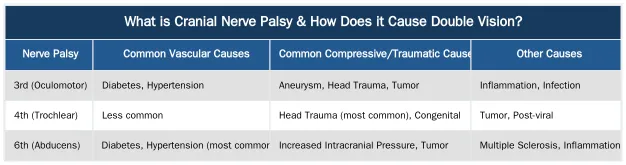
Causes are categorized as vascular, traumatic, compressive, or inflammatory. In adults over 50, microvascular ischemia—a temporary disruption of blood flow to the nerve, often from diabetes or hypertension—is a common cause, particularly for 6th nerve palsies. Head trauma is the most common cause of 4th nerve palsy because of the nerve’s long, vulnerable path in the skull. Serious causes like a brain aneurysm or tumor must be considered, especially in 3rd nerve palsy.
Diagnosing the Underlying Issue
Diagnosis involves an ophthalmic and neurological examination to characterize the eye movement limitation. Neuro-imaging, such as an MRI or CT scan, often follows to visualize the brain and cranial nerve paths. Blood tests may be required to check for conditions like diabetes or inflammatory markers. This process identifies any serious underlying condition for management before treating the double vision.
When is Surgery Needed for Diplopia from Nerve Palsy?
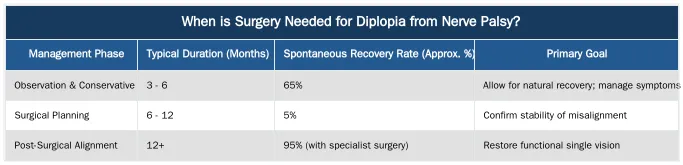
Many cranial nerve palsies, especially those from microvascular issues, may resolve spontaneously over 3 to 6 months. During this observation period, symptoms can be managed with temporary measures like patching one eye or using stick-on prisms. If double vision persists and the eye misalignment stabilizes, surgery is often the most effective long-term solution.
Limitations of Prisms and Botox for Squint
Prisms, lenses that bend light to realign images, are effective only for small, stable eye deviations. For the large, variable misalignments common in nerve palsies, prisms can be too heavy, thick, and visually distorting. Botulinum toxin (Botox) injections can temporarily weaken an opposing eye muscle, but the effect is temporary and not suitable for all palsies. Patients seek surgery when these non-surgical options become impractical or ineffective. Read about what causes adult diplopia that needs surgery.
Criteria for Surgical Intervention
Surgery is considered when eye misalignment has been stable for at least six months and the double vision impacts quality of life. The goal is to restore a useful field of single binocular vision, particularly in straight-ahead and reading positions. For individuals whose professional or daily activities are compromised, surgery offers a path to functional independence.
Specialist Surgical Approaches for Cranial Nerve Palsy Diplopia
Surgical correction of diplopia from nerve palsies is a specialized field of ophthalmology. Unlike routine strabismus surgery, these procedures must compensate for a non-functioning or weak muscle. The surgical plan is tailored to the patient, considering the specific nerve affected, residual muscle function, and the misalignment pattern in different gaze positions.
Tailored Surgery for 3rd, 4th, and 6th Nerve Palsies
The surgical strategy varies by palsy. For a complete sixth nerve palsy, where the outward-pulling muscle is paralyzed, a muscle transposition procedure may be performed. This involves re-routing parts of the vertical-moving muscles (superior and inferior rectus) to pull the eye outwards. For a fourth nerve palsy, surgery involves weakening opposing muscles (the inferior oblique) or strengthening the affected superior oblique muscle if it has residual function. Third nerve palsy surgery is the most complex, often requiring procedures on multiple muscles to address combined horizontal, vertical, and torsional deviations.
The Advantage of Adjustable Suture Techniques
Adjustable sutures are a significant advancement in adult strabismus surgery. This technique allows for fine-tuning the eye’s alignment hours after the operation, while the patient is awake. The surgeon places the repositioned muscle on a temporary, adjustable knot. Later that day, the alignment can be checked and optimized before the suture is permanently tied. This method, detailed by sources like the American Academy of Ophthalmology, improves the precision and success rate of the surgery, which is valuable in the complex cases of cranial nerve palsy double vision.
Life-Changing Outcomes: What to Expect from Diplopia Surgery
The primary objective of surgery for diplopia is to eliminate double vision in key fields of gaze, allowing a return to normal activities. While perfect eye movement in all directions may not be possible after a complete nerve paralysis, the results can improve a patient’s daily life and independence.
Restoring Single Vision and Independence
Successful surgery restores a field of single vision, centered on the straight-ahead and reading positions. This allows patients to resume activities like driving, working on a computer, navigating crowded spaces, and hobbies. Relief from the mental effort of suppressing a second image and eliminating associated symptoms like dizziness and disorientation enhances quality of life.
Recovery and Post-Operative Care
Recovery from eye muscle surgery is quick. The eye will be red and feel gritty for a few weeks; dissolvable stitches are used. Patients are prescribed antibiotic and steroid eye drops to prevent infection and reduce inflammation. Most people can return to work and normal activities within one to two weeks, though strenuous activity and swimming should be avoided for longer. Follow-up appointments monitor healing and confirm final eye alignment.
Conclusion
Double vision from a cranial nerve palsy is a significant burden, but it can be treated. After an investigation to identify the cause and an observation period for potential recovery, specialist surgery offers an effective and durable solution. By realigning the eyes, these procedures can restore single vision, improve function, and return patient independence and quality of life. Consulting a specialist is the first step for those affected by this condition.
To explore your options, contact us. You can enquire about double vision surgery or find out why it may be time to say goodbye to double vision.
Frequently Asked Questions
What is a cranial nerve palsy and how does it cause double vision?
A cranial nerve palsy is a weakness or paralysis of one of the three nerves (3rd, 4th, or 6th) that control eye movements. When a nerve is affected, the muscles it controls cannot function properly, leading to eye misalignment. This misalignment means the two eyes point in different directions, causing the brain to see two separate images, which is known as diplopia.
When is surgery considered for cranial nerve palsy double vision?
Many nerve palsies recover on their own over a period of 6 to 12 months. Surgery is typically considered only after this observation period if the eye alignment has stabilised but the double vision persists. If the diplopia remains and significantly impacts daily life, specialist surgery is a highly effective option to correct the misalignment causing the cranial nerve palsy double vision.
What does surgery for cranial nerve palsy double vision involve?
The surgical approach is tailored to the specific nerve affected and the degree of muscle weakness. It may involve weakening overacting muscles, strengthening weakened ones, or performing a muscle transposition procedure where healthy muscles are moved to take over the function of the paralysed muscle. These are complex techniques aimed at restoring a large field of single vision.
What can be done to manage cranial nerve palsy double vision while waiting for recovery?
During the initial 6-12 month recovery phase, the symptoms of cranial nerve palsy double vision can be managed with temporary measures. This often involves occluding one eye with a patch or tape on glasses to eliminate the second image. In some stable cases, temporary stick-on Fresnel prisms can be fitted to glasses to help merge the two images.
Which type of nerve palsy is most common?
The sixth nerve (abducens) palsy is the most frequently seen, causing horizontal double vision that worsens when looking to the side. Fourth nerve (trochlear) palsy is also common and causes vertical or tilted double vision, often noticed when reading or going down stairs. A third nerve palsy is less common but can be more complex, affecting multiple eye movements and sometimes the eyelid.
How can I get an expert opinion on my double vision from a nerve palsy?
If you are experiencing persistent double vision from a nerve palsy and prisms are no longer effective, the first step is a specialist consultation. Mr. Nadeem Ali provides in-person and video consultations to assess your condition and determine if you are a suitable candidate for surgery. You can start the process by making an enquiry to discuss your specific case.
Related Posts
Find out if you are suitable for Double Vision Treatment
Find out if you could benefit from this life changing surgery by contacting us today
Our most popular procedures


Hello, I’m Nadeem Ali
I’m one of the few eye surgeons in the world with 100% focus on Squint and Double Vision Surgery.
I have 24 years of eye surgery experience, and worked for 13 years as a Consultant at London’s renowned Moorfields Eye Hospital.
In 2023, I left the NHS to focus fully on treating patients from across the world at the London Squint Clinic. You can read more about me here.
There’s lots of information on the website about: squint surgery, double vision surgery and our pricing.
The most rewarding part of my job is hearing patients tell me how squint or double vision surgery has changed their lives. You can hear these stories here.
Mr Nadeem Ali
MA MB BChir MRCOphth FRCSEd(Ophth)