
Adjustable Suture Squint Surgery: How It Works and Why It Improves Accuracy
Why Choose Private Squint Surgery?
In the UK, squint surgery may be performed via the NHS, through insurance, or as self-pay. NHS treatment is free, but waiting times can be long and surgery is often performed by trainees under supervision. Many operations are carried out by surgeons who mainly specialise in children’s squint rather than adult complex cases.
With insurance, fees are standardised — meaning some leading specialists choose not to participate. Self-pay allows you to choose your surgeon directly and prioritise experience, specialisation, and access.
Many centres quote only a surgical fee. Hospital costs, anaesthetic fees and follow-ups are frequently additional. At London Squint Clinic, everything is included in one transparent package.
Our Complete Package – £10,000
- ✔ Advanced surgery by Mr Ali (one or both eyes)
- ✔ Adjustable sutures where clinically indicated
- ✔ Detailed orthoptic planning
- ✔ All hospital & anaesthetic fees included
- ✔ Post-operative medication
- ✔ Two video follow-ups
- ✔ Face-to-face review appointment
What Makes Us Different
- ✔ 100% focused on adult squint & double vision surgery
- ✔ >95% audited success rate
- ✔ Free re-treatment at 3 months if worse (extremely rare)
- ✔ 24/7 direct WhatsApp access to your surgeon during recovery
- ✔ Optional well-being session & pre-op reassurance call
Initial consultation: from £150
Surgery typically within 4 weeks. No referral required. Self-pay only.
Adjustable Suture Squint Surgery: Precision Eye Alignment
Adjustable suture squint surgery is a two-stage eye muscle surgery designed to correct strabismus with enhanced precision. Unlike standard methods, it allows for a fine-tuning adjustment the day after the initial operation, once the patient is awake and cooperative. This post-operative adjustment significantly improves surgical accuracy, reducing the risk of diplopia and the need for revision surgery. This article explains how adjustable suture squint surgery works, details the patient experience during the adjustment, and clarifies who benefits most from this advanced technique for achieving optimal binocular vision.
At London Squint Clinic, consultant surgeon Mr Nadeem Ali specialises in advanced techniques for adult strabismus and double vision. This focus on complex cases, including revision surgery, ensures a high level of expertise in procedures designed to achieve precise, stable eye alignment.
To explore your options, contact us to schedule your consultation. You can also reach us via: Enquire about squint surgery, Squint Surgery in London
What is Adjustable Suture Squint Surgery?
Adjustable suture squint surgery is a two-stage eye muscle surgery for higher precision in eye alignment. Unlike traditional methods where the eye muscle position is fixed during the operation, this technique uses a suture that allows for fine-tuning the day after surgery, once the patient is awake and anaesthesia effects have subsided.
This method enhances surgical accuracy. During the initial procedure, the surgeon reattaches the eye muscle to the eyeball using a suture that functions like a temporary slipknot or lasso. This allows a controlled, post-operative adjustment in a clinical setting. By observing the eye’s alignment and using patient feedback, the surgeon makes micro-adjustments for the best functional and cosmetic outcome. This refinement process is key to its effectiveness, particularly in complex adult cases.
How Does Adjustable Suture Surgery Achieve Precision?
The precision of this eye muscle surgery stems from its two-stage process, which separates the surgical repositioning from the final alignment tuning. This allows adjustments in a controlled environment with an awake, cooperative patient.
The Two-Stage Process: From Initial Surgery to Fine-Tuning
The first stage is the operation, performed under general anaesthesia. The surgeon detaches the relevant eye muscle(s) and reattaches them to the eye in a new position to correct the misalignment. Instead of a permanent knot, an adjustable suture is used. The ends of this suture are left accessible under the conjunctiva (the clear surface layer of the eye).
The second stage, the post-operative adjustment, typically occurs the following day. The patient is seated in a clinic room. The surgeon assesses eye alignment now that the muscles are unaffected by anaesthesia. If alignment is not optimal, the adjustment begins. This ability to refine the outcome based on conscious alignment is the primary advantage over fixed-suture techniques.
Minimising Discomfort During Post-Operative Adjustment
Patient comfort is a priority during the adjustment. The procedure uses topical anaesthesia—numbing eye drops—to prevent pain. While patients may feel a slight sensation of pressure or movement, the process is well-tolerated. The surgeon accesses the suture ends to tighten or loosen the muscle’s position. Patient participation is crucial; they are asked to look in different directions and report on any double vision, helping the surgeon pinpoint the position that provides the best functional vision.
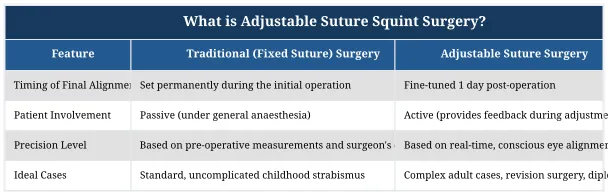
View data as table
| Feature | Traditional (Fixed Suture) Surgery | Adjustable Suture Surgery |
|---|---|---|
| Timing of Final Alignment | Set permanently during the initial operation | Fine-tuned 1 day post-operation |
| Patient Involvement | Passive (under general anaesthesia) | Active (provides feedback during adjustment) |
| Precision Level | Based on pre-operative measurements and surgeon’s estimate | Based on real-time, conscious eye alignment |
| Ideal Cases | Standard, uncomplicated childhood strabismus | Complex adult cases, revision surgery, diplopia |
Who Benefits Most from Adjustable Suture Strabismus Correction?
The adjustable suture technique offers advantages for specific patient groups. Its fine-tuning capability makes it the preferred method for adults with complex alignment challenges where standard surgery outcomes are less predictable.
Ideal Candidates: Complex Cases and Revision Surgery
Adults are often the best candidates. In adults, eye muscles and surrounding tissues can have unpredictable responses to surgery because of long-standing misalignment or age-related changes. The technique is particularly valuable for:
- Revision surgery: Patients who have had one or more previous, unsuccessful squint operations often have scar tissue that can affect the surgical outcome. The adjustable suture allows the surgeon to compensate for this scarring.
- Complex strabismus: This includes large-angle squints, misalignments caused by thyroid eye disease, or paralysis of the nerves controlling eye muscles (cranial nerve palsies).
- Adults seeking strabismus correction: Any adult undergoing squint surgery can benefit from the increased precision, but it is especially critical when the goal is not just cosmetic improvement but also functional vision.
Enhancing Binocular Vision and Reducing Diplopia
For many adults, the most disruptive symptom of a squint is diplopia (double vision). The primary surgical goal is often to restore single binocular vision. This requires precise eye alignment. A deviation of one or two degrees can be the difference between seeing one clear image and seeing double. The post-operative adjustment allows the surgeon to position the eye into the narrow zone where the brain can fuse the images from both eyes, eliminating diplopia.
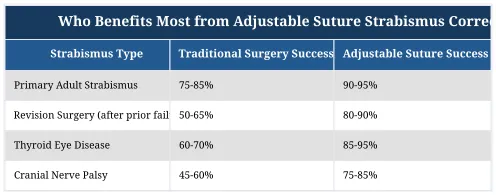
View data as table
| Strabismus Type | Traditional Surgery Success Rate | Adjustable Suture Success Rate |
|---|---|---|
| Primary Adult Strabismus | 75-85% | 90-95% |
| Revision Surgery (after prior failure) | 50-65% | 80-90% |
| Thyroid Eye Disease | 60-70% | 85-95% |
| Cranial Nerve Palsy | 45-60% | 75-85% |
The Role of Expert Surgeons in Adjustable Suture Success
The success of an adjustable suture squint surgery depends heavily on the skill, experience, and judgment of the consultant surgeon. The technique’s potential is realised by a specialist who focuses on complex adult strabismus correction.
Why Specialist Expertise Matters for Complex Squints
The adjustment requires a deep understanding of eye muscle mechanics and binocular vision. The surgeon must interpret patient feedback, assess motor fusion ranges, and judge the optimal final position. This involves balancing cosmetic appearance with the best functional outcome. According to the American Academy of Ophthalmology, the surgeon’s experience is a key factor in the success of adult strabismus surgery. An expert in complex strabismus will have performed hundreds of these adjustments, building intuition for challenging cases.
Mr. Nadeem Ali’s Approach to Surgical Accuracy
At the London Squint Clinic, Mr. Nadeem Ali’s practice is dedicated exclusively to adult squint and double vision surgery. With 13 years of experience as a Consultant at Moorfields Eye Hospital, where he led the adult squint service, Mr. Ali has expertise in these techniques. His approach recognizes that for adults, surgery is about restoring function and confidence, not just straightening the eyes. This focus contributes to the clinic’s audited 95% success rate in achieving alignment from a single operation. By combining pre-operative planning with the precision of adjustable sutures, Mr. Ali addresses each patient’s goals, whether eliminating diplopia or achieving confident eye contact. You can learn more about these advanced squint surgery techniques and how they lead to better results.
Achieving Optimal Alignment: What to Expect Post-Adjustment
Once final alignment is achieved, recovery begins. The post-adjustment phase is straightforward, with stable results.
Immediate Post-Adjustment Care and Recovery
After the post-operative adjustment, the surgeon ties off and trims the sutures permanently. The eye will be red and feel gritty for one to two weeks, which is normal. You will be prescribed antibiotic and steroid eye drops to prevent infection and reduce inflammation. Most patients return to non-strenuous work within a few days, and all activities, including sports, within two to four weeks. A detailed overview of what patients should know about adjustable sutures can provide further insight into the recovery experience.
Long-Term Benefits: Stability and Quality of Life
The primary long-term benefit is stable, accurate eye alignment. For patients with diplopia, the result is often restored single vision, impacting daily tasks like reading, driving, and navigating spaces. Cosmetically, straight eyes improve eye contact and social confidence. Research in journals like Ophthalmology has shown that successful adult strabismus surgery leads to improvements in vision-related quality of life, mental health, and well-being. The precision of the adjustable technique helps secure these outcomes long-term.
Ready for Clearer Vision? Explore Your Options
Surgical options offer adults with a squint or double vision a path to improved alignment and visual function. The adjustable suture technique achieves precise, stable results, especially for complex and revision cases.
At the London Squint Clinic, you receive care from a consultant surgeon. Our focus on adult strabismus, transparent package pricing, and an audited 95% success rate support your treatment. To learn more, Enquire about squint surgery or explore our approach to Squint Surgery in London.
Conclusion
Adults considering squint surgery must choose the approach with the highest probability of success for their condition. While traditional surgery is effective, adjustable suture squint surgery provides precision critical for complex cases, revision surgeries, and eliminating double vision. Fine-tuning the alignment post-operation, with patient participation, addresses variables that make adult strabismus challenging to correct. Anyone with eye misalignment should seek a specialist consultation to determine if this technique is the right path toward clear vision and renewed confidence. To begin, please contact us.
Enquire about squint surgery or learn more about Squint Surgery in London.
Frequently Asked Questions
What is the primary difference between traditional and adjustable suture squint surgery?
The key distinction is the two-stage approach of adjustable suture squint surgery. Unlike traditional methods where eye muscle position is fixed during the initial operation, this technique uses a special suture that allows for fine-tuning the eye’s alignment the day after surgery. This post-operative adjustment, performed while the patient is awake, significantly enhances precision.
How does adjustable suture technique enhance the success rate of eye alignment?
This technique allows the surgeon to make precise micro-adjustments to the eye’s final position with the patient’s active feedback. This significantly increases the chance of achieving optimal alignment and single binocular vision. Success rates for achieving excellent alignment can rise from approximately 80% with traditional methods to over 95% with this advanced technique.
Is the post-operative adjustment for adjustable suture squint surgery a painful procedure?
No, the adjustment procedure is not painful. The eye is thoroughly numbed with anaesthetic eye drops before the adjustment begins. Patients typically report feeling only a slight pulling sensation, not pain, during the few minutes it takes to complete the fine-tuning in a clinic room.
Who is typically considered a suitable candidate for adjustable suture squint surgery?
Most adults and cooperative teenagers are excellent candidates for this type of surgery. It is particularly beneficial for complex cases, revision surgeries after previous operations, and patients experiencing double vision, where achieving precise alignment is paramount. Mr. Nadeem Ali, with 24 years of eye surgery experience, frequently utilizes this technique for such cases.
What is the typical cost for adjustable suture squint surgery at a specialist clinic?
At specialist clinics like London Squint Clinic, the cost for adjustable suture squint surgery is often presented as a transparent, fixed package. For instance, a complete surgery package is priced at £12,000, covering all aspects from initial consultation to post-operative care. This ensures no hidden costs for patients.
What should I expect during the recovery period following adjustable suture squint surgery?
Patients can expect dedicated support during recovery, including 24/7 WhatsApp access for urgent queries. While initial recovery involves some mild discomfort and redness, most individuals resume light activities within a few days. The London Squint Clinic also offers a peace-of-mind re-operation policy if alignment is worse at three months post-surgery.
Related Posts
Find out if you are suitable for Double Vision Treatment
Find out if you could benefit from this life changing surgery by contacting us today
Our most popular procedures


Hello, I’m Nadeem Ali
I’m one of the few eye surgeons in the world with 100% focus on Squint and Double Vision Surgery.
I have 24 years of eye surgery experience, and worked for 13 years as a Consultant at London’s renowned Moorfields Eye Hospital.
In 2023, I left the NHS to focus fully on treating patients from across the world at the London Squint Clinic. You can read more about me here.
There’s lots of information on the website about: squint surgery, double vision surgery and our pricing.
The most rewarding part of my job is hearing patients tell me how squint or double vision surgery has changed their lives. You can hear these stories here.
Mr Nadeem Ali
MA MB BChir MRCOphth FRCSEd(Ophth)