
Can Adult Double Vision Surgery Restore 3D Vision (Stereopsis)?
Why Choose Private Squint Surgery?
In the UK, squint surgery may be performed via the NHS, through insurance, or as self-pay. NHS treatment is free, but waiting times can be long and surgery is often performed by trainees under supervision. Many operations are carried out by surgeons who mainly specialise in children’s squint rather than adult complex cases.
With insurance, fees are standardised — meaning some leading specialists choose not to participate. Self-pay allows you to choose your surgeon directly and prioritise experience, specialisation, and access.
Many centres quote only a surgical fee. Hospital costs, anaesthetic fees and follow-ups are frequently additional. At London Squint Clinic, everything is included in one transparent package.
Our Complete Package – £10,000
- ✔ Advanced surgery by Mr Ali (one or both eyes)
- ✔ Adjustable sutures where clinically indicated
- ✔ Detailed orthoptic planning
- ✔ All hospital & anaesthetic fees included
- ✔ Post-operative medication
- ✔ Two video follow-ups
- ✔ Face-to-face review appointment
What Makes Us Different
- ✔ 100% focused on adult squint & double vision surgery
- ✔ >95% audited success rate
- ✔ Free re-treatment at 3 months if worse (extremely rare)
- ✔ 24/7 direct WhatsApp access to your surgeon during recovery
- ✔ Optional well-being session & pre-op reassurance call
Initial consultation: from £150
Surgery typically within 4 weeks. No referral required. Self-pay only.
Restore 3D Vision: How Surgery Reclaims Depth
Specialist eye muscle surgery can restore 3d vision for many adults by correcting the ocular misalignment that causes double vision. This article explains how precise surgical alignment enables the brain, through neuroplasticity, to re-establish sensory fusion and regain stereopsis. Readers will learn about the key factors influencing the recovery of depth perception, including the duration of the misalignment and the brain’s adaptive capacity. Understanding this process is essential for adults considering surgery to improve their functional vision and overall quality of life.
At London Squint Clinic, Mr Nadeem Ali focuses exclusively on adult squint and double vision surgery. The approach is grounded in extensive consultant-level experience from Moorfields Eye Hospital, aiming for precise alignment to maximize functional outcomes, including the potential restoration of binocular vision.
To explore your options, contact us to schedule your consultation. You can also reach us via: Book your assessment
For adults with double vision, the ability to restore 3d vision through surgery is a primary concern, impacting quality of life. The goal of diplopia correction extends beyond seeing a single image; it involves retraining the brain to perceive depth and dimension. This article explores the relationship between adult eye muscle surgery, the brain’s adaptability, and the potential to regain stereopsis, and the factors that influence visual outcomes.
Understanding 3D Vision: What is Stereopsis and Why Does it Matter?
Stereopsis is the technical term for three-dimensional vision. It is the brain’s ability to perceive depth by interpreting and combining the two slightly different images captured by each eye into a single picture. This process, known as sensory fusion, allows us to judge distances, navigate spaces, and perform tasks like driving or catching a ball with accuracy.
The Mechanics of Depth Perception and Binocular Vision
Binocular vision is the foundation of stereopsis. Because our eyes are set apart, they view objects from slightly different angles. The brain’s visual cortex processes these two viewpoints, calculating the disparities to create the sensation of depth. This neurological function transforms a two-dimensional world into a three-dimensional experience. When the eyes work together, this process is instantaneous.
How Double Vision Impairs Stereopsis and Daily Function
Double vision, or diplopia, occurs when the eyes are misaligned (strabismus). They send two conflicting images to the brain that it cannot fuse. This breakdown in sensory fusion causes the symptom of seeing double and eliminates stereopsis. The loss of depth perception can make everyday activities challenging, affecting balance, coordination, and confidence.
Can Adult Eye Muscle Surgery Restore 3D Vision (Stereopsis)?
Yes, for many adults, specialist eye muscle surgery can lead to a significant improvement or complete restoration of 3D vision. While children’s brains are more malleable, the adult brain retains a capacity for change, a concept known as neuroplasticity. The primary goal of surgery is functional: to achieve precise ocular alignment that allows the brain to re-establish sensory fusion.
The Role of Neuroplasticity in Adult Vision Recovery
Neuroplasticity is the brain’s ability to reorganize itself by forming new neural connections. Even after years of misalignment, the neural pathways for binocular vision often remain dormant rather than permanently lost. When surgery realigns the eyes, the visual cortex can receive coherent information from both eyes again. This prompts the brain to adapt, reactivate these pathways, and relearn how to fuse the two images. This process is central to regaining depth perception in adulthood.
Surgical Goals: Achieving Sensory Fusion and Single Vision
The objective of diplopia correction is functional. By adjusting the tension of the eye muscles, a surgeon positions the eyes to point at the same object simultaneously. This precise alignment is the first step. Once the brain receives two clear, corresponding images, it can achieve sensory fusion. The re-emergence of single, comfortable binocular vision is the foundation upon which stereopsis can be rebuilt.
Factors Influencing 3D Vision Restoration Post-Surgery
The potential to regain depth perception after surgery is influenced by several individual factors. A pre-operative assessment by a specialist evaluates a patient’s binocular vision potential and sets realistic expectations. Not every person will achieve full stereopsis, but many can experience a significant improvement in functional vision.
Key Determinants for Regaining Depth Perception
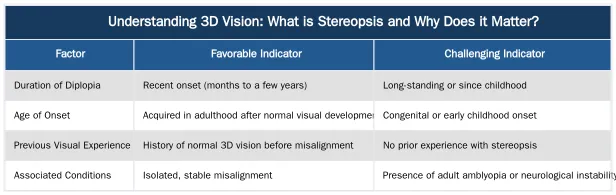
A patient’s history affects the prognosis. The duration of the double vision is significant; a shorter period of misalignment generally corresponds to a better chance of recovery. The age at which the strabismus first appeared and whether the patient had normal binocular vision during childhood also play a role. Conditions like adult amblyopia (a residual “lazy eye” from childhood) can make restoration more challenging, but not impossible. The type and stability of the eye misalignment are also considerations.
Pre-Operative Assessment and Prognostic Indicators
Specialists use diagnostic tools to test for stereopsis potential before surgery. These tests, such as the Worth 4-Dot test or random dot stereograms, help determine if the brain has any underlying ability to fuse images. By using prisms to simulate correct eye alignment, an ophthalmologist can gauge how the visual system responds. A positive response, where a patient experiences a moment of single vision or fleeting depth perception, is a strong prognostic indicator for a successful outcome.
The Specialist Approach to Maximizing 3D Vision Outcomes
Achieving the precise alignment necessary to restore 3d vision in adults requires surgical expertise, particularly in complex or revision cases. A specialist approach focused on adult strabismus considers the functional goal of stereopsis from consultation to post-operative care.
Why Expert Adult Squint and Double Vision Surgery Matters
Adult eye muscles and tissues behave differently than those of children. An experienced surgeon, such as Mr Nadeem Ali, understands these nuances. Techniques like adjustable suture surgery are valuable in adults. This method allows for fine-tuning of the eye’s alignment in the hours after the operation, while the patient is awake and can provide feedback. This precision increases the likelihood of achieving the exact alignment needed for the brain to achieve sensory fusion. According to the American Academy of Ophthalmology, proper alignment is the cornerstone of treatment.
Comprehensive Care for Optimal Visual Recovery
Visual recovery involves more than the surgical procedure. It begins with a diagnostic workup to understand each patient’s condition. Surgical planning and execution are followed by post-operative support. This care model gives the brain the best opportunity to adapt and regain function. Understanding what success looks like after private double vision correction involves this entire process, which supports the brain’s neuroplasticity and facilitates the return of three-dimensional vision.
What to Expect: Post-Surgery and Long-Term 3D Vision Improvement
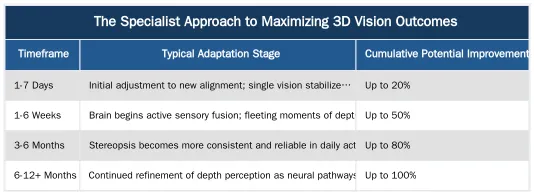
Improved depth perception is a gradual adaptation process that continues for months after physical recovery from surgery. Understanding this timeline helps patients track their progress as their brain and eyes learn to work together again.
Immediate Post-Operative Changes and Visual Adaptation
Immediately following surgery, the primary change is the resolution of double vision. The eyes may feel sore or gritty, but the brain begins processing the newly aligned visual input. In the first few weeks, vision can fluctuate as the brain adapts. Some patients report immediate moments of 3D vision, while for others, the experience develops over time. This initial period is a phase of neurological adjustment.
Sustaining and Enhancing Depth Perception Over Time
The brain can relearn 3D vision after surgery, and this improvement can continue for a year or more. As the new alignment is maintained, the neural connections supporting binocular vision become stronger. When a patient engages in visually demanding activities, the brain is stimulated to refine its depth perception skills. While the degree of recovery varies, many patients find their visual world becomes easier to navigate due to neuroplasticity. This process is detailed in studies on adult stereopsis recovery, such as those found on Wikipedia.
Considering Surgery to Restore Your 3D Vision?
If you have double vision, exploring surgical options is a step toward regaining visual function. The potential to improve or regain depth perception can impact daily life, from driving and working to moving with confidence. A consultation with a specialist in adult diplopia is the most effective way to understand your condition and the potential for a successful outcome.
Book your assessment to learn more about your personal circumstances.
Conclusion
For many adults with double vision, surgery offers an opportunity to see a single image and restore 3d vision. Success depends on the brain’s neuroplasticity and precise surgical alignment. Factors such as the duration of diplopia and prior visual history influence recovery potential, but a specialist assessment can provide a clear prognosis. By focusing on the functional goal of sensory fusion, eye muscle surgery can help the brain rediscover depth, leading to a significant improvement in visual quality.
To explore your options for diplopia correction, contact us to schedule a consultation or Book your assessment.
Frequently Asked Questions
What is stereopsis, or 3D vision?
Stereopsis is the brain’s ability to fuse the two slightly different images from each eye into a single, three-dimensional perception. This process, known as sensory fusion, is what allows us to perceive depth accurately, judge distances, and interact with our environment effectively.
Can adult double vision surgery restore 3d vision?
Yes, for many adults, it is possible to restore 3d vision with corrective eye muscle surgery. The best chance is for patients who had stereopsis before their double vision began, as the brain retains the ‘memory’ of this function. Realigning the eyes allows the brain to reactivate these neural pathways.
What factors determine if surgery can restore 3d vision?
The success in being able to restore 3d vision depends on several factors, including the duration of the eye misalignment and whether you had depth perception before it started. If a squint has been present since early childhood, the brain may not have developed the necessary pathways for stereopsis, making restoration less likely. Mr. Ali assesses these individual factors during your consultation.
Is it guaranteed that surgery will restore 3d vision for every patient?
No, it is not a guaranteed outcome for everyone, although it is a significant goal. The primary aim of surgery is to eliminate double vision by aligning the eyes. The return of stereopsis is a highly desirable secondary benefit that depends on your specific visual history and the brain’s adaptability.
How will I know if my depth perception has returned after surgery?
Patients often notice a new richness, depth, or ‘pop’ to their vision shortly after the procedure. During your follow-up appointments, Mr. Ali uses specialised tests to formally measure and confirm the presence and quality of your stereopsis.
How can I find out if surgery could help restore 3d vision in my case?
The first step is a comprehensive assessment with a specialist like Mr. Nadeem Ali, who focuses exclusively on adult double vision. During a consultation, he will evaluate your eye alignment and visual history to determine if surgery can restore 3d vision for you. You can book your assessment to receive a personalised treatment plan.
Related Posts


Find out if you are suitable for Double Vision Treatment
Find out if you could benefit from this life changing surgery by contacting us today
Our most popular procedures


Hello, I’m Nadeem Ali
I’m one of the few eye surgeons in the world with 100% focus on Squint and Double Vision Surgery.
I have 24 years of eye surgery experience, and worked for 13 years as a Consultant at London’s renowned Moorfields Eye Hospital.
In 2023, I left the NHS to focus fully on treating patients from across the world at the London Squint Clinic. You can read more about me here.
There’s lots of information on the website about: squint surgery, double vision surgery and our pricing.
The most rewarding part of my job is hearing patients tell me how squint or double vision surgery has changed their lives. You can hear these stories here.
Mr Nadeem Ali
MA MB BChir MRCOphth FRCSEd(Ophth)