
Why a Surgeon’s Fellowship in Neuro-Ophthalmology Matters for Your Outcome
Why Choose Private Squint Surgery?
In the UK, squint surgery may be performed via the NHS, through insurance, or as self-pay. NHS treatment is free, but waiting times can be long and surgery is often performed by trainees under supervision. Many operations are carried out by surgeons who mainly specialise in children’s squint rather than adult complex cases.
With insurance, fees are standardised — meaning some leading specialists choose not to participate. Self-pay allows you to choose your surgeon directly and prioritise experience, specialisation, and access.
Many centres quote only a surgical fee. Hospital costs, anaesthetic fees and follow-ups are frequently additional. At London Squint Clinic, everything is included in one transparent package.
Our Complete Package – £10,000
- ✔ Advanced surgery by Mr Ali (one or both eyes)
- ✔ Adjustable sutures where clinically indicated
- ✔ Detailed orthoptic planning
- ✔ All hospital & anaesthetic fees included
- ✔ Post-operative medication
- ✔ Two video follow-ups
- ✔ Face-to-face review appointment
What Makes Us Different
- ✔ 100% focused on adult squint & double vision surgery
- ✔ >95% audited success rate
- ✔ Free re-treatment at 3 months if worse (extremely rare)
- ✔ 24/7 direct WhatsApp access to your surgeon during recovery
- ✔ Optional well-being session & pre-op reassurance call
Initial consultation: from £150
Surgery typically within 4 weeks. No referral required. Self-pay only.
Neuro-ophthalmology Fellowship: Better Surgical Outcomes
A neuro-ophthalmology fellowship provides surgeons with advanced training to diagnose and treat complex double vision originating from the brain-eye connection. This specialized education is critical for understanding conditions like cranial nerve palsy and other optic nerve disorders that cause persistent diplopia. A surgeon with a neuro-ophthalmology fellowship can more accurately identify the neurological root cause of eye misalignment, leading to a more precise surgical plan. This expertise ensures treatment addresses the underlying issue, not just the symptom, resulting in more stable and successful long-term outcomes for patients.
Mr. Nadeem Ali’s expertise is founded on dual fellowships at Moorfields Eye Hospital and the National Hospital for Neurology and Neurosurgery, Queen Square. This training provides the diagnostic and surgical skill required to manage complex adult strabismus and double vision cases at London Squint Clinic.
To explore your options, contact us to schedule your consultation. You can also reach us via: Book your assessment
What is a Neuro-Ophthalmology Fellowship?
A neuro-ophthalmology fellowship is intensive, post-residency subspecialist training, lasting one to two years, focusing on the relationship between the brain, nerves, and eyes. It equips an ophthalmologist with skills to diagnose and manage complex visual problems with neurological origins, such as persistent double vision, optic nerve disorders, and unexplained vision loss. This training provides patients a more precise diagnosis and effective treatment plan, especially when the cause of their visual disturbance is not immediately obvious.
The Brain-Eye Connection
Standard ophthalmology training covers the eye as an organ. The visual system is more complex, involving optic nerves and brain processing centers. A neuro-ophthalmology specialism covers this entire pathway.
This training explores how conditions like strokes, brain tumours, multiple sclerosis, or cranial nerve damage manifest as eye problems. A surgeon with this background understands a misaligned eye or double vision can be a sign of a neurological process, not just a muscular issue. This perspective helps develop a surgical strategy that addresses the root cause, not just the symptom, for more stable and successful long-term outcomes.
How Neuro-Ophthalmology Unravels Complex Double Vision Causes
Some patients have double vision (diplopia) not easily corrected with glasses or prisms. The problem is often in the nerve network controlling eye movement. A neuro-ophthalmologist is trained to investigate these cases and identify the origin.
Diagnosing the Brain-Eye Connection
A neuro-ophthalmologist’s diagnostic process is more than an eye chart test. It includes assessing eye movements, pupil responses, and peripheral vision to find neurological dysfunction. This expertise helps identify conditions causing complex diplopia.
These conditions include cranial nerve palsies (affecting the third, fourth, or sixth cranial nerves), optic nerve disorders, myasthenia gravis, or thyroid eye disease. Understanding the specific eye misalignment patterns for each condition allows the specialist to create a targeted treatment plan. For example, the surgical approach for a fourth nerve palsy differs from that for a sixth nerve palsy, and diagnostic precision is fundamental to success.
When Standard Ophthalmology Isn’t Enough
Patients are referred to a neuro-ophthalmologist when symptoms are complex or unresponsive to initial treatment. Examples include fluctuating double vision, gaze-dependent eye misalignment, or diplopia with neurological symptoms like headaches or dizziness. While a general ophthalmologist can identify strabismus, a neuro-ophthalmic specialist interprets it in the context of the patient’s neurological health to ensure no underlying condition is missed.
How Fellowship Training Enhances Surgical Outcomes
In strabismus surgery, the surgeon’s background directly impacts the result. Understanding the neurological inputs to the eye muscles enables a more predictable surgical approach, especially for adults with long-standing or complex alignment issues.
Tailoring Surgery for Neurological Factors
A surgeon with neuro-ophthalmic training sees misaligned eye muscles as a dynamic system influenced by nerve signals from the brain. This allows them to anticipate how muscles will behave after surgery, especially with nerve damage where muscle function is compromised. They can tailor the surgical technique—using muscle transpositions or adjustable sutures—to account for these neurological factors. This planning increases the likelihood of achieving single, comfortable vision post-operatively.
View data as table
| Aspect of Care | General Ophthalmology Approach | Neuro-Ophthalmology Specialist Approach |
|---|---|---|
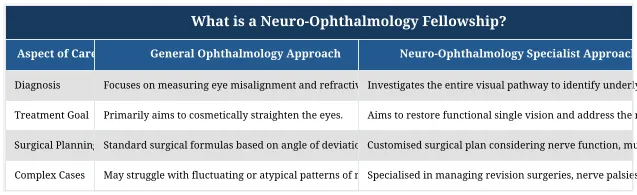
| Diagnosis | Focuses on measuring eye misalignment and refractive error. | Investigates the entire visual pathway to identify underlying neurological causes. |
| Treatment Goal | Primarily aims to cosmetically straighten the eyes. | Aims to restore functional single vision and address the root cause of diplopia. |
| Surgical Planning | Standard surgical formulas based on angle of deviation. | Customised surgical plan considering nerve function, muscle restrictions, and gaze-specific issues. |
| Complex Cases | May struggle with fluctuating or atypical patterns of misalignment. | Specialised in managing revision surgeries, nerve palsies, and post-trauma diplopia. |
Experience in Complex Cases
Many adults seeking double vision surgery have had previous operations or been told their condition is untreatable. A surgeon with fellowship training is accustomed to these scenarios. Their experience with revision surgery, scar tissue, and unpredictable muscle behaviour is an advantage. This background allows them to adapt during surgery and make judgments critical for success in non-standard cases.
| Condition | Typical Age of Onset | Estimated UK Incidence (per 100,000/year) |
|---|---|---|
| Sixth Cranial Nerve Palsy | Over 50 | 11.3 |
| Fourth Cranial Nerve Palsy | Any age (often congenital or post-trauma) | 5.5 |
| Third Cranial Nerve Palsy | Over 60 | 4.2 |
| Myasthenia Gravis (Ocular) | 20-40 (women), 60-80 (men) | 1.5 |
| Thyroid Eye Disease | 30-50 | 16 (women), 3 (men) |
Mr Nadeem Ali’s Neuro-Ophthalmology Journey
A surgeon’s training indicates their ability to manage complex conditions. The expertise of Mr Nadeem Ali is founded on fellowships at respected institutions for ophthalmology and neurology.
Fellowships at Moorfields and Queen Square
Mr Ali’s subspecialist training includes fellowships at Moorfields Eye Hospital and the National Hospital for Neurology and Neurosurgery, Queen Square. This dual training is rare and provides understanding of both the “eye” and “brain” aspects of vision. The Queen Square fellowship offers exposure to diagnosing and managing complex neurological disorders affecting vision. This experience, with one-to-one surgical training, forms his approach to adult strabismus.
Dedicated Adult Squint and Double Vision Specialist
This neuro-ophthalmology fellowship training is the foundation of Mr Ali’s exclusive focus on adult squint and double vision. Concentrating his practice 100% on this area, he applies his understanding of the brain-eye connection to each case. This makes him a dedicated adult squint and double vision specialist, able to help patients who have struggled to find solutions, including those told by the NHS that nothing more can be done.
What to Expect from a Specialist
Choosing a surgeon with neuro-ophthalmology training restores quality of life, not just eye alignment. The goal is comfortable, functional single vision, allowing a return to activities like driving, working, and reading.
Restoring Single Vision and Quality of Life
Successful surgery for double vision alleviates cognitive burden. Ignoring a second image causes headaches, disorientation, and fatigue. Success is measured by eliminating these symptoms. The aim is expanding the field of single vision, improving balance, and restoring confidence. This outcome can be life-changing, enabling a return to a previously lost level of function.
Navigating Complex Diagnoses
A specialist’s expertise is valuable when double vision is a symptom of a systemic or neurological condition. For patients with double vision stemming from conditions like brain tumours, head trauma, or thyroid eye disease, the surgeon must understand the underlying disease. This knowledge ensures appropriate surgical timing and approach, coordinated with other medical care. This neuro-ophthalmic perspective is key to safely managing the visual aspects of these health challenges.
Is a Neuro-Ophthalmology Fellowship Essential for Your Double Vision Surgery?
Standard strabismus surgery may be sufficient for straightforward eye misalignment. For adults with complex, long-standing, or neurologically-based double vision, a surgeon’s neuro-ophthalmology fellowship is often critical for a successful outcome. This training provides the diagnostic acumen to understand the cause of symptoms and the surgical skill to address it. It enables management of challenging cases to restore functional, comfortable vision. For debilitating double vision, choosing a surgeon with this expertise is crucial for reclaiming quality of life.
Conclusion
When evaluating a surgeon for double vision or complex squint surgery, consider their experience with the underlying causes of your condition. A neuro-ophthalmology background provides the framework to diagnose and operate on the brain-eye connection. This is vital for revision surgeries or cases linked to neurological events. Seek a consultation with a specialist. To explore your options, contact us or Book your assessment for clear, single vision.
Frequently Asked Questions
How does a surgeon’s neuro-ophthalmology fellowship specifically improve diagnosis for complex double vision?
A surgeon with a neuro-ophthalmology fellowship possesses specialized training to identify neurological causes of double vision, such as cranial nerve palsies or conditions like multiple sclerosis, which might be overlooked in general ophthalmology. This advanced expertise allows for a more precise diagnosis of the underlying issue, crucial for developing an effective and targeted treatment plan. For instance, Mr. Nadeem Ali’s fellowship at the National Hospital for Neurology and Neurosurgery, Queen Square, honed his ability to distinguish between ocular and neurological origins of diplopia.
What types of complex adult squint cases particularly benefit from a surgeon having a neuro-ophthalmology fellowship?
Patients with double vision stemming from neurological conditions like third, fourth, or sixth nerve palsies, thyroid eye disease, or those with post-trauma or brain tumour-related diplopia, significantly benefit. A surgeon with this specialized training, like Mr. Ali who was the lead for Adult Squint and Neuro-Ophthalmology at Moorfields South, can better understand the intricate brain-eye connection and tailor surgical approaches for these challenging cases. This expertise is particularly vital when previous surgeries have failed or the cause is not immediately apparent.
What is the typical duration of a neuro-ophthalmology fellowship, and why does this intensive training matter for surgical outcomes?
A neuro-ophthalmology fellowship typically involves an intensive one to two years of post-residency subspecialist training. This extended period allows for deep immersion in the complex interplay between the brain, nerves, and eyes, equipping the surgeon with advanced diagnostic and management skills. This comprehensive understanding directly translates to improved surgical outcomes, especially for complex adult strabismus, by enabling more accurate pre-operative planning and a nuanced approach to eye muscle adjustments.
Can a surgeon with neuro-ophthalmology training offer solutions when the NHS has indicated no further treatment options for double vision?
Yes, in many instances, a surgeon with neuro-ophthalmology training can offer solutions when standard treatments have been exhausted or the NHS has indicated no further options. Their specialized understanding of complex neurological causes and advanced surgical techniques, including revision squint surgery, allows them to re-evaluate the underlying issues. This expertise can lead to successful outcomes even in cases previously deemed untreatable, as demonstrated by specialists like Mr. Ali who focuses on complex adult squint and double vision.
How does a surgeon’s neuro-ophthalmology expertise influence the success rate for revision squint surgery?
A surgeon with neuro-ophthalmology expertise possesses a deeper understanding of eye muscle mechanics and their neurological control, which is crucial for revision surgery. This helps them accurately identify why a previous operation may have failed and to plan a more effective corrective procedure. For example, specialist centers report cumulative success rates exceeding 95% after accounting for revision procedures, highlighting how this specialized training contributes to better outcomes, even after prior surgical attempts.
Related Posts

Find out if you are suitable for Double Vision Treatment
Find out if you could benefit from this life changing surgery by contacting us today
Our most popular procedures



Hello, I’m Nadeem Ali
I’m one of the few eye surgeons in the world with 100% focus on Squint and Double Vision Surgery.
I have 24 years of eye surgery experience, and worked for 13 years as a Consultant at London’s renowned Moorfields Eye Hospital.
In 2023, I left the NHS to focus fully on treating patients from across the world at the London Squint Clinic. You can read more about me here.
There’s lots of information on the website about: squint surgery, double vision surgery and our pricing.
The most rewarding part of my job is hearing patients tell me how squint or double vision surgery has changed their lives. You can hear these stories here.
Mr Nadeem Ali
MA MB BChir MRCOphth FRCSEd(Ophth)