
Is Repeat Double Vision Surgery Possible After a Previous Failed Operation?
Why Choose Private Squint Surgery?
In the UK, squint surgery may be performed via the NHS, through insurance, or as self-pay. NHS treatment is free, but waiting times can be long and surgery is often performed by trainees under supervision. Many operations are carried out by surgeons who mainly specialise in children’s squint rather than adult complex cases.
With insurance, fees are standardised — meaning some leading specialists choose not to participate. Self-pay allows you to choose your surgeon directly and prioritise experience, specialisation, and access.
Many centres quote only a surgical fee. Hospital costs, anaesthetic fees and follow-ups are frequently additional. At London Squint Clinic, everything is included in one transparent package.
Our Complete Package – £10,000
- ✔ Advanced surgery by Mr Ali (one or both eyes)
- ✔ Adjustable sutures where clinically indicated
- ✔ Detailed orthoptic planning
- ✔ All hospital & anaesthetic fees included
- ✔ Post-operative medication
- ✔ Two video follow-ups
- ✔ Face-to-face review appointment
What Makes Us Different
- ✔ 100% focused on adult squint & double vision surgery
- ✔ >95% audited success rate
- ✔ Free re-treatment at 3 months if worse (extremely rare)
- ✔ 24/7 direct WhatsApp access to your surgeon during recovery
- ✔ Optional well-being session & pre-op reassurance call
Initial consultation: from £150
Surgery typically within 4 weeks. No referral required. Self-pay only.
Repeat Double Vision Surgery: Restoring Single Vision
A repeat double vision surgery is a viable option for adults who have had a previous, unsuccessful operation. This article explains the complexities of revision strabismus surgery, including navigating scar tissue and addressing undercorrection or overcorrection from the initial procedure. Understanding the causes of the first failure is critical for planning a successful reoperation. A specialist assessment determines candidacy for a secondary eye muscle surgery, which can restore clear, single vision and significantly improve daily function for those with persistent diplopia.
At the London Squint Clinic, Mr Nadeem Ali focuses exclusively on adult squint and double vision surgery. His expertise in complex cases, including revision procedures for patients with persistent diplopia, is informed by over two decades of specialist ophthalmic surgical experience.
To explore your options, contact us to schedule your consultation. You can also reach us via: Enquire about double vision surgery, Time to say goodbye to double vision
Can You Have Repeat Double Vision Surgery After a Failed Operation?
Yes, a second or third eye muscle operation is possible if a previous procedure did not correct double vision (diplopia). This procedure, revision strabismus surgery, is a specialized field of ophthalmology that addresses unsuccessful operations to achieve better eye alignment.
For adults with persistent diplopia, the prospect of another operation can be daunting. With an experienced specialist, advanced surgical techniques, and a thorough assessment, a reoperation can restore clear, single binocular vision and improve quality of life.
Understanding Revision Strabismus Surgery
Revision strabismus surgery involves re-operating on the extraocular muscles, which control eye movement. The goal is to correct the residual misalignment causing double vision. Unlike a primary operation, a revision procedure must account for anatomical changes from the first surgery, making it more intricate. The objective is to adjust the eye muscles’ position or tension so both eyes can focus on the same point simultaneously. This is a viable path to permanently fix double vision and regain visual comfort.
Why is Repeat Double Vision Surgery More Complex?
A secondary eye muscle surgery presents challenges not present in a first-time procedure. The surgeon navigates an environment altered by previous intervention. This requires precision, experience, and meticulous planning.
The Impact of Scar Tissue and Altered Anatomy
The most significant complicating factor in a reoperation is scar tissue (fibrosis). The body’s healing process creates scar tissue, which can bind the eye muscle to the eyeball (sclera) and surrounding tissues. This scar tissue can make it difficult to identify the muscle’s original path, isolate it for repositioning, and can restrict its movement, mimicking a muscle weakness. A revision surgeon must dissect this scar tissue without damaging the muscle or the thin wall of the eye, which requires considerable technical skill.
Common Reasons for Initial Squint Surgery Failure
An initial operation may fail for several reasons, which a specialist must diagnose before planning a repeat double vision surgery. These reasons include:
- Undercorrection: The initial surgery did not move the muscle far enough, leaving a residual eye turn and persistent double vision.
- Overcorrection: The muscle was moved too far, causing the eye to deviate in the opposite direction (e.g., an inward turn, or esotropia, becomes an outward turn, or exotropia).
- Development of a New Deviation: Correcting one misalignment (e.g., horizontal) can reveal or induce another (e.g., vertical).
- Underlying Conditions: Complex cases involving thyroid eye disease or cranial nerve palsies can have unpredictable healing responses, leading to outcomes that change over time.
Understanding the reason for the initial failure is critical. It informs the strategy for the revision, helping the surgeon decide which muscles to operate on and by how much. You can learn more about revision options after a failed squint surgery here.
Who is a Candidate for Revision Double Vision Surgery?
Determining candidacy for a reoperation involves a detailed evaluation by a diplopia specialist. The ideal candidate has a stable eye misalignment that has not changed for at least six months. This stability ensures the surgical plan is based on a consistent measurement, increasing the outcome’s predictability. Patients should be in good general health and have realistic expectations about the procedure’s goals and limitations.
The Comprehensive Pre-Operative Assessment Process
The assessment is critical for a successful revision and goes beyond measuring the squint’s angle. The process includes:
- Detailed History: Understanding the patient’s symptoms, the outcome of the previous surgery, and their visual goals.
- Orthoptic Measurement: Precise measurement of the eye deviation in all positions of gaze, using prisms to quantify the misalignment.
- Ocular Motility Examination: Assessing the function and range of motion of each eye muscle to identify restrictions or weaknesses.
- Binocular Vision Testing: Evaluating the brain’s ability to fuse the images from both eyes.
- Review of Previous Records: Operative notes from the prior surgery provide information about which muscles were operated on and how they were altered.
The Role of Adjustable Sutures in Revision Surgery
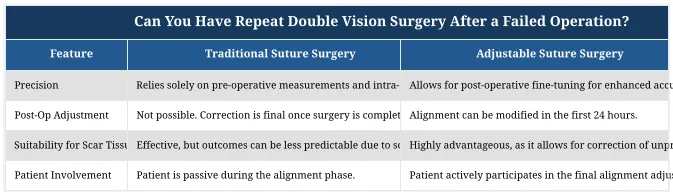
Adjustable suture surgery is an advantageous technique in complex revision cases. The surgeon reattaches the eye muscle with a temporary knot that can be adjusted in the hours following the operation while the patient is awake. This allows for fine-tuning of the eye alignment, which is particularly beneficial when scar tissue makes the surgical outcome less predictable. This technique improves the precision of a repeat double vision surgery.
View data as table
| Feature | Traditional Suture Surgery | Adjustable Suture Surgery |
|---|---|---|
| Precision | Relies solely on pre-operative measurements and intra-operative judgement. | Allows for post-operative fine-tuning for enhanced accuracy. |
| Post-Op Adjustment | Not possible. Correction is final once surgery is complete. | Alignment can be modified in the first 24 hours. |
| Suitability for Scar Tissue | Effective, but outcomes can be less predictable due to scarring. | Highly advantageous, as it allows for correction of unpredictable effects of scar tissue. |
| Patient Involvement | Patient is passive during the alignment phase. | Patient actively participates in the final alignment adjustment. |
The Specialist Expertise Required for Complex Revision Surgery
While many ophthalmologists perform strabismus surgery, revision procedures for adult diplopia are a sub-specialty requiring a specific skill set. The complexities of scar tissue, altered anatomy, and the higher stakes for the patient mean the choice of surgeon is the most important factor in determining the outcome. A surgeon’s experience correlates with their ability to anticipate challenges and adapt their technique.
Why Experience in Adult Strabismus is Paramount
Adult strabismus differs from childhood strabismus. Adults have a developed visual system, so the goal is to eliminate double vision, not prevent amblyopia (lazy eye). The muscles are often stiffer and the tissues less elastic. Mr. Nadeem Ali has dedicated his practice to adult squint and double vision, with 24 years of surgical experience, including 13 years as a Consultant at Moorfields Eye Hospital. This focused expertise is critical for a reoperation.
Advanced Techniques for Optimal Outcomes
A specialist in complex diplopia uses advanced techniques, including adjustable sutures, muscle selection, muscle transpositions, and management of scarred tissues. This knowledge is acquired through fellowship training, such as the advanced training Mr. Ali received at Moorfields Eye Hospital and the National Hospital for Neurology and Neurosurgery, Queen Square. According to the American Academy of Ophthalmology, successful outcomes depend on the surgeon’s accurate diagnosis and surgical plan.
What to Expect: Success Rates, Risks, and Recovery
A second operation requires a clear understanding of the potential outcomes, risks, and recovery process. While revision surgery is more challenging, a high success rate is achievable with a specialist. At the London Squint Clinic, the audited success rate for achieving satisfactory alignment from one operation is 95%.
Understanding Potential Outcomes and Risks
The goal of a reoperation is to eliminate double vision in the straight-ahead and reading positions, restoring single vision for most daily activities. Risks include infection, bleeding, and over or undercorrection. A specific risk in revision surgery is that scarring may be more extensive than anticipated. A pre-operative consultation will cover these risks in detail. The National Eye Institute provides a general overview of strabismus treatment and associated considerations.
The Recovery Journey After Revision Eye Muscle Surgery
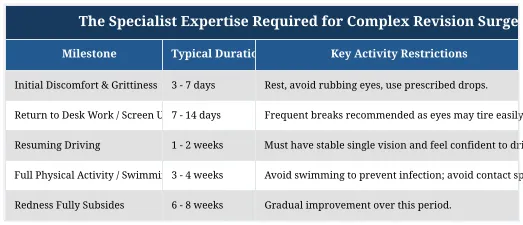
Recovery from a secondary eye muscle surgery is similar to a primary procedure, though initial discomfort may be greater due to more extensive dissection. The eye will be red and feel gritty for several weeks. Vision may be blurry or fluctuate as the eyes and brain adapt to the new alignment. Continuous support is important; patients at the London Squint Clinic have 24/7 WhatsApp access to Mr. Ali during their recovery.
View data as table
| Milestone | Typical Duration | Key Activity Restrictions |
|---|---|---|
| Initial Discomfort & Grittiness | 3 – 7 days | Rest, avoid rubbing eyes, use prescribed drops. |
| Return to Desk Work / Screen Use | 7 – 14 days | Frequent breaks recommended as eyes may tire easily. |
| Resuming Driving | 1 – 2 weeks | Must have stable single vision and feel confident to drive safely. |
| Full Physical Activity / Swimming | 3 – 4 weeks | Avoid swimming to prevent infection; avoid contact sports. |
| Redness Fully Subsides | 6 – 8 weeks | Gradual improvement over this period. |
Take the Next Step Towards Clear, Single Vision
Double vision after a previous surgery can be discouraging, but further treatment is often possible. A successful outcome is possible with a specialist and a planned revision procedure. If you have diplopia after a prior operation, seeking a second opinion from a surgeon who focuses on complex adult strabismus is an important step.
Mr. Nadeem Ali and the team at the London Squint Clinic specialize in helping patients after unsuccessful treatments. It’s Time to say goodbye to double vision. To learn more about your options, Enquire about double vision surgery.
Conclusion
The key decision for a patient considering a reoperation for diplopia is the selection of their surgeon. Revision surgery’s complexity, due to scar tissue and altered anatomy, requires specialist experience. A surgeon focused on adult strabismus, with experience from a center like Moorfields Eye Hospital and proficiency in techniques like adjustable sutures, can increase the likelihood of a successful outcome. If you are considering your options, the next step is a comprehensive assessment to determine the cause of the initial failure and to map out a precise, personalised surgical plan. To explore your options, contact us. Enquire about double vision surgery and learn how to Time to say goodbye to double vision.
Frequently Asked Questions
How soon after a previous failed operation can I consider repeat double vision surgery?
We generally advise waiting at least 6 months after your initial eye muscle operation before undergoing a revision procedure. This timeframe allows the eye tissues to heal completely and any residual misalignment to stabilize, which is crucial for accurate pre-operative measurements and planning the subsequent surgery effectively.
What makes revision double vision surgery more challenging than a primary procedure?
Revision surgery is inherently more complex due to the presence of scar tissue and altered anatomical structures from the initial operation. Navigating these changes requires a surgeon with specific expertise to safely identify and reposition the extraocular muscles for a successful outcome, which Mr. Nadeem Ali possesses from his extensive experience at Moorfields Eye Hospital.
What advanced techniques are used to improve outcomes in complex repeat double vision surgery?
For complex revision cases, advanced techniques such as adjustable sutures are frequently employed to enhance precision. This method allows for fine-tuning of eye alignment shortly after the operation, optimizing the chances of achieving clear, single vision, a technique Mr. Nadeem Ali utilizes to achieve superior results.
What success rate can I expect from a specialist for a second double vision operation?
While individual outcomes vary, a specialist clinic like London Squint Clinic aims for a high success rate, with an audited 95% alignment success from one operation, even in revision cases. This commitment to precision and expertise provides patients with a definitive solution after a previous surgical failure.
Are there specific risks associated with undergoing a second eye muscle operation?
As with any surgery, there are risks, and revision procedures can carry a slightly increased risk due to the altered anatomy and scar tissue. However, with an experienced surgeon like Mr. Nadeem Ali, who specializes in complex revision cases, these risks are carefully managed to prioritize patient safety and optimal visual outcomes.
What is the typical cost for a complete repeat double vision surgery package at a specialist clinic like London Squint Clinic?
At London Squint Clinic, a complete surgery package for adult double vision, including revision procedures, is transparently priced at £12,000. This fixed cost covers all aspects of your care from start to finish, ensuring no hidden expenses for patients seeking specialist treatment.
Related Posts


Find out if you are suitable for Double Vision Treatment
Find out if you could benefit from this life changing surgery by contacting us today
Our most popular procedures



Hello, I’m Nadeem Ali
I’m one of the few eye surgeons in the world with 100% focus on Squint and Double Vision Surgery.
I have 24 years of eye surgery experience, and worked for 13 years as a Consultant at London’s renowned Moorfields Eye Hospital.
In 2023, I left the NHS to focus fully on treating patients from across the world at the London Squint Clinic. You can read more about me here.
There’s lots of information on the website about: squint surgery, double vision surgery and our pricing.
The most rewarding part of my job is hearing patients tell me how squint or double vision surgery has changed their lives. You can hear these stories here.
Mr Nadeem Ali
MA MB BChir MRCOphth FRCSEd(Ophth)