
Understanding Success Rates: What a 95% Alignment Outcome Means for Patients
Why Choose Private Squint Surgery?
In the UK, squint surgery may be performed via the NHS, through insurance, or as self-pay. NHS treatment is free, but waiting times can be long and surgery is often performed by trainees under supervision. Many operations are carried out by surgeons who mainly specialise in children’s squint rather than adult complex cases.
With insurance, fees are standardised — meaning some leading specialists choose not to participate. Self-pay allows you to choose your surgeon directly and prioritise experience, specialisation, and access.
Many centres quote only a surgical fee. Hospital costs, anaesthetic fees and follow-ups are frequently additional. At London Squint Clinic, everything is included in one transparent package.
Our Complete Package – £10,000
- ✔ Advanced surgery by Mr Ali (one or both eyes)
- ✔ Adjustable sutures where clinically indicated
- ✔ Detailed orthoptic planning
- ✔ All hospital & anaesthetic fees included
- ✔ Post-operative medication
- ✔ Two video follow-ups
- ✔ Face-to-face review appointment
What Makes Us Different
- ✔ 100% focused on adult squint & double vision surgery
- ✔ >95% audited success rate
- ✔ Free re-treatment at 3 months if worse (extremely rare)
- ✔ 24/7 direct WhatsApp access to your surgeon during recovery
- ✔ Optional well-being session & pre-op reassurance call
Initial consultation: from £150
Surgery typically within 4 weeks. No referral required. Self-pay only.
Squint Surgery Success Rate: Defining Clinical Success
A high squint surgery success rate reflects the likelihood of achieving stable eye alignment and functional vision from a single operation. This article explains how a 95% outcome is calculated through a formal surgical audit, focusing on clinical success metrics beyond cosmetic appearance. True success is defined by both objective measurements and patient-reported outcomes, such as restoring comfortable binocular single vision and eliminating double vision. Understanding these factors helps patients interpret the meaning behind a high squint surgery success rate and set realistic expectations for their strabismus surgery outcomes.
At London Squint Clinic, Mr. Nadeem Ali’s practice is focused exclusively on adult squint and double vision surgery. This specialization, combined with extensive experience as a former Moorfields Eye Hospital consultant, informs the clinical standards that underpin these audited outcomes.
To explore your options, contact us to schedule your consultation. You can also reach us via: Enquire about double vision surgery, Time to say goodbye to double vision
What Does a 95% Squint Surgery Success Rate Truly Mean?
A 95% squint surgery success rate signifies that 95 out of 100 patients achieve satisfactory and stable eye alignment from a single operation. This percentage reflects a functional outcome, including the reduction or elimination of double vision and the restoration of comfortable binocular vision for most patients.
This figure is derived from audited data tracking patient results over three to six months post-surgery to ensure the alignment is stable. It represents a high standard of surgical precision and patient care, indicating a low likelihood of needing more procedures.
Beyond Cosmetic: Defining ‘Successful’ Eye Alignment
Surgical success extends beyond the visible straightening of the eyes. While improved appearance is a goal for many, the primary benefits are often functional. A successful procedure aims to restore comfortable, single vision, improving a person’s ability to perform daily tasks like driving, reading, and interacting socially.
Patient reported outcomes (PROs) are formal measures of how a patient feels and functions after treatment. For adults undergoing strabismus surgery, this means assessing the reduction in symptoms like eye strain, headaches, and double vision. High rates of diplopia surgery success are defined by the surgeon’s objective measurements and the patient’s subjective experience of improved quality of life. This blend of cosmetic, functional, and personal satisfaction is key to understanding why a 95% success rate matters.
How Are Squint Surgery Success Rates Calculated and Audited?
Reputable clinics calculate success rates from systematic data collection and analysis. This process involves a formal surgical audit, where the outcomes of every procedure are recorded and reviewed against established benchmarks.
The calculation begins with a clear definition of success. For strabismus surgery, this is typically defined as achieving an eye alignment within 8 to 10 prism dioptres of straight in the primary position (looking straight ahead). This small residual angle is generally not noticeable and does not cause symptoms. Data is collected at pre-operative assessments and at post-operative intervals, such as one week, six weeks, and three months, to track stability. The final squint surgery success rate is the percentage of patients who meet these criteria at the final follow-up from a single operation.
The Role of Surgical Audits and Clinical Success Metrics
A surgical audit is a quality improvement process that systematically reviews clinical care against explicit criteria. Eye muscle surgery audits track key clinical success metrics. These metrics are both objective and subjective. Objective measures include the precise angle of misalignment (measured in prism dioptres) before and after surgery. Subjective measures capture the patient’s experience, such as the elimination of double vision or improvements on standardized quality-of-life questionnaires like the Adult Strabismus-20 (AS-20).
Auditing strabismus surgery outcomes allows a surgeon or clinic to verify performance, identify areas for refinement, and provide patients with accurate, evidence-based information about likely results.
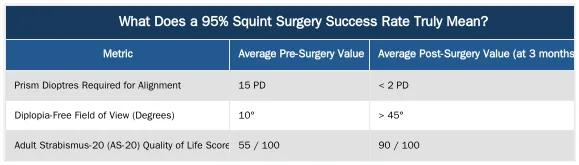
View data as table
| Metric | Average Pre-Surgery Value | Average Post-Surgery Value (at 3 months) |
|---|---|---|
| Prism Dioptres Required for Alignment | 15 PD | < 2 PD |
| Diplopia-Free Field of View (Degrees) | 10° | > 45° |
| Adult Strabismus-20 (AS-20) Quality of Life Score | 55 / 100 | 90 / 100 |
Why Does Surgeon Expertise Drive Higher Success Rates?
The most important factor influencing the squint surgery success rate is the surgeon’s skill and experience. A specialist who focuses on adult strabismus understands the mechanics of eye muscles and the nuances of surgical planning. This is particularly true for complex cases, such as those caused by nerve palsies, thyroid eye disease, or previous failed operations.
An expert surgeon’s ability to predict how eye muscles will respond to surgery is honed over thousands of procedures. This experience allows for more precise surgical plans, reducing the chances of over- or under-correction. For patients, this translates to a higher probability of achieving good alignment with one operation. The value of this expertise is recognized by professional bodies like The Royal College of Ophthalmologists, which sets standards for ophthalmic training and practice in the UK.
The Impact of Consultant-Led Care and Specialist Techniques
A model of consultant-led care, where the most experienced surgeon performs every consultation, surgical plan, and procedure, helps maximize outcomes. At London Squint Clinic, Mr Nadeem Ali’s expertise, from 13 years as a Consultant at Moorfields Eye Hospital, provides this focus for every patient. This continuity of care eliminates communication gaps and ensures the person with the most knowledge makes every decision.
Specialist surgeons use advanced techniques to enhance precision. The adjustable suture benefit is a prime example. This technique allows for fine-tuning of the eye’s alignment in the hours after the initial operation, while the patient is awake. By making small adjustments before the sutures are permanently tied, the surgeon can achieve greater accuracy than with standard, non-adjustable techniques, contributing to higher success rates.
Understanding Your Outcome: What to Expect Post-Surgery
Following eye muscle surgery, the initial recovery involves some redness, mild discomfort, and often fluctuating double vision as the eyes and brain adapt to the new alignment. Most patients can return to non-strenuous activities within a few days, with the eye’s appearance improving over several weeks.
A primary goal for many patients is restoring comfortable binocular single vision (BSV). BSV is the ability of the brain to fuse the images from both eyes into a single, three-dimensional picture. Achieving this provides improved depth perception and visual comfort. While not possible in every case (especially in long-standing squints from childhood), many adults can achieve clear single vision and its associated functional benefits.
The Journey to Binocular Single Vision and Quality of Life
A stable, final outcome typically takes around three months. During this time, the brain neuro-adapts to the new muscle positions. The improvement in patient reported outcomes is often significant. Patients frequently describe more confidence in social situations, a return to hobbies, and a reduction in the fatigue caused by managing a squint or double vision. The table below illustrates the impact successful surgery can have on daily life.
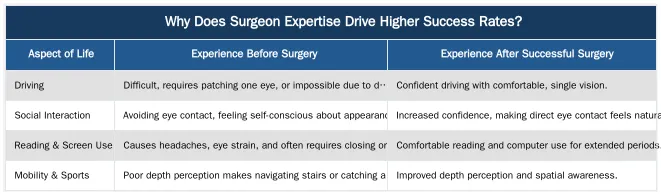
View data as table
| Aspect of Life | Experience Before Surgery | Experience After Successful Surgery |
|---|---|---|
| Driving | Difficult, requires patching one eye, or impossible due to double vision. | Confident driving with comfortable, single vision. |
| Social Interaction | Avoiding eye contact, feeling self-conscious about appearance. | Increased confidence, making direct eye contact feels natural. |
| Reading & Screen Use | Causes headaches, eye strain, and often requires closing one eye. | Comfortable reading and computer use for extended periods. |
| Mobility & Sports | Poor depth perception makes navigating stairs or catching a ball difficult. | Improved depth perception and spatial awareness. |
What If the First Squint Surgery Isn’t 100% Successful?
A 95% success rate acknowledges that in a small number of cases (approximately 1 in 20), the outcome of the first operation may not be optimal. The body’s healing process is unpredictable, and occasionally, the eyes may heal into a slightly over- or under-corrected position. This biological variable can sometimes necessitate further intervention.
In these instances, a second, smaller procedure, known as revision surgery, may be recommended. A specialist clinic’s goal is to keep the revision surgery rate as low as possible through planning and advanced surgical techniques. A low rate indicates the surgeon’s accuracy. Research published in journals like the Eye (Nature) shows factors like adjustable sutures can significantly reduce the need for reoperations.
Addressing Revision Surgery and Ensuring Patient Peace of Mind
The consent process includes understanding the possibility of a second procedure. A transparent clinic will discuss this openly. At London Squint Clinic, this is addressed through a “peace of mind” re-operation policy. If a patient’s alignment is functionally or cosmetically worse at the three-month post-operative review, any necessary further surgery to correct this is provided without an additional surgical fee.
This policy demonstrates a commitment to the best long-term outcome for every patient. It aligns the clinic’s goals with the patient’s, focusing on satisfactory, stable eye alignment and symptom resolution.
Choose a Specialist for Life-Changing Eye Alignment Outcomes
For squint or double vision surgery, specialist expertise matters. Choosing a consultant who focuses on adult strabismus with high, audited success rates provides the best assurance of a life-changing result from a single procedure. This focus provides access to advanced techniques, surgical planning, and an understanding of the needs of adults with eye misalignment.
Investing in specialist eye alignment surgery is an investment in your quality of life. To schedule a consultation about consultant-led care, contact us.
Enquire about double vision surgery, or learn about how it’s Time to say goodbye to double vision.
Conclusion
A 95% success rate from a single operation reflects specialized expertise, surgical technique, and a patient-centric approach. For adults with eye misalignment and double vision, these metrics provide insight into potential outcomes. Choosing a clinic with transparent, audited success rates and consultant-led care is an investment in clearer vision and restored independence. Explore your surgical options with a dedicated specialist.
Enquire about double vision surgery or learn about Time to say goodbye to double vision. Contact us for more information.
Frequently Asked Questions
What does a 95% alignment outcome mean for my vision after squint surgery?
A 95% alignment outcome signifies that 95 out of 100 patients achieve satisfactory and stable eye alignment, typically assessed 3 to 6 months post-surgery. This often translates to a significant reduction or elimination of double vision and restoration of comfortable binocular vision, improving daily function and quality of life.
How is the London Squint Clinic’s 95% squint surgery success rate verified?
Our 95% squint surgery success rate is based on rigorously audited data, reflecting outcomes from a single operation. This high standard is achieved through Mr. Nadeem Ali’s 24 years of eye surgery experience, including 13 years as a Consultant at Moorfields Eye Hospital, and his exclusive focus on adult squint and double vision surgery.
Does this high success rate apply to complex cases or if I’ve had previous failed squint surgery?
Yes, the 95% alignment outcome is an overall figure that includes complex cases and patients who have undergone previous failed surgeries elsewhere. Mr. Nadeem Ali’s expertise, honed through extensive fellowship training and his role as Lead for Adult Squint at Moorfields South, is specifically geared towards achieving successful results in these challenging situations.
What happens if my eye alignment isn’t perfect after the initial surgery?
For the small percentage of patients (around 5%) whose alignment isn’t perfectly achieved after one procedure, outcomes can often be managed with minor adjustments, prism glasses, or a planned second procedure. The London Squint Clinic offers a peace of mind re-operation policy if the outcome is worse at 3 months post-surgery, providing further surgical intervention at no additional cost.
How does a high squint surgery success rate impact the overall cost and recovery?
A high squint surgery success rate significantly increases the likelihood of achieving your desired outcome with just one procedure, which can lead to a faster recovery and lower overall costs. Our transparent fixed package pricing of £12,000 for a complete surgery package reflects this commitment to a single, effective intervention, covering all aspects from pre-operative assessments to post-operative care.
Related Posts

Find out if you are suitable for Double Vision Treatment
Find out if you could benefit from this life changing surgery by contacting us today
Our most popular procedures



Hello, I’m Nadeem Ali
I’m one of the few eye surgeons in the world with 100% focus on Squint and Double Vision Surgery.
I have 24 years of eye surgery experience, and worked for 13 years as a Consultant at London’s renowned Moorfields Eye Hospital.
In 2023, I left the NHS to focus fully on treating patients from across the world at the London Squint Clinic. You can read more about me here.
There’s lots of information on the website about: squint surgery, double vision surgery and our pricing.
The most rewarding part of my job is hearing patients tell me how squint or double vision surgery has changed their lives. You can hear these stories here.
Mr Nadeem Ali
MA MB BChir MRCOphth FRCSEd(Ophth)