
How Conditions Like Thyroid Eye Disease or Myasthenia Gravis Lead to Strabismus
Why Choose Private Squint Surgery?
In the UK, squint surgery may be performed via the NHS, through insurance, or as self-pay. NHS treatment is free, but waiting times can be long and surgery is often performed by trainees under supervision. Many operations are carried out by surgeons who mainly specialise in children’s squint rather than adult complex cases.
With insurance, fees are standardised — meaning some leading specialists choose not to participate. Self-pay allows you to choose your surgeon directly and prioritise experience, specialisation, and access.
Many centres quote only a surgical fee. Hospital costs, anaesthetic fees and follow-ups are frequently additional. At London Squint Clinic, everything is included in one transparent package.
Our Complete Package – £10,000
- ✔ Advanced surgery by Mr Ali (one or both eyes)
- ✔ Adjustable sutures where clinically indicated
- ✔ Detailed orthoptic planning
- ✔ All hospital & anaesthetic fees included
- ✔ Post-operative medication
- ✔ Two video follow-ups
- ✔ Face-to-face review appointment
What Makes Us Different
- ✔ 100% focused on adult squint & double vision surgery
- ✔ >95% audited success rate
- ✔ Free re-treatment at 3 months if worse (extremely rare)
- ✔ 24/7 direct WhatsApp access to your surgeon during recovery
- ✔ Optional well-being session & pre-op reassurance call
Initial consultation: from £150
Surgery typically within 4 weeks. No referral required. Self-pay only.
Thyroid Eye Disease Strabismus: Causes & Treatment
Thyroid eye disease strabismus is an autoimmune condition causing restrictive strabismus and double vision due to eye muscle inflammation and fibrosis. This article explains the mechanical process behind this misalignment and contrasts it with the variable diplopia seen in Myasthenia Gravis, which stems from neuromuscular weakness. Understanding these distinct causes is essential for accurate diagnosis and effective management. The content details the diagnostic pathway and surgical solutions, including eye muscle surgery, designed to restore single vision and proper eye alignment for patients with this condition.
At the London Squint Clinic, Mr. Nadeem Ali specializes in complex adult strabismus, including cases caused by autoimmune conditions. The clinic focuses exclusively on consultant-led surgical correction for adults seeking to resolve double vision and restore eye alignment.
To explore your options, contact us to schedule your consultation. You can also reach us via: Enquire about squint surgery, Squint Surgery in London
Thyroid eye disease strabismus is an autoimmune condition that causes eye misalignment and debilitating double vision in adults. Myasthenia Gravis (MG), another autoimmune disorder, affects neuromuscular eye control, causing a different form of squint. This article covers the mechanisms of strabismus in Thyroid Eye Disease and Myasthenia Gravis, the diagnostic process, and the surgical and medical treatments to restore alignment and single vision.
Understanding Strabismus in Autoimmune Conditions
Autoimmune-related strabismus occurs when the body’s immune system attacks the muscles or nerves that control eye movement. This causes eye misalignment (a squint) and often double vision (diplopia), which can severely impact daily activities like reading, driving, and navigating spaces. The two most common autoimmune causes are Thyroid Eye Disease and Myasthenia Gravis.
What is Autoimmune-Related Strabismus?
Strabismus, or squint, is when the eyes do not point in the same direction. While often associated with childhood, a sudden squint in adulthood requires prompt investigation. In autoimmune disorders, the misalignment is a secondary consequence of a systemic condition. The immune attack causes either physical restriction of the eye muscles (Graves’ ophthalmopathy) or functional weakness (Myasthenia Gravis). The resulting diplopia and visible turn can affect confidence, social interaction, and quality of life.
How Does Thyroid Eye Disease (TED) Cause Restrictive Strabismus?
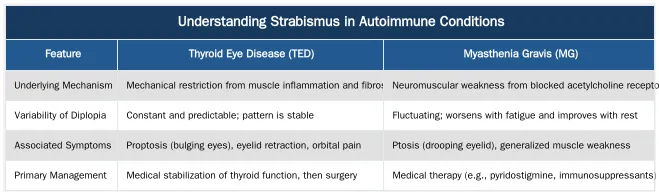
Thyroid Eye Disease (TED), or Graves’ ophthalmopathy, is an autoimmune condition where the immune system targets tissues within the eye socket (orbit). This causes restrictive strabismus. The problem in TED is mechanical: the eye muscles become too stiff and enlarged to move freely, unlike squints caused by nerve or brain issues. This can cause a squint to suddenly appear in adults, often with signs like bulging eyes (proptosis) and eyelid retraction.
The Inflammatory Pathway to Eye Muscle Fibrosis
Thyroid eye disease strabismus begins with an inflammatory phase. Immune cells infiltrate the extraocular muscles and orbital fat, causing them to swell. This inflammation increases pressure within the eye socket, pushing the eyeball forward and restricting its movement. Over months, inflammation subsides and is replaced by scar tissue (fibrosis). This scarring makes the muscles permanently stiff, inelastic, and shortened. They can no longer relax, tethering the eye into a misaligned position. The most commonly affected muscles are the inferior rectus (pulling the eye down) and the medial rectus (pulling the eye in), often causing vertical or horizontal double vision. In severe cases, orbital decompression may be needed to create more space in the eye socket before strabismus surgery.
Why Does Myasthenia Gravis Lead to Variable Diplopia?
Myasthenia Gravis (MG) causes strabismus through a different mechanism than TED. MG causes functional weakness, not mechanical restriction. In this neuromuscular disorder, the immune system produces antibodies that attack and block acetylcholine receptors on muscle cells. These receptors receive nerve signals that command muscle contraction. Blocked receptors disrupt nerve-muscle communication, causing muscle weakness and fatigue.
Neuromuscular Junction Dysfunction and Ocular Symptoms
The muscles controlling eye movement and eyelid position are susceptible to MG because they are in constant use and fatigue easily. The first symptoms of MG are often ocular, such as a drooping eyelid (ptosis) and double vision (myasthenia gravis diplopia). Its key characteristic is variability: diplopia and ptosis often worsen with prolonged eye use (e.g., reading, end of day) and improve with rest. This fluctuation can make diagnosis challenging. Diagnosis is confirmed by blood tests for acetylcholine receptor antibodies and sometimes clinical tests like the Tensilon test, which temporarily improves muscle strength. This fluctuating weakness contrasts with the constant, fixed misalignment of restrictive strabismus from TED.
Diagnosing and Managing Autoimmune-Related Squint: Mr. Ali’s Specialist Approach
Accurately diagnosing the cause of an adult-onset squint is critical because treatments for TED and MG are different. A specialist in adult strabismus and neuro-ophthalmology, like Mr. Nadeem Ali, is essential for these complex cases. The diagnostic process is a detailed evaluation to pinpoint the underlying autoimmune mechanism.
Comprehensive Assessment for Complex Cases
At the London Squint Clinic, assessment begins with a detailed patient history, focusing on the onset, duration, and variability of symptoms like double vision. An examination of eye movements, alignment measurements in different gaze positions, and assessment for ptosis helps differentiate between the restrictive pattern of TED and the fatigable weakness of MG. Mr. Ali’s expertise for this distinction comes from his background as the former Lead for Adult Squint and Neuro-Ophthalmology at Moorfields Eye Hospital. Initial management may use prisms in glasses to relieve double vision while the autoimmune condition is medically stabilized. The National Eye Institute states that managing the systemic disease is the first step before surgical correction.
Comparing Strabismus in TED vs. Myasthenia Gravis
The table below summarizes the key differences between strabismus in TED and Myasthenia Gravis.
Surgical Solutions for Autoimmune Strabismus: Restoring Alignment and Vision
Once an autoimmune condition is medically stabilized, surgery can effectively correct persistent eye misalignment and eliminate double vision. The surgical approach must be tailored to the specific cause of the strabismus. Surgery for the restrictive strabismus of TED is common and successful, while surgery for MG-related diplopia is considered more selectively.
Precision Eye Muscle Surgery for TED-Related Strabismus
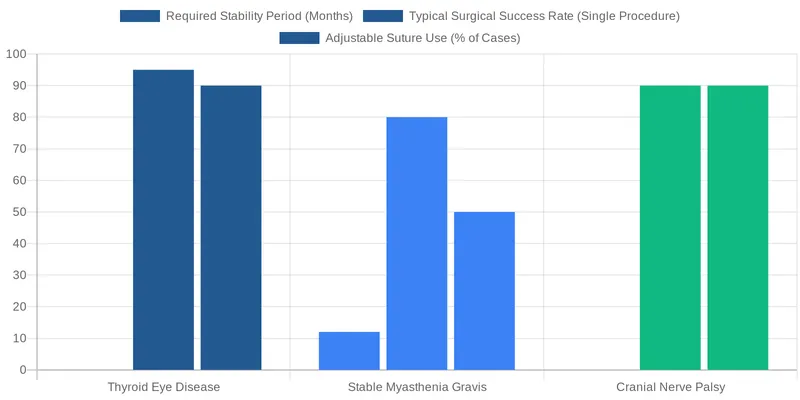
Surgery for TED-related strabismus releases scarred, tight muscles and repositions them to align the eyes. This procedure requires experience with restrictive squints. Timing is critical for success: surgery is performed only after the active inflammatory phase of TED has resolved and eye alignment has been stable for at least six months. For complex cases of thyroid eye disease strabismus, adjustable suture surgery is often used. This technique allows fine-tuning of the eye’s position hours after the operation, while the patient is awake, to achieve optimal alignment.
When Surgery is Considered for Myasthenia Gravis Diplopia
Surgery for myasthenia gravis diplopia is less common because medical management is the primary treatment. Surgery may be an option for stable, persistent double vision unresponsive to medication and prism correction. The decision to operate is cautious, as fluctuating muscle weakness can affect the outcome. The goal of surgery in MG is to achieve single vision in the primary (straight-ahead) and reading positions, acknowledging that some double vision may persist in side gazes.
The table below outlines typical clinical timelines and considerations for strabismus surgery in different conditions.
Regain Clear Vision and Confidence: Your Path to Specialist Adult Squint Correction
Double vision and eye misalignment from an autoimmune condition are challenging, but specialist care can restore single vision and confidence. Correcting complex strabismus requires a surgeon with expertise in adult eye muscle disorders. Mr. Nadeem Ali focuses exclusively on adult squint surgery, and his experience at Moorfields Eye Hospital is tailored to conditions like TED and MG. The London Squint Clinic provides rapid access to this expertise and a clear treatment pathway.
Conclusion
Autoimmune conditions like Thyroid Eye Disease and Myasthenia Gravis cause strabismus through distinct pathological processes: mechanical restriction and neuromuscular weakness. Accurate diagnosis by a specialist is crucial for management. For patients with stable thyroid eye disease strabismus, eye muscle surgery can permanently correct misalignment and eliminate double vision. Specialist consultation can help those with an autoimmune-related squint. Contact us to learn more. Enquire about squint surgery or learn more about Squint Surgery in London.
Frequently Asked Questions
How does Thyroid Eye Disease cause strabismus?
In Thyroid Eye Disease, the body’s immune system attacks the tissues surrounding the eyes, causing the eye muscles to become inflamed and swollen. Over time, this can lead to scarring and fibrosis, making the muscles stiff and restricted. This restriction prevents normal eye movement and pulls the eyes out of alignment, resulting in thyroid eye disease strabismus and double vision.
Why does Myasthenia Gravis lead to a squint and double vision?
Myasthenia Gravis is an autoimmune disorder that disrupts the signals between nerves and muscles, causing muscle weakness. The eye muscles are frequently affected, leading to a variable squint and double vision that typically worsens with fatigue or at the end of the day. This happens because the weakened muscles cannot maintain proper eye alignment, especially during prolonged use.
Is the surgical approach for thyroid eye disease strabismus different?
Yes, surgery for eye misalignment from thyroid disease is highly specialised. Unlike standard squint surgery which repositions healthy muscles, this procedure often involves carefully releasing or lengthening muscles that have become scarred and tight. This requires an expert understanding of the disease to restore alignment and achieve a stable, long-term result.
What is the correct timing for surgery to correct thyroid eye disease strabismus?
Surgery is only performed once the active, inflammatory phase of the disease is over and the eye misalignment has been stable for at least six months. Operating on thyroid eye disease strabismus before the condition has stabilised can lead to unpredictable outcomes and the need for further surgery. Patience is key to achieving the best possible result.
Can strabismus from Thyroid Eye Disease be fully corrected?
In the hands of a specialist surgeon, the outlook is excellent. The primary goals of surgery are to eliminate double vision in the straight-ahead and reading positions, restore cosmetic alignment, and improve the range of single vision. With advanced techniques, a very high success rate can be achieved, often from a single operation.
How can I get a specialist assessment for my squint?
You can book a consultation directly with Mr. Nadeem Ali, a specialist in complex adult strabismus, without needing a GP referral. An initial assessment will determine the cause of your eye misalignment and the most appropriate treatment plan. To get started, you can enquire about squint surgery through the clinic’s website.
Related Posts

Find out if you are suitable for Double Vision Treatment
Find out if you could benefit from this life changing surgery by contacting us today
Our most popular procedures



Hello, I’m Nadeem Ali
I’m one of the few eye surgeons in the world with 100% focus on Squint and Double Vision Surgery.
I have 24 years of eye surgery experience, and worked for 13 years as a Consultant at London’s renowned Moorfields Eye Hospital.
In 2023, I left the NHS to focus fully on treating patients from across the world at the London Squint Clinic. You can read more about me here.
There’s lots of information on the website about: squint surgery, double vision surgery and our pricing.
The most rewarding part of my job is hearing patients tell me how squint or double vision surgery has changed their lives. You can hear these stories here.
Mr Nadeem Ali
MA MB BChir MRCOphth FRCSEd(Ophth)