
What Causes a Squint to Suddenly Appear in Adults? Neurological and Muscular Factors
Why Choose Private Squint Surgery?
In the UK, squint surgery may be performed via the NHS, through insurance, or as self-pay. NHS treatment is free, but waiting times can be long and surgery is often performed by trainees under supervision. Many operations are carried out by surgeons who mainly specialise in children’s squint rather than adult complex cases.
With insurance, fees are standardised — meaning some leading specialists choose not to participate. Self-pay allows you to choose your surgeon directly and prioritise experience, specialisation, and access.
Many centres quote only a surgical fee. Hospital costs, anaesthetic fees and follow-ups are frequently additional. At London Squint Clinic, everything is included in one transparent package.
Our Complete Package – £10,000
- ✔ Advanced surgery by Mr Ali (one or both eyes)
- ✔ Adjustable sutures where clinically indicated
- ✔ Detailed orthoptic planning
- ✔ All hospital & anaesthetic fees included
- ✔ Post-operative medication
- ✔ Two video follow-ups
- ✔ Face-to-face review appointment
What Makes Us Different
- ✔ 100% focused on adult squint & double vision surgery
- ✔ >95% audited success rate
- ✔ Free re-treatment at 3 months if worse (extremely rare)
- ✔ 24/7 direct WhatsApp access to your surgeon during recovery
- ✔ Optional well-being session & pre-op reassurance call
Initial consultation: from £150
Surgery typically within 4 weeks. No referral required. Self-pay only.
Sudden Squint in Adults: Understanding the Causes
A sudden squint in adults is a critical medical sign that requires urgent evaluation. This guide explains the primary neurological and muscular causes, including cranial nerve palsy, stroke, and conditions like thyroid eye disease. Understanding these factors is the first step toward a correct diagnosis and effective treatment for the resulting double vision (diplopia). The appearance of a sudden squint in adults should never be ignored, as it can indicate a serious underlying health issue that demands immediate specialist assessment to restore alignment and single vision.
The London Squint Clinic focuses exclusively on adult strabismus and diplopia. Led by consultant surgeon Mr Nadeem Ali, the clinic provides specialist diagnosis and management for complex cases, including those arising from neurological conditions, to restore eye alignment and single vision.
To explore your options, contact us to schedule your consultation. You can also reach us via: Enquire about squint surgery, Squint Surgery in London
A sudden squint in adults requires immediate medical attention, as it often signals an underlying neurological or muscular condition. Unlike a squint present since childhood, an acute misalignment of the eyes, frequently accompanied by double vision, is a critical red flag. This article overviews the primary causes, from cranial nerve palsies and strokes to autoimmune disorders. A precise diagnosis is the first step toward a specialist-led management plan to restore eye alignment and single vision.
What is a Sudden Squint in Adults and Why is it Urgent?
A sudden squint, or acute adult-onset strabismus, is the rapid development of eye misalignment. This condition is a medical concern because the adult brain cannot fuse the two aligned images, resulting in double vision (diplopia).
Defining Adult-Onset Strabismus and Diplopia
Strabismus is the clinical term for any misalignment of the eyes. When it develops acutely in adulthood, it is called adult-onset strabismus. The primary symptom is diplopia, or double vision. Unlike a child’s brain, which can suppress the image from the misaligned eye (amblyopia), an adult’s brain cannot adapt this way. The result is persistent double vision, which can impair balance, reading, and driving. More information is available in this explanation of double vision.
The Critical Need for Prompt Medical Evaluation
A sudden squint is a neurological red flag. It indicates an abrupt disruption to the nerves and muscles that control eye movement. This can be caused by serious conditions such as a stroke, brain tumour, or aneurysm. Any adult experiencing a new squint or double vision should seek an urgent medical assessment to rule out life-threatening causes and establish a diagnosis. A comprehensive guide to adult strabismus provides further context.
Key Neurological Causes Behind a Sudden Squint
The brain and its connecting nerves coordinate the movements of the six muscles attached to each eye. Damage along these neurological pathways can lead to a sudden squint and diplopia.
Cranial Nerve Palsies: 3rd, 4th, and 6th Nerve Involvement
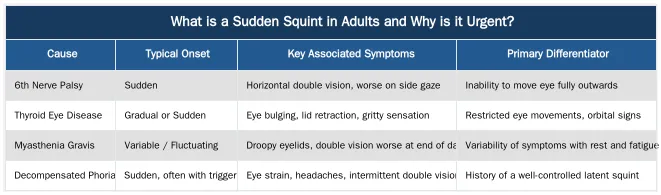
Three cranial nerves are responsible for eye movement: the oculomotor (3rd), trochlear (4th), and abducens (6th) nerves. A palsy (paralysis) of one of these nerves is a common cause of acute adult strabismus.
- Sixth Nerve Palsy: The most common cranial nerve palsy affecting eye movement. It impacts the lateral rectus muscle, which moves the eye outward. A palsy results in the eye turning inward (esotropia) and causes horizontal double vision, worse when looking towards the affected side.
- Fourth Nerve Palsy: Affects the superior oblique muscle, which helps with downward and rotational eye movements. It often causes vertical or tilted double vision, which patients may correct by tilting their head.
- Third Nerve Palsy: Often the most dramatic, as the third nerve controls four of the six eye muscles, the eyelid, and the pupil. A complete palsy can cause the eye to drift down and out, with a droopy eyelid (ptosis) and a dilated pupil.
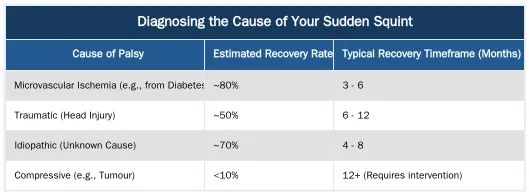
A frequent cause of these palsies in older adults with vascular risk factors like diabetes and hypertension is microvascular ischemia—a temporary disruption of blood flow to the nerve. While many resolve on their own, they require investigation to rule out serious causes like compression from an aneurysm. Learn more about surgical options for nerve palsy-related double vision.
Stroke, Head Injury, and Brain Tumours
Direct damage to the brain can cause a sudden squint. A stroke can damage the brainstem or cerebellum, areas critical for coordinating eye movements. A head injury can cause trauma to the cranial nerves or the brain. A growing brain tumour or other intracranial mass can compress cranial nerves or brain tissue, leading to a progressive or sudden onset of double vision and eye misalignment. The presence of other neurological symptoms, such as headache, weakness, or numbness, makes urgent neuro-imaging (CT or MRI scan) essential. See our information on squint after a stroke or brain injury.
Muscular and Other Factors Causing Adult-Onset Strabismus
Conditions that directly affect the eye muscles or the junction between nerves and muscles are also significant causes of adult-onset strabismus.
Thyroid Eye Disease and Myasthenia Gravis
Two autoimmune conditions can manifest with a sudden squint. Thyroid Eye Disease (TED), associated with an overactive or underactive thyroid gland, causes inflammation and swelling of the tissues and muscles around the eyes. This can lead to restricted eye movements, double vision, and a visible squint as the muscles become stiff and enlarged. Read more about how thyroid eye disease can cause double vision.
Myasthenia Gravis (MG) is a neuromuscular disorder that causes fluctuating weakness in the voluntary muscles. When it affects the eye muscles (ocular myasthenia), it can cause variable double vision and ptosis (droopy eyelids) that worsens with fatigue and improves with rest. The pattern of misalignment can change throughout the day, a key diagnostic clue.
Decompensated Phoria and Other Ocular Conditions
Many adults have a small, latent tendency for their eyes to misalign, known as a phoria. The brain’s fusional mechanisms work to keep the eyes straight. This system can break down due to fatigue, illness, stress, or age-related changes in the eye muscles. When this happens, the latent phoria becomes a manifest squint (a tropia), leading to the sudden onset of eye strain and double vision. This is known as decompensated phoria.
Diagnosing the Cause of Your Sudden Squint
Diagnosing an adult-onset strabismus requires a systematic investigation by a specialist. The process combines history-taking with a clinical examination and, when necessary, imaging and blood tests.
Comprehensive Ophthalmic and Neurological Assessment
The evaluation assesses the symptoms: when the squint started, whether the double vision is horizontal, vertical, or tilted, and if it varies during the day. The clinical examination includes:
- Visual Acuity and Refraction: Testing the vision in each eye.
- Orthoptic Assessment: Measuring the eye alignment in different positions of gaze using prisms to quantify the squint.
- Ocular Motility Testing: Observing the range of movement of each eye to identify muscle weakness or restriction.
- Neurological Checks: Assessing pupil responses, eyelid position, and facial sensation.
- Slit Lamp and Fundus Examination: A microscopic examination of the front and back of the eye.
Based on these findings, further tests may be ordered, such as an MRI or CT scan of the brain and orbits, or blood tests for thyroid dysfunction or myasthenia gravis antibodies.
Why Specialist Expertise is Paramount for Accurate Diagnosis
Differentiating between the causes of a sudden squint requires sub-specialist expertise. A consultant experienced in adult strabismus and neuro-ophthalmology can interpret subtle clinical signs that point towards a specific diagnosis. Distinguishing between a restrictive process like thyroid eye disease and a paralytic nerve palsy is fundamental to determining the correct management pathway.
Expert Insight: Mr. Nadeem Ali’s Approach to Sudden Squint
Investigating and managing a sudden squint in adults requires a specialist experienced in the connections between the eyes and the brain. Mr. Nadeem Ali’s practice is focused on this field.
Rapid Access and Precision Diagnosis for Complex Cases
The clinic prioritizes rapid access to specialist consultation. Mr. Ali’s background includes his tenure as the Lead for Adult Squint, Double Vision, and Neuro-Ophthalmology at Moorfields Eye Hospital and his fellowship at the National Hospital for Neurology and Neurosurgery. This experience allows for precise identification of the underlying cause, from a common microvascular nerve palsy to a more complex neurological or muscular condition.
Personalized Treatment Pathways
The management strategy is tailored to the patient and the diagnosis. The initial phase may involve observation, as conditions like microvascular nerve palsies often resolve spontaneously. During this time, symptoms can be managed with prisms or patching one eye. If the misalignment persists and stabilizes, surgical correction is an option. Mr. Ali uses techniques, including adjustable sutures, to achieve precise alignment, eliminate double vision, and restore a normal appearance. This approach is supported by institutions like the National Eye Institute.
Seeking Specialist Help for a Sudden Squint in Adults
If you experience the sudden onset of a squint or double vision, seek prompt medical advice. An initial assessment at an A&E or with a GP is important to rule out an emergency like a stroke. For a definitive diagnosis and a long-term management plan, a consultation with a specialist in adult strabismus and neuro-ophthalmology is necessary.
To arrange a consultation, contact us. You can also Enquire about squint surgery or learn about Squint Surgery in London.
Conclusion
A sudden squint in an adult is a medical sign that warrants urgent investigation. The causes are diverse, ranging from decompensated phoria to serious neurological events like strokes or cranial nerve palsies. An accurate diagnosis from a specialist is required to address any underlying condition and create a plan to manage the double vision and misalignment. With current diagnostic tools and surgical techniques, restoring single vision and normal eye alignment is an achievable goal for most patients.
If you are affected by these symptoms, see a specialist. Contact us to schedule a consultation. For more information, Enquire about squint surgery or see our services for Squint Surgery in London.
Frequently Asked Questions
What should I do if I experience a sudden squint in adults?
The acute onset of a squint, often with double vision, requires urgent medical evaluation as it can signify a serious underlying health issue. It is critical to see a medical professional promptly for an assessment. A specialist neuro-ophthalmologist can provide a definitive diagnosis and management plan.
What are the most common neurological causes of a sudden squint in adults?
The most frequent neurological causes for a sudden squint in adults are cranial nerve palsies, which control eye movements and can be affected by conditions like diabetes or high blood pressure. More serious causes that require immediate investigation include stroke, head trauma, or a brain tumour, highlighting the need for a thorough examination.
Can systemic health conditions cause a sudden squint in adults?
Yes, certain conditions that affect the entire body can directly lead to an acute eye misalignment. For example, Thyroid Eye Disease can cause inflammation and swelling of the eye muscles, while Myasthenia Gravis disrupts the nerve signals sent to the muscles, both of which are known causes of adult-onset strabismus.
Can a long-standing but controlled squint suddenly become noticeable?
This is known as a ‘decompensated phoria’. Many people have a very small, latent squint that their brain has successfully controlled for years. Factors like fatigue, illness, or the natural ageing process can weaken this control mechanism, causing the squint to become visible and symptomatic.
Why is a sudden squint in adults considered a medical concern?
A sudden squint in adults is a significant concern because it indicates a new, active problem within the brain, nerves, or eye muscles. Unlike a squint present since childhood, its acute onset points to a recent change in health that must be identified quickly to rule out serious conditions and begin appropriate treatment.
How is the cause of a new-onset squint diagnosed?
A specialist diagnosis involves a detailed medical history, a comprehensive eye movement examination, and often neuro-imaging like an MRI or CT scan to investigate the brain and eye sockets. Once the cause is determined, a tailored treatment plan can be created. To begin this process, you can enquire about a specialist consultation for a thorough assessment.
Related Posts

Find out if you are suitable for Double Vision Treatment
Find out if you could benefit from this life changing surgery by contacting us today
Our most popular procedures


Hello, I’m Nadeem Ali
I’m one of the few eye surgeons in the world with 100% focus on Squint and Double Vision Surgery.
I have 24 years of eye surgery experience, and worked for 13 years as a Consultant at London’s renowned Moorfields Eye Hospital.
In 2023, I left the NHS to focus fully on treating patients from across the world at the London Squint Clinic. You can read more about me here.
There’s lots of information on the website about: squint surgery, double vision surgery and our pricing.
The most rewarding part of my job is hearing patients tell me how squint or double vision surgery has changed their lives. You can hear these stories here.
Mr Nadeem Ali
MA MB BChir MRCOphth FRCSEd(Ophth)