
How Thyroid Eye Disease Leads to Surgical Double Vision
Why Choose Private Squint Surgery?
In the UK, squint surgery may be performed via the NHS, through insurance, or as self-pay. NHS treatment is free, but waiting times can be long and surgery is often performed by trainees under supervision. Many operations are carried out by surgeons who mainly specialise in children’s squint rather than adult complex cases.
With insurance, fees are standardised — meaning some leading specialists choose not to participate. Self-pay allows you to choose your surgeon directly and prioritise experience, specialisation, and access.
Many centres quote only a surgical fee. Hospital costs, anaesthetic fees and follow-ups are frequently additional. At London Squint Clinic, everything is included in one transparent package.
Our Complete Package – £10,000
- ✔ Advanced surgery by Mr Ali (one or both eyes)
- ✔ Adjustable sutures where clinically indicated
- ✔ Detailed orthoptic planning
- ✔ All hospital & anaesthetic fees included
- ✔ Post-operative medication
- ✔ Two video follow-ups
- ✔ Face-to-face review appointment
What Makes Us Different
- ✔ 100% focused on adult squint & double vision surgery
- ✔ >95% audited success rate
- ✔ Free re-treatment at 3 months if worse (extremely rare)
- ✔ 24/7 direct WhatsApp access to your surgeon during recovery
- ✔ Optional well-being session & pre-op reassurance call
Initial consultation: from £150
Surgery typically within 4 weeks. No referral required. Self-pay only.
Thyroid Eye Disease Double Vision: Path to Surgical Correction
This article explains how thyroid eye disease double vision develops when autoimmune inflammation causes eye muscle enlargement and stiffness. We detail the progression from an active inflammatory phase to a stable, inactive phase, a critical factor in timing surgical intervention. Understanding this process, known as restrictive myopathy, is essential for evaluating when strabismus surgery is the most effective solution to correct the misalignment. The goal is to realign the eyes and restore clear, comfortable single vision, addressing the diplopia often associated with Graves’ disease.
At London Squint Clinic, Mr Nadeem Ali provides specialist surgical treatment for adults with complex diplopia resulting from thyroid eye disease. The focus is on precise eye muscle surgery, often using adjustable sutures, to achieve optimal alignment and functional vision for patients.
To explore your options, contact us to schedule your consultation. You can also reach us via: Enquire about double vision surgery, Time to say goodbye to double vision
Thyroid eye disease double vision (diplopia) can disrupt daily life, making tasks like reading or driving challenging. This condition arises when the autoimmune processes of Thyroid Eye Disease (TED) affect the muscles controlling eye movement. This article explains the mechanism, disease progression, and when surgery is the most effective path to restoring clear, single vision, including the critical timing and specialist techniques required.
What is Thyroid Eye Disease (TED) and How Does it Cause Double Vision?
Thyroid Eye Disease (TED), or thyroid-associated ophthalmopathy, is an autoimmune disorder where the body’s immune system attacks the tissues behind and around the eyes. This inflammatory response causes the muscles that move the eyes and the fatty tissue behind them to swell. This enlargement restricts the muscles’ ability to move freely and in coordination, leading to misalignment and double vision (diplopia).
The brain requires both eyes to point at the same target to fuse two images into a single, three-dimensional view. When TED causes one or more eye muscles to become stiff and enlarged, they can no longer coordinate with the muscles of the other eye. This misalignment sends two different images to the brain, which it cannot merge, resulting in the perception of two images.
The Autoimmune Link: Graves’ Disease and Ophthalmopathy
TED is most commonly associated with Graves’ disease, an autoimmune condition that causes hyperthyroidism (an overactive thyroid gland). The same antibodies that attack the thyroid gland can also target proteins in the eye muscles and orbital fat that appear similar to thyroid tissue. While most individuals with TED have Graves’ disease, the eye condition can also occur in people with normal or underactive thyroid function. Management of the underlying thyroid imbalance by an endocrinologist is a crucial part of the care plan, though it does not always halt the progression of the eye-related symptoms.
The Progression of Eye Muscle Changes in TED
Double vision in Thyroid Eye Disease results from physical changes to the structures within the eye socket (orbit). These changes occur in two phases: an active, inflammatory phase followed by a stable, inactive phase.
From Inflammation to Restrictive Myopathy
During the active phase, inflammation causes eye muscle enlargement. The muscles swell with water and inflammatory cells, making them tight and less flexible. As the inflammation subsides and the disease enters the inactive phase, this swelling can be replaced by scar tissue (fibrosis). This process leads to a condition known as restrictive myopathy. Unlike other forms of strabismus where muscles may be weak, in TED the muscles become stiff and inelastic. They cannot relax or stretch properly, which physically tethers the eye and restricts its range of motion, causing a constant misalignment.
Understanding Proptosis and its Impact on Eye Alignment
A hallmark sign of TED is proptosis, or the bulging of one or both eyes. This occurs because the swelling of the eye muscles and orbital fat pushes the eyeball forward. Severe proptosis can stretch the optic nerve and, in some cases, prevent the eyelids from closing completely, leading to corneal exposure and dryness. It can also exacerbate eye misalignment, contributing to double vision by altering the mechanics of how the stiffened muscles move the globe within the orbit. The degree of proptosis is an important factor in surgical planning.
When is Surgery Recommended for Diplopia from Thyroid Eye Disease?
The timing for surgical intervention is a critical factor for a successful outcome in treating diplopia from TED. The approach is patient-specific, focusing on stability and the failure of less invasive measures. Understanding the causes of adult diplopia that warrant surgery is a key first step.
The Importance of the ‘Stable Phase’ for Surgical Success
Eye muscle surgery is deferred until TED has entered its inactive, or ‘stable’, phase. This is defined as a period of at least six months during which eye measurements—including the degree of misalignment and proptosis—have not changed. Operating during the active inflammatory phase is unpredictable; ongoing swelling and scarring mean that an alignment achieved in surgery could change weeks or months later. Waiting for stability ensures the surgical correction is performed on a predictable foundation, increasing the likelihood of a lasting result.
When Prism Glasses Are No Longer Sufficient
Before surgery, double vision is often managed with prism glasses. Prisms are lenses that bend light to help realign the two images, allowing the brain to fuse them into one. They can be effective for small, stable misalignments. In TED, the degree of misalignment is often large and complex, changing depending on the direction of gaze. Prisms may become too strong, heavy, and visually distorting to be practical. When prisms fail to provide clear, comfortable single vision or are no longer tolerated, surgery is the definitive solution for restoring binocular vision.
Surgical Approaches to Correct Double Vision from TED
Correcting diplopia from TED requires specialised surgical techniques for the challenges of restrictive myopathy. The goal is not to strengthen weak muscles but to release and reposition stiff, tight muscles to align the eyes. This form of strabismus surgery demands extensive experience.
Strabismus Surgery for Eye Muscle Realignment
The primary procedure is strabismus surgery. During this operation, the surgeon detaches one or more of the tight extraocular muscles from the eyeball and reattaches them at a new position further back. This lengthens the muscle’s effective action, allowing the eye to return to a more central position. Because TED often involves scarring, the surgery can be more complex than standard strabismus procedures. For precision, adjustable sutures may be used. This technique allows for fine-tuning of the eye’s alignment in the hours after surgery, once the patient is awake and able to cooperate, which is valuable in complex cases like TED.
Considering Orbital Decompression in Complex Cases
In cases with severe proptosis that threatens vision or causes significant cosmetic and functional issues, a procedure called orbital decompression may be performed first. This surgery involves removing small pieces of bone from the eye socket to create more space, allowing the eye to settle back into a more normal position. It is typically performed by an oculoplastic surgeon before strabismus surgery, as it can alter the eye’s alignment. According to the American Academy of Ophthalmology, a multi-stage surgical approach is often necessary for comprehensive rehabilitation.

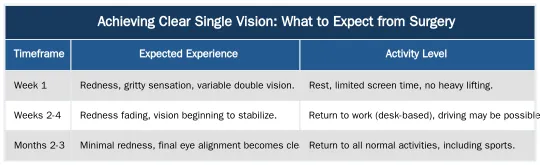
Achieving Clear Single Vision: What to Expect from Surgery
Patients can expect a structured recovery process and a high probability of a successful outcome. Our clinic has a 95% audited alignment success rate from a single operation.
The Recovery Journey and Post-Operative Care
After surgery, the eye will be red and feel gritty for a few weeks. Double vision may feel different, or temporarily worse, as the brain adapts to the new eye position. Medicated eye drops are prescribed to prevent infection and reduce inflammation. Most patients can return to non-strenuous activities within a week, but full healing and stabilisation of the eye position can take several months. Regular follow-up appointments are essential to monitor progress.
Life-Changing Outcomes: Restoring Independence and Confidence
The goal of surgery is to eliminate double vision in the primary (straight-ahead) and reading positions, which are critical for daily function. Success means being able to drive, read, work on a computer, and interact socially without diplopia. Restoring single vision improves physical function and boosts confidence and independence.
Why Choose a Specialist for Your Thyroid Eye Disease Surgery?
Surgical management of thyroid eye disease double vision is a complex area of ophthalmology. The restrictive myopathy and orbital scarring present challenges that differ from more common types of strabismus. Success depends on a surgeon’s understanding of these pathological changes and extensive experience managing them.
Mr. Nadeem Ali: A World Expert in Adult Squint and Double Vision
With a career at Moorfields Eye Hospital and a practice now 100% focused on adult squint and diplopia, Mr. Nadeem Ali has the specialist expertise for these cases. His experience in complex and revision surgeries ensures patients receive care based on an understanding of their condition. Enquire about double vision surgery to learn more about your options. It may be Time to say goodbye to double vision.
Conclusion
Thyroid Eye Disease causes persistent, disabling double vision from inflammation and stiffening of the eye muscles. While prisms offer temporary relief, strabismus surgery during the stable phase of the disease provides a lasting solution. Success depends on precise timing and the skill of a specialist surgeon experienced in TED. By realigning the eyes, surgery can restore clear, single vision, improving a person’s ability to perform daily tasks and enhancing their quality of life. If you struggle with diplopia from TED, a specialist consultation is the first step toward recovery. Please contact us to schedule a consultation. Enquire about double vision surgery today. It may be your Time to say goodbye to double vision.
Frequently Asked Questions
What is the mechanism behind thyroid eye disease double vision?
In Thyroid Eye Disease (TED), the body’s immune system attacks the tissues surrounding the eyes, causing the eye muscles to swell and stiffen. This inflammation restricts their normal movement, preventing the eyes from aligning on a single target. This misalignment is the direct cause of thyroid eye disease double vision (diplopia).
When is surgery the right choice for thyroid eye disease double vision?
Surgery is recommended once the disease enters its inactive or ‘burnt-out’ phase, meaning the inflammation has resolved and the eye misalignment has been stable for at least six months. This timing is crucial for a predictable and lasting surgical outcome. For persistent diplopia, surgery is the definitive treatment to correct thyroid eye disease double vision.
What type of surgery corrects double vision from TED?
The procedure used is strabismus (squint) surgery, which is performed to release the tight, restricted muscles and reposition them to realign the eyes. This is a highly specialised operation that requires a surgeon with extensive experience in the complexities of TED. The goal is to restore single, comfortable vision in key positions of gaze.
Can prism glasses fix double vision from thyroid eye disease?
Prisms can be a useful temporary solution to manage diplopia during the active inflammatory phase of the disease or for very small, stable misalignments. However, for the large and complex eye deviations common in TED, prisms are often too strong or impractical. Surgery provides a more permanent and effective correction.
Is other surgery needed before correcting thyroid eye disease double vision?
In cases with severe eye bulging (proptosis) or pressure on the optic nerve, orbital decompression surgery may be required first to create more space in the eye socket. Corrective squint surgery to address the thyroid eye disease double vision is typically performed as a separate, subsequent stage once the eye position is stable.
How can I get an expert assessment for my double vision?
If you are struggling with double vision from TED or another condition, the first step is a specialist consultation. Mr. Nadeem Ali offers expert assessments to determine the best course of treatment for your specific situation. You can enquire about a consultation to start your journey towards clear, single vision.
Related Posts

Find out if you are suitable for Double Vision Treatment
Find out if you could benefit from this life changing surgery by contacting us today
Our most popular procedures



Hello, I’m Nadeem Ali
I’m one of the few eye surgeons in the world with 100% focus on Squint and Double Vision Surgery.
I have 24 years of eye surgery experience, and worked for 13 years as a Consultant at London’s renowned Moorfields Eye Hospital.
In 2023, I left the NHS to focus fully on treating patients from across the world at the London Squint Clinic. You can read more about me here.
There’s lots of information on the website about: squint surgery, double vision surgery and our pricing.
The most rewarding part of my job is hearing patients tell me how squint or double vision surgery has changed their lives. You can hear these stories here.
Mr Nadeem Ali
MA MB BChir MRCOphth FRCSEd(Ophth)