
What Happens if a Re-Operation Is Needed After Squint Surgery?
Why Choose Private Squint Surgery?
In the UK, squint surgery may be performed through the NHS, through insurance or as self-pay. NHS treatment is free, but waiting times can be long.
Self-pay allows you to choose your surgeon directly and prioritise experience, specialisation and access.
London Squint Clinic offers two fixed-price surgical packages. Our pricing page lists exactly what each one includes.
Our Packages: Complete Care £9,750 · Signature Care £12,000
- ✔ Surgery by Mr Ali, one or both eyes as clinically required
- ✔ Adjustable sutures when clinically indicated
- ✔ Detailed pre-operative measurements & surgical planning
- ✔ Anaesthetist fees
- ✔ Post-operative eye drops
- ✔ 2 scheduled video follow-ups
- ✔ Face-to-face review if clinically required
Signature Care Also Includes
- ✔ Direct 24/7 WhatsApp access to Mr Ali during recovery
- ✔ Pre-op reassurance call with anaesthetist if desired
- ✔ Additional face-to-face review if desired
- ✔ Ongoing eye advice from Mr Ali after discharge
Initial consultation: £150 (video or in person)
Surgery can usually be offered within 4 weeks. No referral required. Self-pay only.
What Happens if a Re-Operation Is Needed After Squint Surgery?
Most adults who have squint or double vision surgery need only one operation, but a minority need a further procedure, because the eyes have been under- or over-corrected or because the alignment changes as healing settles. This article explains why a second operation is sometimes needed, how the result of the first operation is reviewed, how revision surgery differs from a first operation and what to ask about at your consultation.
Led by Mr Nadeem Ali, a former Moorfields Eye Hospital consultant, the London Squint Clinic focuses exclusively on adult squint and double vision surgery.
To explore your options, contact us to schedule your consultation. You can also reach us via: Book your assessment
How Common Is a Second Operation?
Most patients need only one operation, but a minority need a further procedure, and it is sensible to understand this before surgery rather than after it. Your own likelihood of needing further treatment is discussed at consultation.
Adjustable sutures, used when clinically indicated, allow the alignment to be fine-tuned shortly after the operation, which can reduce the need for a further procedure in suitable patients.
Why a Further Operation Is Sometimes Needed
Eye muscle surgery is a precise procedure involving complex biological systems. Each individual’s muscles and tissues heal differently. While most surgeries achieve the desired outcome, a small possibility of an undercorrection (not enough change) or an overcorrection (too much change) exists.
These variations are usually not errors; they reflect differences in how muscles and tissues heal. Some conditions, such as thyroid eye disease or a nerve palsy that is still changing, can also alter the alignment after surgery.
Understanding Surgical Outcomes and Patient Expectations
The main fear for many patients with double vision (diplopia) is that surgery could make their symptoms worse. This is uncommon, but it is discussed as part of consent, together with the chance that a further operation may be needed and how that would be planned.
How the Result Is Reviewed
The eyes take time to settle after surgery. Both of the clinic’s surgical packages include two scheduled video follow-ups, typically around two weeks and two months after the operation, with a face-to-face review if clinically required (see our costs page).
If the Alignment Is Not as Planned
If the alignment has not settled where planned, Mr Ali repeats the measurements taken before surgery and discusses the options with you. Depending on the size of the remaining deviation and your symptoms, these can include waiting for the alignment to settle further, prism glasses or a further operation. Re-operation terms, if any, are confirmed in writing at consultation.
Navigating Revision Squint Surgery: What to Expect
A second operation, or revision squint surgery, adjusts the outcome of a previous operation. It fine-tunes the eye’s alignment based on the initial surgery’s results.
The Revision Surgical Process and Recovery
The surgical technique for a revision is similar to the primary surgery, repositioning one or more eye muscles. The surgeon must navigate scar tissue from the first operation, requiring significant skill and experience. The goal is a precise adjustment to correct the over- or under-response. Recovery is similar to the first surgery, with a comparable timeline for returning to normal activities. Post-operative care follows the same pattern as after the first operation; what your package includes (for example, direct WhatsApp access to Mr Ali on the Signature Care package) is listed on our costs page.
Patients who have had unsuccessful operations elsewhere can learn about revision options at London Squint Clinic.
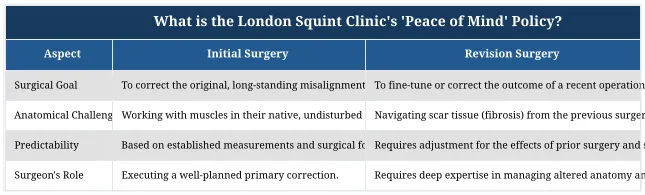
View data as table
| Aspect | Initial Surgery | Revision Surgery |
|---|---|---|
| Surgical Goal | To correct the original, long-standing misalignment. | To fine-tune or correct the outcome of a recent operation. |
| Anatomical Challenge | Working with muscles in their native, undisturbed state. | Navigating scar tissue (fibrosis) from the previous surgery. |
| Predictability | Based on established measurements and surgical formulas. | Requires adjustment for the effects of prior surgery and scarring. |
| Surgeon’s Role | Executing a well-planned primary correction. | Requires deep expertise in managing altered anatomy and tissue response. |
Potential Considerations for a Second Procedure
The presence of scar tissue can make the muscle’s response to revision surgery less predictable than in a primary operation. Choosing a surgeon with extensive experience in revision cases is paramount. Their judgment in approaching scarred or previously operated muscles is key to a successful adjustment.
| Consideration | Description |
|---|---|
| Realistic Expectations | The goal is typically significant improvement or correction, discussed in detail with your surgeon. |
| Healing Time | The recovery period is generally similar to the first surgery, though individual experiences can vary. |
| Surgeon Selection | Expertise in revision surgery is critical due to the increased complexity from scar tissue and altered anatomy. |
| Psychological Aspect | It’s important to approach a second surgery with a positive but realistic mindset, supported by your surgical team. |
Mr Nadeem Ali’s Experience With Revision Cases
Revision surgery relies on judgement about how previously operated muscles and scar tissue will respond. Mr Nadeem Ali’s practice is dedicated to adult strabismus and diplopia, a distinct sub-specialty within ophthalmology.
This focus is crucial for complex or revision cases. As a Consultant at Moorfields Eye Hospital from 2010 to 2023, and Lead for Adult Squint, Double Vision, and Neuro-Ophthalmology at Moorfields South, Mr Ali managed a high volume of challenging cases from the UK and internationally.
A Specialist’s Approach to Complex Cases
Mr Ali’s expertise includes the diagnostic process preceding surgery and the nuanced judgment required to handle tissues altered by previous operations. His background includes advanced training with pioneers in the field and a deep understanding of neuro-ophthalmology, which informs how revision cases are assessed and planned. He is a Member of the Royal College of Ophthalmologists (MRCOphth) and a Fellow of the Royal College of Surgeons of Edinburgh (FRCSEd(Ophth)).
Next Steps
If you are considering surgery, or have had an operation elsewhere that has not achieved the result you hoped for, a consultation is the place to discuss what further surgery would involve and what it would cost in your case.
If you are ready to explore your options, contact us or book your assessment.
Frequently Asked Questions
How common is a second operation after adult squint surgery?
Most patients need only one operation; a minority need further treatment, such as prism glasses or a second operation. Your own likelihood is discussed at consultation.
When is the result of squint surgery assessed?
The alignment is reviewed at the scheduled follow-ups, typically around two weeks and two months after surgery, with a face-to-face review if clinically required. The eyes can continue to settle for some weeks, so a decision about further surgery is not usually made straight away.
Is revision squint surgery more difficult than the first operation?
It can be. The surgeon has to work with scar tissue from the first operation, which can make the muscle’s response less predictable, so experience with revision cases matters. Recovery is usually similar to the first operation.
Who pays if a further operation is needed?
Re-operation terms, if any, are confirmed in writing at consultation. What each surgical package includes is set out on our costs page.
How does Mr Ali’s surgical approach aim to reduce the need for a re-operation?
Mr Ali uses adjustable sutures when clinically indicated, which allow the alignment to be fine-tuned shortly after the operation. Careful pre-operative measurement and surgical planning also aim to achieve the planned alignment from the first operation.
Can revision surgery help if my first operation was elsewhere?
It may. Mr Ali sees patients whose previous surgery elsewhere did not achieve the result they hoped for, and the options for your situation are discussed at consultation. More detail is in our guide to revision options at London Squint Clinic.
Related Posts
Find out if you are suitable for Double Vision Treatment
Find out if you could benefit from this life changing surgery by contacting us today
Our most popular procedures


Hello, I’m Nadeem Ali
I’m one of the few eye surgeons in the world with 100% focus on Squint and Double Vision Surgery.
I have 24 years of eye surgery experience, and worked for 13 years as a Consultant at London’s renowned Moorfields Eye Hospital.
In 2023, I left the NHS to focus fully on treating patients from across the world at the London Squint Clinic. You can read more about me here.
There’s lots of information on the website about: squint surgery, double vision surgery and our pricing.
The most rewarding part of my job is hearing patients tell me how squint or double vision surgery has changed their lives. You can hear these stories here.
Mr Nadeem Ali
MA MB BChir MRCOphth FRCSEd(Ophth)