
When Can You Return to Driving, Work, and Exercise After Double Vision Surgery?
Why Choose Private Squint Surgery?
In the UK, squint surgery may be performed via the NHS, through insurance, or as self-pay. NHS treatment is free, but waiting times can be long and surgery is often performed by trainees under supervision. Many operations are carried out by surgeons who mainly specialise in children’s squint rather than adult complex cases.
With insurance, fees are standardised — meaning some leading specialists choose not to participate. Self-pay allows you to choose your surgeon directly and prioritise experience, specialisation, and access.
Many centres quote only a surgical fee. Hospital costs, anaesthetic fees and follow-ups are frequently additional. At London Squint Clinic, everything is included in one transparent package.
Our Complete Package – £10,000
- ✔ Advanced surgery by Mr Ali (one or both eyes)
- ✔ Adjustable sutures where clinically indicated
- ✔ Detailed orthoptic planning
- ✔ All hospital & anaesthetic fees included
- ✔ Post-operative medication
- ✔ Two video follow-ups
- ✔ Face-to-face review appointment
What Makes Us Different
- ✔ 100% focused on adult squint & double vision surgery
- ✔ >95% audited success rate
- ✔ Free re-treatment at 3 months if worse (extremely rare)
- ✔ 24/7 direct WhatsApp access to your surgeon during recovery
- ✔ Optional well-being session & pre-op reassurance call
Initial consultation: from £150
Surgery typically within 4 weeks. No referral required. Self-pay only.
Driving After Double Vision Surgery: a Safe Return
The timeline for driving after double vision surgery depends entirely on achieving stable, single vision, not a fixed number of weeks. This guide outlines key recovery milestones for safely returning to driving, work, and exercise. While visual recovery is unique to each patient, many can resume driving within one to two weeks, provided they meet DVLA eyesight standards and receive their surgeon’s clearance. Understanding activity restrictions for both office work and physical activity is crucial for a smooth healing process. A safe return to driving after double vision surgery requires complete confidence in your depth perception.
At London Squint Clinic, Mr Nadeem Ali focuses exclusively on adult squint and double vision surgery. The guidance provided is based on extensive experience managing post-operative recovery to help patients safely regain their independence and restore their quality of life through clear, single vision.
To explore your options, contact us to schedule your consultation. You can also reach us via: Enquire about double vision surgery, Time to say goodbye to double vision
When Can You Safely Return to Driving After Double Vision Surgery?
You can resume driving with consistent, comfortable single vision and confidence in your spatial awareness and depth perception, often within one to two weeks. Do not drive if you have any double vision; it is unsafe and illegal.
Returning to the road depends on functional visual recovery, not a fixed timeline. You must be able to read a standard number plate from 20 metres and have vision stable enough for all driving conditions. Your surgeon provides final clearance at a follow-up appointment after assessing your eye alignment and visual function.
DVLA Guidelines and Your Responsibilities
In the UK, the Driver and Vehicle Licensing Agency (DVLA) has eyesight rules for driving. If you have diplopia, you must stop driving and inform the DVLA. You can resume driving only when your double vision is corrected and you meet minimum eyesight standards.
Ensure your vision is safe for driving. If double vision persists or you are unsure, do not drive and consult your surgeon and the DVLA. Refer to the official DVLA guidelines on eyesight and driving.
Returning to Work and Daily Activities Post-Surgery
Returning to work depends on your job and recovery pace. Avoid activities that could strain your eyes or risk infection or injury during initial healing.
Many people in sedentary jobs return within one to two weeks. Physically demanding jobs, those requiring heavy machinery operation, or exposure to dusty environments require a longer absence, often four to six weeks. Discuss your job requirements with your surgeon to establish a safe timeline.
Managing Screen Time and Office Work
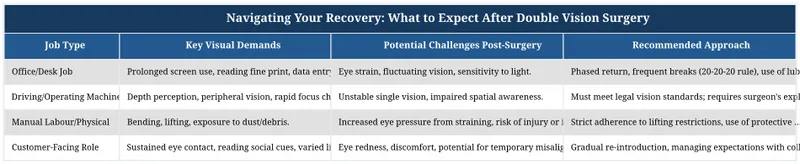
For office-based roles, managing visual tasks is part of recovery. In the first week, limit screen time and reading to rest your eyes. Your eyes may tire more easily when you return to work.
To minimise eye strain, take breaks using the 20-20-20 rule: every 20 minutes, look at something 20 feet away for 20 seconds. Position your screen to avoid glare and use prescribed lubricating eye drops for comfort. Read our guide on managing double vision at work.
View data as table
| Job Type | Key Visual Demands | Potential Challenges Post-Surgery | Recommended Approach |
|---|---|---|---|
| Office/Desk Job | Prolonged screen use, reading fine print, data entry. | Eye strain, fluctuating vision, sensitivity to light. | Phased return, frequent breaks (20-20-20 rule), use of lubricating drops. |
| Driving/Operating Machinery | Depth perception, peripheral vision, rapid focus changes. | Unstable single vision, impaired spatial awareness. | Must meet legal vision standards; requires surgeon’s explicit clearance. |
| Manual Labour/Physical | Bending, lifting, exposure to dust/debris. | Increased eye pressure from straining, risk of injury or infection. | Strict adherence to lifting restrictions, use of protective eyewear. |
| Customer-Facing Role | Sustained eye contact, reading social cues, varied lighting. | Eye redness, discomfort, potential for temporary misalignment. | Gradual re-introduction, managing expectations with colleagues if needed. |
Resuming Exercise and Physical Activity After Diplopia Surgery
Gradually reintroduce physical activity, guided by your comfort and surgeon’s advice. Avoid any activity that increases head and eye pressure or risks eye trauma.
Light activities like walking can start within a few days. Avoid strenuous exercise, heavy lifting, and bending for several weeks. Avoid swimming until the eye is healed to prevent infection from waterborne bacteria.
Activity Progression: A General Timeline
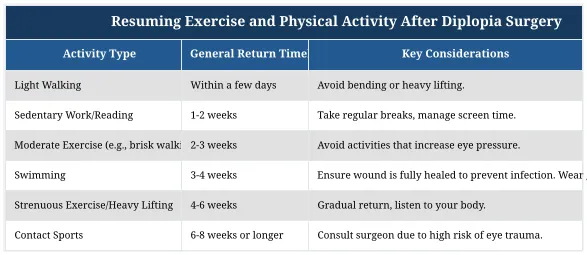
Your surgeon will provide personalised instructions. This table is a general guide for resuming physical activity. Listen to your body and stop if you feel pain, strain, or eye discomfort.
View data as table
| Activity Type | General Return Timeline | Key Considerations |
|---|---|---|
| Light Walking | Within a few days | Avoid bending or heavy lifting. |
| Sedentary Work/Reading | 1-2 weeks | Take regular breaks, manage screen time. |
| Moderate Exercise (e.g., brisk walking) | 2-3 weeks | Avoid activities that increase eye pressure. |
| Swimming | 3-4 weeks | Ensure wound is fully healed to prevent infection. Wear goggles. |
| Strenuous Exercise/Heavy Lifting | 4-6 weeks | Gradual return, listen to your body. |
| Contact Sports | 6-8 weeks or longer | Consult surgeon due to high risk of eye trauma. |
Expert Guidance & Personalised Care from Mr Nadeem Ali
The post-operative period requires expert guidance tailored to your situation. Mr Nadeem Ali, a specialist with over two decades of experience including as a Consultant at Moorfields Eye Hospital, provides personalised care plans.
Your recovery timeline for activities like driving after double vision surgery is a clinical judgement based on your healing progress. Follow-up appointments are for monitoring eye alignment, assessing visual function, and providing clearances to resume normal activities.
Why Specialist Consultation is Paramount for Safe Recovery
A successful return to daily life depends on quality post-operative care and surgeon’s advice. A specialist surgeon understands visual recovery and can distinguish normal healing from complications. At the London Squint Clinic, patients have direct access to Mr Ali for any recovery concerns.
This specialist care aligns with standards from bodies like The Royal College of Ophthalmologists, which emphasize patient safety and evidence-based practice. For more on what to expect, explore our day-by-day recovery guide.
Your Journey to Single Vision: Recovery & Support
Following all post-operative instructions—from administering eye drops to adhering to activity restrictions—is your contribution to the healing process. These measures protect your eyes, minimise complications, and support the best visual outcome.
While major restrictions are lifted within weeks, vision and comfort can improve for months. Patience and consistent communication with your clinic are key.
Understanding Your Diplopia Surgery Recovery Timeline
Recovery progresses through distinct phases, from initial healing in the first week to gradual vision stabilisation over the following months. Each phase has different guidelines and expectations.
For a breakdown of each stage, including symptoms and milestones, review our Diplopia Surgery Recovery Timeline. This resource provides information to navigate your recovery.
Ready to Regain Your Independence? Explore Double Vision Surgery
Double vision can limit your freedom and quality of life. Surgery can restore the single vision needed for driving, working, and hobbies.
At the London Squint Clinic, Mr Nadeem Ali provides specialist assessment and surgery for adults with squint and double vision.
Conclusion
Resuming activities after diplopia surgery depends on achieving stable, comfortable single vision. While general timelines are a guide, your recovery pace and surgeon’s clinical assessment are the determinants. Prioritising a safe recovery ensures the procedure’s success. Follow your post-operative plan and attend all follow-up appointments.
To begin, contact us. Time to say goodbye to double vision. You can also Enquire about double vision surgery to schedule a consultation.
Frequently Asked Questions
When is it generally safe to resume driving after double vision surgery?
You can typically resume driving after double vision surgery when you achieve comfortable, stable single vision and can confidently meet the legal eyesight standards. For many patients, this occurs within 1-2 weeks, but it is crucial to refrain from driving as long as any double vision persists.
What specific visual criteria must I meet before getting back behind the wheel?
Before driving, you must be able to read a standard number plate from a distance of 20 metres in good daylight, with or without corrective lenses if normally worn. Additionally, you need a visual acuity of at least 6/12 (decimal 0.5) on the Snellen scale with both eyes open, and an adequate field of vision, as mandated by the DVLA.
How long should I plan to take off from work after my double vision operation?
The time needed off work varies by profession. For desk-based roles, many patients return within one week, though frequent breaks may be necessary. Individuals in physically demanding jobs or those requiring perfect vision, such as operating heavy machinery, may require two or more weeks off for full recovery.
What types of exercise should I avoid in the initial weeks following diplopia surgery?
Light activities like walking can be resumed within a few days of surgery. However, you should avoid strenuous exercises, heavy lifting, and swimming for at least two weeks to prevent undue strain on the healing eye muscles and to minimise the risk of infection. Mr. Ali will provide personalised guidance based on your individual healing progress.
Do I need to inform the DVLA about my improved vision after double vision surgery?
If you previously notified the DVLA about diplopia affecting your driving, you are required to inform them once your vision is corrected and meets the legal driving standard. The London Squint Clinic can provide a supporting letter to confirm your improved visual status for this purpose.
Are there any long-term restrictions on activities once fully recovered from eye alignment surgery?
No, once you have fully recovered from the double vision surgery, there are typically no long-term restrictions on your activities. The primary goal of the operation is to restore your ability to live a full and active life without limitations imposed by your vision.
Related Posts

Find out if you are suitable for Double Vision Treatment
Find out if you could benefit from this life changing surgery by contacting us today
Our most popular procedures



Hello, I’m Nadeem Ali
I’m one of the few eye surgeons in the world with 100% focus on Squint and Double Vision Surgery.
I have 24 years of eye surgery experience, and worked for 13 years as a Consultant at London’s renowned Moorfields Eye Hospital.
In 2023, I left the NHS to focus fully on treating patients from across the world at the London Squint Clinic. You can read more about me here.
There’s lots of information on the website about: squint surgery, double vision surgery and our pricing.
The most rewarding part of my job is hearing patients tell me how squint or double vision surgery has changed their lives. You can hear these stories here.
Mr Nadeem Ali
MA MB BChir MRCOphth FRCSEd(Ophth)