
Psychological Impact of Living with a Lifelong Squint: Adult Perspectives
Why Choose Private Squint Surgery?
In the UK, squint surgery may be performed via the NHS, through insurance, or as self-pay. NHS treatment is free, but waiting times can be long and surgery is often performed by trainees under supervision. Many operations are carried out by surgeons who mainly specialise in children’s squint rather than adult complex cases.
With insurance, fees are standardised — meaning some leading specialists choose not to participate. Self-pay allows you to choose your surgeon directly and prioritise experience, specialisation, and access.
Many centres quote only a surgical fee. Hospital costs, anaesthetic fees and follow-ups are frequently additional. At London Squint Clinic, everything is included in one transparent package.
Our Complete Package – £10,000
- ✔ Advanced surgery by Mr Ali (one or both eyes)
- ✔ Adjustable sutures where clinically indicated
- ✔ Detailed orthoptic planning
- ✔ All hospital & anaesthetic fees included
- ✔ Post-operative medication
- ✔ Two video follow-ups
- ✔ Face-to-face review appointment
What Makes Us Different
- ✔ 100% focused on adult squint & double vision surgery
- ✔ >95% audited success rate
- ✔ Free re-treatment at 3 months if worse (extremely rare)
- ✔ 24/7 direct WhatsApp access to your surgeon during recovery
- ✔ Optional well-being session & pre-op reassurance call
Initial consultation: from £150
Surgery typically within 4 weeks. No referral required. Self-pay only.
Psychological Impact of Squint: Reclaiming Confidence
The psychological impact of squint in adults frequently involves significant social anxiety, diminished self-esteem, and challenges with maintaining eye contact. This article examines the emotional burden of living with strabismus, addressing how the condition affects self-perception, personal relationships, and professional life. Understanding the true psychological impact of squint is the first step toward exploring effective treatments like adult strabismus surgery. Corrective procedures can offer a profound improvement in quality of life by aligning the eyes and restoring personal confidence for the individual.
As a specialist clinic focused exclusively on adult squint and double vision surgery, London Squint Clinic addresses these complex issues. Led by consultant surgeon Mr Nadeem Ali, our approach considers both the functional and emotional aspects of eye misalignment to achieve positive outcomes for patients.
To explore your options, contact us to schedule your consultation. You can also reach us via: Enquire about squint surgery, Squint Surgery in London
The psychological impact of squint extends beyond vision, shaping an adult’s emotional landscape, self-perception, and social interactions. For many with strabismus since childhood, the condition creates persistent anxiety and self-consciousness that affects personal relationships, career opportunities, and quality of life.
What is the Psychological Impact of Living with a Lifelong Squint?
Living with a lifelong squint causes psychological distress, including low self-esteem, social anxiety, and a lack of confidence. These feelings stem from awareness of a visible physical difference and judgment from others, shaping an individual’s personality and behaviour over time.
The Invisible Burden: More Than Just Aesthetics
The visible misalignment of the eyes is often misperceived as a cosmetic issue. For the individual, it is an invisible burden impacting mental well-being. The emotional effects of adult strabismus create a cycle of negative self-perception and social avoidance. This internal struggle is a valid health concern affecting all aspects of a person’s life.
Many adults feel their concerns are dismissed, especially if their vision is functionally good. The desire for normal eye alignment is connected to the need for social acceptance and self-confidence. A common misconception is that a childhood squint cannot be corrected in adulthood. Understanding how to correct a childhood squint in adulthood can alleviate this psychological weight.
Beyond Aesthetics: Unpacking the Emotional Burden of Adult Strabismus
The emotional toll of strabismus is complex. It can evolve beyond shyness into significant mental health challenges. The condition can become a central part of an individual’s identity, which they feel powerless to change without specialist help.
Navigating Social Anxiety and Self-Consciousness
Strabismus social anxiety is well-documented. It stems from fear of negative evaluation in social interactions. Individuals may worry about where the other person is looking or feel their squint is the sole focus of attention. This can lead to avoiding social gatherings, public speaking, or one-on-one conversations.
This anxiety is linked to self-esteem and eye contact. Inability to hold conventional eye contact can be misinterpreted as disinterest, dishonesty, or a lack of confidence, reinforcing a negative self-image. This creates a feedback loop: anxiety leads to avoidance, which lowers self-esteem.
The Link Between Squint, Body Image, and Mental Health
For some, intense focus on their eye alignment develops into symptoms resembling body dysmorphia. This involves a distressing preoccupation with a perceived flaw. Because eyes are a focal point of communication, a visible misalignment can lead to a distorted body image.
The cumulative stress of social anxiety, low self-esteem, and negative body image can contribute to serious mental health conditions. Research from the American Association for Pediatric Ophthalmology and Strabismus (AAPOS) shows an increased prevalence of anxiety and depression in adults with strabismus. Addressing strabismus-related depression is a critical part of care.
How Does a Squint Affect Daily Interactions and Opportunities?
The psychological impact of squint has real-world consequences that limit personal and professional growth. Navigating social engagement, particularly eye contact, becomes a source of stress.
The Challenge of Eye Contact and Communication
Eye contact is fundamental to non-verbal communication, conveying trust and engagement. For a person with a squint, this act is complex. They may be unsure which eye to use to fixate or worry that the other person is confused about where they are looking. This uncertainty often leads to avoiding eye contact.
This avoidance can be detrimental in many settings. In a job interview, it can be perceived as a lack of confidence. In a personal relationship, it can be misinterpreted as emotional distance. These confidence issues are a coping mechanism, not a reflection of character.
Impact on Career, Relationships, and Social Life
These communication challenges impact quality of life. Professionally, adults with strabismus may avoid roles requiring public speaking or client interaction, limiting career progression. Socially, self-consciousness can make it difficult to initiate conversations, form friendships, or date.
Quality of life with strabismus is diminished by social friction and the energy spent managing anxiety. Many feel isolated or misunderstood, believing their personality is hidden by their condition. This leads to a pattern of missed opportunities and emotional strain, as explored in how adult strabismus affects daily life.
Expert Insights: Addressing the Mental Health Aspects of Squint Correction
The psychological distress caused by strabismus is a primary indication for treatment. Restoring eye alignment is linked to restoring emotional well-being and improving a patient’s health.
Is Improving Confidence a Valid Medical Reason for Squint Surgery?
Yes. The medical community recognizes the psychosocial disability associated with adult strabismus. Studies in journals like the British Journal of Ophthalmology quantify the negative impact on quality of life. Surgery to alleviate this burden is considered reconstructive, not cosmetic.
A confidence boost is a predictable outcome of successful strabismus surgery. The goal of surgery is to improve ocular alignment and function, and to relieve the patient’s psychological weight. Improving confidence is a valid medical reason for intervention.
The Specialist Approach to Adult Squint and Emotional Well-being
A specialist clinic for adult strabismus, like the London Squint Clinic, understands these emotional factors. Mr. Nadeem Ali’s experience, including his former role as Lead for Adult Squint and Neuro-Ophthalmology at Moorfields Eye Hospital, provides empathy and expertise. The consultation allows patients to discuss their anxieties and experiences related to their squint.
This approach focuses on renewing self-esteem, not just surgical technique. The focus is on the patient’s personal goals, such as making eye contact without anxiety, feeling comfortable in photographs, or pursuing a previously closed career path.
Reclaiming Confidence: The Transformative Power of Squint Surgery
For many adults, squint surgery provides relief and liberation. The change is physical and psychological, shifting self-perception and social engagement, which unlocks confidence suppressed by the condition.
Life Before vs. After: A Psychological Transformation
The contrast between life before and after successful surgery is often dramatic. Patients frequently describe the outcome as “getting their life back.” Mental energy previously spent worrying about appearance is freed, allowing for more genuine social interaction. A high surgical success rate is important for this transformation, as discussed in articles about the importance of a 95% success rate.
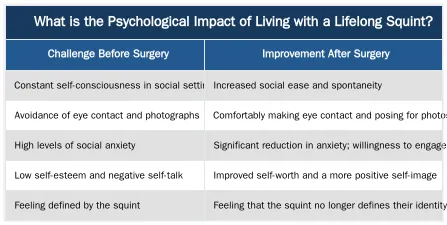
Patient Perspectives: Stories of Renewed Self-Esteem
Patient testimonials highlight resolved confidence issues. Many express regret only for not having sought treatment sooner. Common themes include speaking to a shop assistant without anxiety, delivering a work presentation with authority, or feeling relaxed at a family gathering.
These stories show the surgery’s value is measured in quality of life gained, not just degrees of eye alignment. The ability to interact freely without self-consciousness is a significant benefit.
| Quality of Life Domain | Average Pre-Surgery Score (out of 100) | Average Post-Surgery Score (out of 100) |
|---|---|---|
| Social Function | 45 | 85 |
| Emotional Well-being | 50 | 90 |
| General Function | 60 | 92 |
| Self-Perception | 40 | 88 |
Ready to Explore a Life Free from the Psychological Burden of Squint?
You do not have to accept the emotional and social challenges of a squint. Specialist-led adult squint surgery addresses both physical eye alignment and the condition’s psychological impact. A consultation is an investment in your confidence and well-being.
To discuss your options with an expert, Enquire about squint surgery. Learn more about our approach to Squint Surgery in London.
Conclusion
The psychological impact of squint in adults is a significant health issue causing social anxiety, low self-esteem, and missed opportunities. It is more than a cosmetic concern, affecting mental health and quality of life. Specialist adult strabismus surgery offers a solution, providing straighter eyes, confidence, and social comfort. Addressing the emotional burden allows individuals to reclaim their self-image. To learn how specialist care can help, contact us to explore options for Squint Surgery in London or Enquire about squint surgery.
Frequently Asked Questions
What is the psychological impact of squint on an adult’s confidence and self-esteem?
The psychological impact of squint can be profound, often leading to a lifetime of low self-esteem and social anxiety. Many adults avoid direct eye contact and feel self-conscious in social or professional situations, which significantly affects their quality of life. Corrective surgery can help restore not just eye alignment but also personal confidence.
How does the psychological impact of squint affect a person’s career?
The psychological impact of squint can create significant professional barriers. Difficulty making eye contact may be misinterpreted in interviews or meetings, and the internal anxiety can prevent individuals from pursuing public-speaking or leadership roles. Addressing the squint can unlock professional potential by boosting confidence in workplace interactions.
Is surgery a valid treatment for the psychological impact of squint?
Yes, surgery is a highly effective and recognised treatment for the psychological impact of squint. The World Health Organization defines health as complete physical, mental, and social well-being. By correcting the eye alignment, surgery directly addresses the root cause of the associated anxiety and low self-esteem, leading to a significant improvement in mental and social well-being.
How do social interactions change after correcting a squint?
Patients frequently report a dramatic positive shift in their social interactions after surgery. They find that others are more engaged and that communication feels more natural and direct. This positive external feedback helps reinforce their own newfound confidence and eases long-held social anxieties.
Can the emotional effects of a childhood squint be resolved in adulthood?
Absolutely. While the emotional burden may have been carried for decades, many adults find immense relief and a new sense of freedom after corrective surgery. The procedure not only improves physical appearance but also provides a powerful psychological reset, allowing them to build new, more confident patterns of social interaction.
How can I get an expert opinion on my squint and its psychological effects?
The first step is a specialist consultation to discuss your concerns. At the London Squint Clinic, Mr. Nadeem Ali provides an empathetic assessment, focusing on both the physical alignment and the emotional impact of your condition. You can enquire about a consultation to receive a personalised treatment plan.
Related Posts
Find out if you are suitable for Double Vision Treatment
Find out if you could benefit from this life changing surgery by contacting us today
Our most popular procedures


Hello, I’m Nadeem Ali
I’m one of the few eye surgeons in the world with 100% focus on Squint and Double Vision Surgery.
I have 24 years of eye surgery experience, and worked for 13 years as a Consultant at London’s renowned Moorfields Eye Hospital.
In 2023, I left the NHS to focus fully on treating patients from across the world at the London Squint Clinic. You can read more about me here.
There’s lots of information on the website about: squint surgery, double vision surgery and our pricing.
The most rewarding part of my job is hearing patients tell me how squint or double vision surgery has changed their lives. You can hear these stories here.
Mr Nadeem Ali
MA MB BChir MRCOphth FRCSEd(Ophth)