
The Limitations of Prisms: When Surgery Becomes the Best Option
Why Choose Private Squint Surgery?
In the UK, squint surgery may be performed via the NHS, through insurance, or as self-pay. NHS treatment is free, but waiting times can be long and surgery is often performed by trainees under supervision. Many operations are carried out by surgeons who mainly specialise in children’s squint rather than adult complex cases.
With insurance, fees are standardised — meaning some leading specialists choose not to participate. Self-pay allows you to choose your surgeon directly and prioritise experience, specialisation, and access.
Many centres quote only a surgical fee. Hospital costs, anaesthetic fees and follow-ups are frequently additional. At London Squint Clinic, everything is included in one transparent package.
Our Complete Package – £10,000
- ✔ Advanced surgery by Mr Ali (one or both eyes)
- ✔ Adjustable sutures where clinically indicated
- ✔ Detailed orthoptic planning
- ✔ All hospital & anaesthetic fees included
- ✔ Post-operative medication
- ✔ Two video follow-ups
- ✔ Face-to-face review appointment
What Makes Us Different
- ✔ 100% focused on adult squint & double vision surgery
- ✔ >95% audited success rate
- ✔ Free re-treatment at 3 months if worse (extremely rare)
- ✔ 24/7 direct WhatsApp access to your surgeon during recovery
- ✔ Optional well-being session & pre-op reassurance call
Initial consultation: from £150
Surgery typically within 4 weeks. No referral required. Self-pay only.
Prisms for Double Vision: Understanding Their Limits
While prisms for double vision provide a non-surgical method to manage diplopia, they have significant limitations, especially for large or unstable angles of misalignment. This article explains the practical drawbacks of prism glasses, including visual distortion and reduced acuity, which can make them an unsuitable long-term solution. Understanding when prisms don’t work is crucial for patients considering eye muscle surgery as a definitive treatment to restore comfortable binocular vision. This surgical approach directly addresses the underlying strabismus when optical aids become impractical.
At the London Squint Clinic, Consultant Ophthalmic Surgeon Mr Nadeem Ali specialises in adult double vision surgery. The clinic provides expert assessment for patients for whom prisms have proven insufficient, offering surgical pathways to correct complex eye alignment issues.
To explore your options, contact us to schedule your consultation. You can also reach us via: Book your assessment
Understanding Prisms for Double Vision: An Initial Approach
Prisms are a non-surgical diplopia treatment for small, stable angles of eye misalignment. They work by bending light before it enters the eye, redirecting the image from the misaligned eye to align with the image from the straight eye. This allows the brain to fuse the two images into a single picture, restoring a degree of binocular vision.
This optical correction provides relief and is often the first step in managing double vision. It is a compensatory measure, not a cure for the underlying eye muscle imbalance.
How Prism Glasses Correct Diplopia
Prisms are incorporated into spectacles in two ways. A Fresnel prism is a thin, flexible vinyl sheet pressed onto a patient’s existing glasses, often for temporary correction or to trial different prism strengths. For long-term use, prisms can be ground directly into the spectacle lenses, creating permanent prism glasses.
What Are the Key Limitations of Prisms for Double Vision?
Prisms have practical and functional limitations, especially as the degree of misalignment increases. Stronger prisms become thicker and heavier, leading to cosmetically unappealing and uncomfortable eyewear. They can also induce visual distortions, chromatic aberration (colour fringing), and reduce visual acuity and peripheral vision. These trade-offs can make daily activities like driving or navigating busy spaces challenging.
The compromises of strong or long-term prism use can outweigh the benefits, prompting a search for a definitive solution. The differences between prism types and their drawbacks are detailed in the comparison of double vision surgery vs. prism glasses.
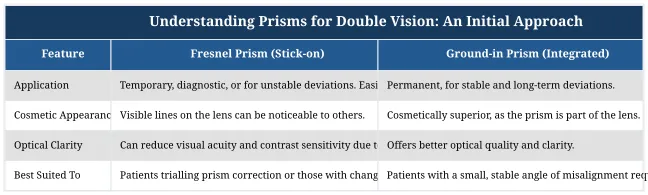
View data as table
| Feature | Fresnel Prism (Stick-on) | Ground-in Prism (Integrated) |
|---|---|---|
| Application | Temporary, diagnostic, or for unstable deviations. Easily changed. | Permanent, for stable and long-term deviations. |
| Cosmetic Appearance | Visible lines on the lens can be noticeable to others. | Cosmetically superior, as the prism is part of the lens. |
| Optical Clarity | Can reduce visual acuity and contrast sensitivity due to the vinyl material. | Offers better optical quality and clarity. |
| Best Suited To | Patients trialling prism correction or those with changing needs. | Patients with a small, stable angle of misalignment requiring long-term correction. |
When Prisms Don’t Work: Beyond Optical Correction
Prisms are not a viable solution in some clinical scenarios. The most common reason is a large angle squint, where the misalignment is too great for a prism to correct without causing unacceptable weight, thickness, and visual distortion. Prisms are also ineffective for unstable or variable squints, where the angle of deviation changes throughout the day or in different positions of gaze. In these cases of when prisms don’t work, they fail to provide consistent relief, and a surgical approach becomes necessary.
Why Might a Doctor Recommend Surgery Over Prisms?
An ophthalmologist may recommend surgery when prism limitations impact a patient’s quality of life. This occurs when the required prism strength is too high, the glasses are too heavy or cosmetically unacceptable, or the visual side effects compromise daily function. Surgery addresses the root cause—the misaligned eye muscles—rather than compensating for the symptom of double vision.
For adults whose double vision affects their ability to work, drive, or maintain balance, surgery can restore normal function that prisms cannot. It provides long-term correction, particularly for those who have exhausted other options. Specialist private care can provide faster access to expert surgeons.
The Inadequacy of Non-Surgical Options for Persistent Diplopia
Relying on non-surgical options like prisms can become a cycle of adjustments and compromises. As the underlying condition changes, patients may need progressively stronger prisms, exacerbating the problems of weight and distortion. This approach manages the symptom but does not resolve the underlying strabismus. Eye muscle surgery is the most effective way to break this cycle and achieve lasting single vision.
Adult Squint Surgery: A Definitive Solution for Prism Failure
Eye muscle surgery is the definitive treatment for diplopia that physically realigns the eyes. The procedure involves adjusting the position or tension of one or more extraocular muscles to restore proper alignment. This strabismus correction allows the eyes to work together, enabling the brain to fuse images naturally without optical aids.
Unlike prisms, which bend light, surgery corrects the mechanical source of the misalignment. This approach can provide a permanent solution, eliminating the need for cumbersome glasses and restoring a full field of single vision. The goal of this diplopia treatment is to achieve functional and cosmetic alignment, improving a patient’s confidence and quality of life.
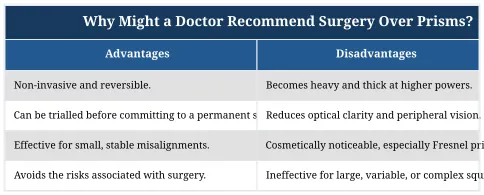
View data as table
| Advantages | Disadvantages |
|---|---|
| Non-invasive and reversible. | Becomes heavy and thick at higher powers. |
| Can be trialled before committing to a permanent solution. | Reduces optical clarity and peripheral vision. |
| Effective for small, stable misalignments. | Cosmetically noticeable, especially Fresnel prisms. |
| Avoids the risks associated with surgery. | Ineffective for large, variable, or complex squints. |
Expertise in Complex Cases and Revision Surgery
The success of strabismus surgery in adults depends on the surgeon’s experience. Mr Nadeem Ali has consultant-level expertise from Moorfields Eye Hospital, with a focus on adult squint and double vision. This specialisation is critical for complex prism failure cases, revision surgeries, and conditions rooted in neuro-ophthalmology, such as cranial nerve palsies. The American Academy of Ophthalmology states that strabismus surgery in adults is a common and effective procedure for improving alignment and reducing double vision.
Achieving Life-Changing Single Vision: What to Expect from Surgery
Successful eye muscle surgery improves quality of life, allowing patients to regain the ability to perform tasks that were difficult or impossible. This includes driving, reading, using a computer, and navigating the world without the disorienting effects of double vision.
Surgical correction also addresses the cosmetic aspect of a squint, which can boost self-esteem. The goal is to restore single binocular vision across most gaze positions, freeing patients from the limitations of prism glasses. The outcome is a return to a more normal and engaged life.
The Journey to Clear Vision: From Assessment to Recovery
Surgical correction begins with a comprehensive assessment to measure the eye misalignment and determine the surgical plan. The procedure is typically performed as a day case. As explained in can double vision be corrected with surgery, the procedure has a high success rate, leading to lasting improvement. Post-operative care is managed to ensure a smooth recovery and the best visual outcome.
Considering Specialist Double Vision Surgery? Your Next Steps
If you are struggling with the limitations of prisms for double vision or have been told nothing more can be done, a specialist surgical opinion may provide a solution. Persistent diplopia can be debilitating, but surgical techniques can restore single vision and improve quality of life.
Consulting a surgeon who focuses on adult squint and double vision ensures care tailored to specific, complex needs. To explore a solution beyond prisms, contact us or Book your assessment.
Conclusion
While prisms are an initial approach for some types of double vision, their limitations often necessitate a definitive solution. For adults with persistent or complex diplopia, eye muscle surgery can restore single vision and improve quality of life. The decision criterion is when the functional and cosmetic compromises of prisms outweigh their benefits. For those experiencing prism limitations and seeking a lasting solution, the next step is consulting a specialist in adult squint and double vision surgery.
Contact us or Book your assessment to discuss your needs.
Frequently Asked Questions
When are prisms for double vision typically prescribed?
Prisms are often prescribed as an initial or temporary measure for individuals experiencing small, stable angles of double vision. They function by optically bending light, which helps the brain to merge two distinct images into a single, clear perception. This approach is particularly useful for managing symptoms without altering the underlying eye muscle imbalance.
What are the practical limitations of relying on prisms for double vision long-term?
Long-term reliance on prisms for double vision can present several practical challenges. For larger corrections, prism lenses can become noticeably thick and heavy, potentially affecting the aesthetics of spectacles. Patients may also experience image distortion, reduced peripheral vision, and difficulties with depth perception, especially with stronger prescriptions.
What is the difference between a Fresnel prism and a ground-in prism lens?
A Fresnel prism is a thin, flexible vinyl sheet temporarily applied to existing glasses, often used for diagnostic purposes or trial periods due to its ease of application and removal. In contrast, a ground-in prism is permanently incorporated into the spectacle lens itself, offering a more stable and cosmetically integrated solution for long-term use, though it is less adaptable to changing prescriptions.
At what point does surgery become a more suitable option than prisms for double vision?
Surgery is generally considered a superior option when the degree of eye misalignment is significant, variable, or when prisms for double vision prove impractical, visually unsatisfactory, or socially intrusive for the patient. Unlike prisms, which are a compensatory measure, surgery offers a permanent physical realignment of the eye muscles to correct the root cause of the double vision.
Can prisms effectively manage double vision that fluctuates or changes with gaze direction?
Prisms are typically less effective for double vision that fluctuates throughout the day or changes significantly with different directions of gaze. Their fixed optical correction struggles to adapt to dynamic eye misalignments, often leading to persistent double vision in certain positions or at varying times. In such cases, surgical intervention may offer a more consistent and comprehensive solution.
How do prisms act as a diagnostic tool before considering double vision surgery?
Prisms can serve as a valuable diagnostic tool by demonstrating the potential for single vision if the eyes were perfectly aligned. If a patient experiences significant relief from double vision with prisms but finds their practical limitations (e.g., thickness, distortion) unacceptable, it strongly suggests that surgical realignment is likely to achieve a successful and liberating outcome.
Related Posts
Find out if you are suitable for Double Vision Treatment
Find out if you could benefit from this life changing surgery by contacting us today
Our most popular procedures


Hello, I’m Nadeem Ali
I’m one of the few eye surgeons in the world with 100% focus on Squint and Double Vision Surgery.
I have 24 years of eye surgery experience, and worked for 13 years as a Consultant at London’s renowned Moorfields Eye Hospital.
In 2023, I left the NHS to focus fully on treating patients from across the world at the London Squint Clinic. You can read more about me here.
There’s lots of information on the website about: squint surgery, double vision surgery and our pricing.
The most rewarding part of my job is hearing patients tell me how squint or double vision surgery has changed their lives. You can hear these stories here.
Mr Nadeem Ali
MA MB BChir MRCOphth FRCSEd(Ophth)