
What Are the NHS Criteria for Offering Adult Squint Surgery?
Why Choose Private Squint Surgery?
In the UK, squint surgery may be performed via the NHS, through insurance, or as self-pay. NHS treatment is free, but waiting times can be long and surgery is often performed by trainees under supervision. Many operations are carried out by surgeons who mainly specialise in children’s squint rather than adult complex cases.
With insurance, fees are standardised — meaning some leading specialists choose not to participate. Self-pay allows you to choose your surgeon directly and prioritise experience, specialisation, and access.
Many centres quote only a surgical fee. Hospital costs, anaesthetic fees and follow-ups are frequently additional. At London Squint Clinic, everything is included in one transparent package.
Our Complete Package – £10,000
- ✔ Advanced surgery by Mr Ali (one or both eyes)
- ✔ Adjustable sutures where clinically indicated
- ✔ Detailed orthoptic planning
- ✔ All hospital & anaesthetic fees included
- ✔ Post-operative medication
- ✔ Two video follow-ups
- ✔ Face-to-face review appointment
What Makes Us Different
- ✔ 100% focused on adult squint & double vision surgery
- ✔ >95% audited success rate
- ✔ Free re-treatment at 3 months if worse (extremely rare)
- ✔ 24/7 direct WhatsApp access to your surgeon during recovery
- ✔ Optional well-being session & pre-op reassurance call
Initial consultation: from £150
Surgery typically within 4 weeks. No referral required. Self-pay only.
What Are the Primary NHS Criteria for Adult Squint Surgery?
The primary NHS criteria for adult squint surgery are based on functional impairment, not cosmetic appearance. To be eligible for strabismus surgery funding, a patient must demonstrate their eye misalignment causes significant, disabling symptoms like persistent double vision (diplopia) or severe eye strain that impacts their daily life.
This focus on function means adults whose squint is stable and causes no disruptive visual symptoms are often ineligible for NHS treatment. Funding bodies prioritise conditions causing a measurable loss of function, placing many adult strabismus cases outside routine commissioning.
Functional vs. Cosmetic: Understanding the NHS Distinction
The distinction between a ‘functional’ and ‘cosmetic’ squint is central to the nhs criteria squint surgery. A functional problem interferes with seeing and performing daily tasks. The most common qualifying symptom is disabling diplopia, where the brain cannot merge images from two misaligned eyes, causing double vision. This can make activities like reading, driving, or walking difficult.
Conversely, if an adult has had a squint since childhood, their brain has often suppressed the image from the misaligned eye to avoid double vision. In these cases, even with a noticeable eye turn, the NHS may classify the issue as cosmetic because it causes no direct functional vision problem. The psychological and social impact of a visible squint, while significant, is not considered sufficient grounds for NHS funding under standard guidelines.
Navigating the NHS Referral and Assessment Process
Assessment for NHS-funded squint surgery begins with a visit to a GP or optometrist. If they agree your symptoms warrant investigation, they will make an NHS ophthalmology referral to your local hospital’s eye department. This initiates what can be a lengthy process.
After the referral is accepted, you are placed on a waiting list for an initial consultation with an ophthalmologist or orthoptist. During this appointment, tests are conducted to measure your eye misalignment, assess your binocular vision (how your eyes work together), and document your symptoms’ nature and severity. Be clear and specific about how your symptoms affect your life.
Proving Functional Impairment: What the NHS Looks For
To be eligible for strabismus surgery, you must provide clear evidence of functional impairment. The clinical team requires documented proof that your condition is more than a cosmetic concern. Key indicators include:
- Disabling Double Vision (Diplopia): The strongest criterion. You will need to describe when it occurs, how it affects you (e.g., needing to close one eye to read), and whether it is constant or intermittent.
- Severe Asthenopia (Eye Strain): Symptoms like headaches, eye fatigue, and difficulty focusing, directly attributable to the effort of controlling the squint. You must demonstrate how this strain prevents tasks like computer work or extended reading.
- Anomalous Head Posture: A significant head tilt or turn to align the eyes and avoid double vision is a clear sign of a functional problem. This can cause secondary issues like neck and shoulder pain.
- Impact on Daily Living: Articulate how symptoms affect your ability to work, drive, participate in hobbies, or navigate your environment safely. A symptom diary can be a powerful assessment tool.
The evidence gathered during this assessment is critical, as it forms the basis for the funding decision. The long NHS waiting times for adult strabismus surgery mean that even after a successful assessment, the treatment delay can be substantial.
When Standard Criteria Aren’t Met: The IFR Process
If your condition does not meet standard, routinely-funded criteria, an alternative is an Individual Funding Request (IFR). This is a formal application made by your NHS consultant to the local funding body—formerly a Clinical Commissioning Group (CCG), now often part of an Integrated Care Board (ICB)—to request surgery funding on an exceptional basis.
The IFR process is for patients with a greater clinical need than the general population of patients with the same condition. The application must demonstrate clinically exceptional circumstances and that you would benefit significantly more from the surgery than other patients. This is a high bar.
Understanding Exceptional Funding Requests and Their Challenges
An IFR panel of clinicians and administrators reviews the application, assessing evidence based on principles in documents like the NHS England commissioning guides. The core challenge is proving “exceptionality.” It is not enough that the treatment would be effective; you must show why you are different from other patients with a similar condition who are also denied funding.
The success rate for IFRs for adult squint surgery is very low. Reasons for rejection often include:
- Insufficient Evidence of Clinical Exceptionality: The panel may decide that while your case is compelling, it does not differ significantly from others and therefore does not meet the threshold.
- Psychological Distress Not Considered: The emotional and social burden of a squint is rarely considered a primary factor for establishing clinical exceptionality in IFR panels.
- Policy Exclusions: Many local funding policies list adult strabismus surgery for non-diplopic cases as a “procedure of limited clinical effectiveness,” making an IFR almost impossible to win.
The process is lengthy, opaque, and emotionally draining, leaving patients in limbo for months, often for a disappointing outcome.
NHS Waiting Times vs. Specialist Private Care
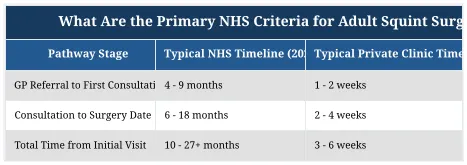
For patients who meet the functional criteria for NHS surgery, the next hurdle is the waiting time. The NHS patient journey is protracted, with long waits for the initial consultation and then for surgery. NHS England data shows referral-to-treatment (RTT) waiting times can be extensive, with many patients waiting well over the 18-week target, sometimes for more than a year, for ophthalmology procedures.
In contrast, private sector patients can access specialist care quickly. A dedicated adult strabismus clinic can offer a consultation within weeks and schedule surgery shortly thereafter, reducing the treatment timeline. This speed is a primary reason many individuals explore self-pay options.
View data as table
| Pathway Stage | Typical NHS Timeline (2026) | Typical Private Clinic Timeline |
|---|---|---|
| GP Referral to First Consultation | 4 – 9 months | 1 – 2 weeks |
| Consultation to Surgery Date | 6 – 18 months | 2 – 4 weeks |
| Total Time from Initial Visit | 10 – 27+ months | 3 – 6 weeks |
The Impact of Delays and Regional Variability on Patient Outcomes
Prolonged waiting times impact a patient’s quality of life. Living with disabling double vision for months or years can affect mental health, employment, and social engagement. NHS provision is not uniform across the UK. The specific nhs criteria squint surgery and waiting list lengths can vary significantly between regions and Integrated Care Boards, creating a “postcode lottery” for care access.
Why Adults Choose Private Squint Surgery in the UK
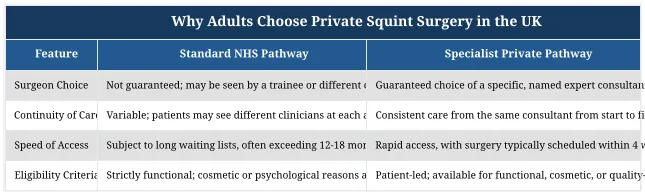
Many UK adults fund their squint surgery privately, often to bypass restrictive NHS eligibility criteria and long waiting lists. Reasons extend beyond speed and access. Private care provides a level of choice, control, and specialist focus often not possible within the NHS pathway.
Patients can choose their surgeon based on expertise, ensuring treatment by a consultant with a dedicated specialism in adult strabismus, such as Mr Nadeem Ali. This is important for complex cases or revision surgeries. The continuity of seeing the same expert from consultation to final follow-up provides reassurance and personalised care. For many, resolving a lifelong issue or a debilitating new symptom quickly is a worthwhile investment in their quality of life.
View data as table
| Feature | Standard NHS Pathway | Specialist Private Pathway |
|---|---|---|
| Surgeon Choice | Not guaranteed; may be seen by a trainee or different consultants. | Guaranteed choice of a specific, named expert consultant. |
| Continuity of Care | Variable; patients may see different clinicians at each appointment. | Consistent care from the same consultant from start to finish. |
| Speed of Access | Subject to long waiting lists, often exceeding 12-18 months. | Rapid access, with surgery typically scheduled within 4 weeks. |
| Eligibility Criteria | Strictly functional; cosmetic or psychological reasons are not funded. | Patient-led; available for functional, cosmetic, or quality-of-life reasons. |
Benefits of Consultant-Led Specialist Care and Transparent Pricing
A key advantage of the private route is direct access to a consultant focused on adult squint and double vision. This specialisation provides experience with a wide range of complex conditions. Reputable private clinics offer transparent, bundled pricing. Patients know the full cost upfront—covering consultation, surgery, and all follow-up care—which removes financial uncertainty. You can learn more about private surgery costs and what is included in a comprehensive care package.
Considering Your Options for Adult Squint Correction
Deciding on the best path for squint correction involves weighing the strict nhs criteria squint surgery and long waiting times against the speed, choice, and expertise of private care. If you have functional symptoms like double vision, an NHS referral is a valid first step. If you do not meet the criteria, face a long wait, or want control over your treatment journey, exploring a private consultation is a logical next step.
A specialist consultation provides a definitive diagnosis and a clear treatment plan, empowering you to make an informed decision. To understand your options with a specialist, contact us.
View private surgery costs | Book an appointment | Read More
Conclusion
Navigating UK pathways for adult squint surgery requires understanding the system’s priorities. The NHS is structured to address urgent functional needs, which leaves many adults with cosmetically or psychologically impactful squints without a funded solution. The key decision for patients is how significantly the condition affects their daily life and whether they can wait for a potential NHS solution or prefer the certainty and speed of private, specialist-led care. Evaluating the impact on your quality of life is the most important step in choosing your path.
To explore a faster route to treatment with an expert: View private surgery costs, Book an appointment, or Read More about the procedures we offer.
Frequently Asked Questions
What is the primary functional impairment the NHS considers for adult squint surgery?
The NHS primarily considers disabling double vision (diplopia) or severe eye strain that significantly impacts daily life. This functional impairment must be clearly documented by an ophthalmologist to meet the nhs criteria squint surgery.
Can I receive NHS funding for adult squint surgery if my squint is purely cosmetic?
Generally, no. If the squint is visible but does not cause functional problems like double vision or severe eye strain, it is typically classified as ‘cosmetic’ by the NHS. In such cases, funding is usually denied, and private treatment becomes the alternative.
What are typical NHS waiting times for adult squint surgery once eligibility is confirmed?
NHS waiting times for adult squint surgery can vary significantly across the UK, often ranging from several months to over a year after initial assessment and approval. In contrast, private clinics like London Squint Clinic can often arrange surgery within 4 weeks.
Does the NHS fund revision squint surgery if a previous operation was unsuccessful?
The NHS may fund revision squint surgery, but only if the patient continues to experience significant functional impairment, such as persistent disabling double vision, despite the previous operation. The criteria remain focused on functional necessity rather than simply correcting a previous surgical outcome.
How do Clinical Commissioning Groups (CCGs) or Integrated Care Boards (ICBs) influence NHS eligibility for adult squint surgery?
CCGs and ICBs are responsible for commissioning healthcare services locally, meaning they set specific thresholds and policies for funding adult squint surgery within their regions. This can lead to variations in eligibility criteria and a “postcode lottery” effect across the UK.
What specific evidence does an NHS ophthalmologist require to support a funding application for adult squint surgery?
An NHS ophthalmologist typically requires objective measurements of the squint angle, detailed tests for double vision (diplopia fields), and a comprehensive patient history. This evidence must clearly document how the squint functionally impairs daily activities like reading, driving, or work.
Related Posts


Find out if you are suitable for Double Vision Treatment
Find out if you could benefit from this life changing surgery by contacting us today
Our most popular procedures


Hello, I’m Nadeem Ali
I’m one of the few eye surgeons in the world with 100% focus on Squint and Double Vision Surgery.
I have 24 years of eye surgery experience, and worked for 13 years as a Consultant at London’s renowned Moorfields Eye Hospital.
In 2023, I left the NHS to focus fully on treating patients from across the world at the London Squint Clinic. You can read more about me here.
There’s lots of information on the website about: squint surgery, double vision surgery and our pricing.
The most rewarding part of my job is hearing patients tell me how squint or double vision surgery has changed their lives. You can hear these stories here.
Mr Nadeem Ali
MA MB BChir MRCOphth FRCSEd(Ophth)