
How a Long Wait for Squint Surgery Can Impact Vision and Quality of Life
Why Choose Private Squint Surgery?
In the UK, squint surgery may be performed via the NHS, through insurance, or as self-pay. NHS treatment is free, but waiting times can be long and surgery is often performed by trainees under supervision. Many operations are carried out by surgeons who mainly specialise in children’s squint rather than adult complex cases.
With insurance, fees are standardised — meaning some leading specialists choose not to participate. Self-pay allows you to choose your surgeon directly and prioritise experience, specialisation, and access.
Many centres quote only a surgical fee. Hospital costs, anaesthetic fees and follow-ups are frequently additional. At London Squint Clinic, everything is included in one transparent package.
Our Complete Package – £10,000
- ✔ Advanced surgery by Mr Ali (one or both eyes)
- ✔ Adjustable sutures where clinically indicated
- ✔ Detailed orthoptic planning
- ✔ All hospital & anaesthetic fees included
- ✔ Post-operative medication
- ✔ Two video follow-ups
- ✔ Face-to-face review appointment
What Makes Us Different
- ✔ 100% focused on adult squint & double vision surgery
- ✔ >95% audited success rate
- ✔ Free re-treatment at 3 months if worse (extremely rare)
- ✔ 24/7 direct WhatsApp access to your surgeon during recovery
- ✔ Optional well-being session & pre-op reassurance call
Initial consultation: from £150
Surgery typically within 4 weeks. No referral required. Self-pay only.
Impact of Delayed Squint Surgery: Protecting Vision & Quality of Life
The impact of delayed squint surgery extends beyond visible eye misalignment, directly affecting visual function and mental well-being. A prolonged wait can cause a progressive decline in binocular vision, leading to persistent double vision, eye strain, and a loss of depth perception. Over time, these functional impairments are compounded by significant psychosocial effects that can diminish confidence and quality of life. This article details the specific risks associated with waiting for treatment and explains how timely intervention can preserve sight and restore normal daily function.
As a specialist clinic focused exclusively on adult squint and double vision surgery, our insights are informed by managing complex strabismus cases. Timely surgical correction is a critical factor in achieving optimal eye alignment and mitigating the long-term consequences of a delayed diagnosis or treatment.
To explore your options, contact us to schedule your consultation. You can also reach us via: View private surgery costs, Book an appointment, Read More
Beyond Sight: The Profound Psychosocial and Quality of Life Effects
The consequences of an untreated adult squint are not confined to vision. The condition carries a significant psychosocial burden affecting mental health, social interactions, and professional life. These effects can be as debilitating as the visual symptoms.
How Does an Adult Squint Affect Mental Health and Self-Esteem?
A visible eye misalignment can affect self-confidence. Adults with strabismus often report feeling self-conscious about their appearance, leading to avoidance of eye contact and social situations. This can foster anxiety and isolation; studies show a higher prevalence of depression among adults with strabismus compared to the general population.
The worry about appearance and the functional challenges of double vision create a persistent mental load. This can erode self-esteem and lead to social withdrawal over time, as detailed in our guide on how adult strabismus affects confidence and daily life.
Impact on Daily Life, Driving, and Professional Performance
Double vision and poor depth perception make everyday activities hazardous. Driving becomes unsafe, reading can be exhausting, and participating in sports may be impossible. In a professional setting, these visual impairments can limit career options, particularly in roles requiring fine motor skills, screen-based work, or operating machinery.
Constant eye strain and headaches can reduce productivity and lead to frequent absences. Managing diplopia at work is a major source of stress, as explored in our article on how diplopia surgery helps adults return to professional life.
The NHS Reality: Why Waiting Lists Exacerbate Squint Complications
The primary barrier to timely treatment for many UK adults is the extended NHS waiting list for strabismus surgery. NHS resource constraints mean non-life-threatening conditions like adult squint often face significant delays. These waits contribute to the worsening of both visual and psychosocial symptoms.
Navigating Prolonged Waiting Times for Adult Strabismus Care
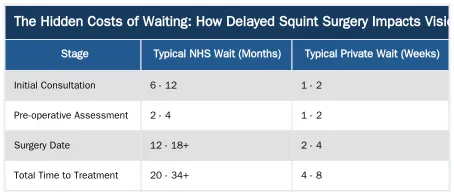
The waiting time for an initial NHS ophthalmologist consultation can be many months, and the subsequent wait for surgery can extend for more than a year. This prolonged wait allows the condition’s negative effects to become entrenched, as detailed in our overview of the reality of NHS waiting times for adult strabismus surgery. During this time, a patient’s quality of life declines, and the potential for full visual recovery may diminish.
View data as table
| Stage | Typical NHS Wait (Months) | Typical Private Wait (Weeks) |
|---|---|---|
| Initial Consultation | 6 – 12 | 1 – 2 |
| Pre-operative Assessment | 2 – 4 | 1 – 2 |
| Surgery Date | 12 – 18+ | 2 – 4 |
| Total Time to Treatment | 20 – 34+ | 4 – 8 |
Can Delaying Surgery Make It Less Successful?
A significant delay can complicate the surgical process and temper the final outcome. As muscles adapt to the long-standing misalignment, they can become fibrotic or stiff, making them less responsive to standard surgical adjustments. The brain’s neural pathways for binocular vision can also weaken from disuse. While surgery can still be effective, a more complex presentation may increase the likelihood of needing a second operation for optimal alignment. Timely intervention allows for a more predictable and straightforward correction.
Expert Insight: Mitigating Risks and Optimizing Outcomes with Timely Care
Addressing a long-standing or complex adult squint requires specialisation. The negative impact of delayed squint surgery can be mitigated by prompt access to a surgeon with dedicated expertise. An experienced specialist can accurately assess the changes that have occurred and tailor the surgical plan accordingly.
The Importance of Specialist Expertise in Complex and Long-Standing Squints
A surgeon like Mr. Nadeem Ali, who focuses exclusively on adult squint and double vision, has critical experience for challenging cases. With a background as a lead consultant at Moorfields Eye Hospital, Mr. Ali has extensive experience managing squints present for decades and complex revision cases where previous surgery was unsuccessful. Techniques such as adjustable suture surgery, where the eye muscle position can be fine-tuned after the patient is awake, are invaluable in these situations. This specialisation ensures the surgical approach is optimised for delayed cases.
Understanding the Window of Opportunity for Best Results
While it is rarely “too late” to improve eye alignment and reduce double vision, there is a window of opportunity for achieving optimal functional results. Earlier intervention, before the brain’s suppression mechanisms become deeply ingrained and before secondary muscle changes occur, leads to a higher chance of restoring comfortable binocular vision. The American Academy of Ophthalmology notes that timely treatment is key to maximising sensory outcomes. (Source: AAO). Prompt treatment prevents the accumulation of visual and psychosocial damage, making recovery more straightforward.
Comparing Pathways: NHS vs. Private Care for Adult Squint Surgery
When faced with a long wait, many adults consider the private healthcare pathway. The primary difference is the speed of access and continuity of care, which directly addresses the risks associated with delay.
A Side-by-Side Look at Access, Waiting Times, and Outcomes
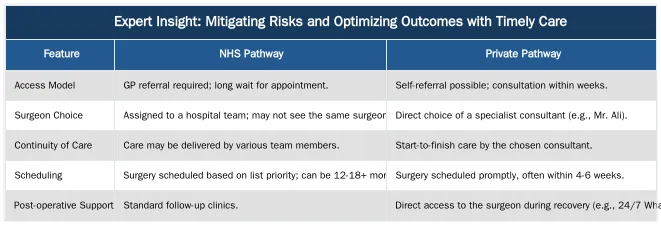
The private pathway eliminates the prolonged waiting periods of the public system. This allows for rapid diagnosis and treatment, halting the progression of visual and psychosocial issues.
View data as table
| Feature | NHS Pathway | Private Pathway |
|---|---|---|
| Access Model | GP referral required; long wait for appointment. | Self-referral possible; consultation within weeks. |
| Surgeon Choice | Assigned to a hospital team; may not see the same surgeon. | Direct choice of a specialist consultant (e.g., Mr. Ali). |
| Continuity of Care | Care may be delivered by various team members. | Start-to-finish care by the chosen consultant. |
| Scheduling | Surgery scheduled based on list priority; can be 12-18+ months. | Surgery scheduled promptly, often within 4-6 weeks. |
| Post-operative Support | Standard follow-up clinics. | Direct access to the surgeon during recovery (e.g., 24/7 WhatsApp). |
Why Prioritising Speed and Expertise Can Be Life-Changing
Choosing private care is an investment in quality of life. By circumventing long waiting lists, patients can address debilitating symptoms like double vision and eye strain months or years sooner. This rapid intervention prevents further deterioration and accelerates the return to normal life—driving, working, and socialising with confidence. Research in journals like Eye (Nature) highlights the substantial functional and psychological benefits of successful strabismus surgery. The value of private care lies in restoring function and well-being without the damaging effects of a prolonged wait.
Reclaim Your Vision and Quality of Life: Take the Next Step
Living with an adult squint or double vision presents daily challenges that can worsen over time. The impact of delayed squint surgery on visual function, mental health, and well-being is significant. Waiting is not a passive act; it is a period during which the condition can become more complex and its effects can worsen. Timely action with a dedicated specialist mitigates these risks and helps restore vision and confidence.
Conclusion
The decision to proceed with squint surgery is significant, and the choice of pathway can determine the timeline to recovery. While the NHS provides a vital service, extended waiting lists mean the negative effects of strabismus can accumulate, making the condition harder to treat and live with. For adults whose personal, professional, and social lives are compromised, waiting is often not a viable option. If you are experiencing the debilitating effects of eye misalignment or double vision, seeking a specialist consultation to understand your options is a critical step.
To learn more about a timely, specialist-led approach, contact us. You can also View private surgery costs, Book an appointment, or Read More about the surgical process.
Frequently Asked Questions
How quickly can binocular vision loss become permanent due to delayed squint surgery in adults?
While the exact timeframe varies, prolonged suppression of one eye’s image by the brain, often occurring with delayed treatment, can lead to a permanent loss of binocular single vision and depth perception. This process can solidify over months to years in adults, making it harder to regain full binocular function even after successful surgery.
What specific complications might arise during squint surgery if it’s significantly delayed?
A significant impact of delayed squint surgery can be an increase in the angle of misalignment and deterioration of eye muscle control, potentially making the surgery more complex. Mr. Nadeem Ali notes that long-standing, complex squints may require more intricate surgical techniques or even revision surgery to achieve optimal alignment.
Beyond vision, what are the long-term psychological effects of living with uncorrected adult squint for years?
Living with an uncorrected adult squint for an extended period can lead to chronic social anxiety, reduced self-esteem, and even depression. Research indicates adults with strabismus are two to three times more likely to experience mental health conditions like anxiety and depression. These psychological impacts can become deeply ingrained, affecting personal relationships and career progression.
Does the NHS waiting list for adult squint surgery typically exceed the timeframe where visual deterioration becomes significant?
NHS waiting lists for adult squint surgery can often extend for 12 to 24 months, and sometimes longer, for non-urgent cases. This prolonged wait can indeed exceed the period where visual deterioration, such as worsening double vision or suppression, becomes significant, exacerbating the impact of delayed squint surgery on a patient’s quality of life and visual function.
Are there specific activities or professions that become unsafe or impossible due to the impact of delayed squint surgery?
Yes, the loss of depth perception and persistent double vision resulting from delayed squint surgery can severely impair activities requiring precise visual judgment. This includes driving, operating machinery, and professions such as surgeons, pilots, commercial drivers, and graphic designers, where accurate spatial awareness is critical for safety and performance.
What is the typical recovery time for adult squint surgery, and how does it compare if the condition was long-standing?
The typical recovery time for adult squint surgery involves about 1-2 weeks for initial discomfort and redness to subside, with most patients resuming normal activities within this period. Full visual stability and neurological adaptation often take 2-3 months, or up to 3-6 months for complete adjustment. While a long-standing condition doesn’t necessarily prolong the physical healing, the brain may take slightly longer to adapt to the new eye alignment and regain binocular vision.
Related Posts
Find out if you are suitable for Double Vision Treatment
Find out if you could benefit from this life changing surgery by contacting us today
Our most popular procedures


Hello, I’m Nadeem Ali
I’m one of the few eye surgeons in the world with 100% focus on Squint and Double Vision Surgery.
I have 24 years of eye surgery experience, and worked for 13 years as a Consultant at London’s renowned Moorfields Eye Hospital.
In 2023, I left the NHS to focus fully on treating patients from across the world at the London Squint Clinic. You can read more about me here.
There’s lots of information on the website about: squint surgery, double vision surgery and our pricing.
The most rewarding part of my job is hearing patients tell me how squint or double vision surgery has changed their lives. You can hear these stories here.
Mr Nadeem Ali
MA MB BChir MRCOphth FRCSEd(Ophth)