
What Specific Tests Are Used to Measure Eye Misalignment and Plan Surgery?
Why Choose Private Squint Surgery?
In the UK, squint surgery may be performed via the NHS, through insurance, or as self-pay. NHS treatment is free, but waiting times can be long and surgery is often performed by trainees under supervision. Many operations are carried out by surgeons who mainly specialise in children’s squint rather than adult complex cases.
With insurance, fees are standardised — meaning some leading specialists choose not to participate. Self-pay allows you to choose your surgeon directly and prioritise experience, specialisation, and access.
Many centres quote only a surgical fee. Hospital costs, anaesthetic fees and follow-ups are frequently additional. At London Squint Clinic, everything is included in one transparent package.
Our Complete Package – £10,000
- ✔ Advanced surgery by Mr Ali (one or both eyes)
- ✔ Adjustable sutures where clinically indicated
- ✔ Detailed orthoptic planning
- ✔ All hospital & anaesthetic fees included
- ✔ Post-operative medication
- ✔ Two video follow-ups
- ✔ Face-to-face review appointment
What Makes Us Different
- ✔ 100% focused on adult squint & double vision surgery
- ✔ >95% audited success rate
- ✔ Free re-treatment at 3 months if worse (extremely rare)
- ✔ 24/7 direct WhatsApp access to your surgeon during recovery
- ✔ Optional well-being session & pre-op reassurance call
Initial consultation: from £150
Surgery typically within 4 weeks. No referral required. Self-pay only.
Eye Misalignment Measurement Tests: a Guide to Surgical Planning
Precise eye misalignment measurement tests are the foundation of successful adult squint surgery. This guide details the key diagnostic procedures used to quantify the angle of deviation for tailored surgical planning. We explain the gold-standard prism cover test, along with other critical assessments like the Hirschberg test and diplopia charting. Understanding these methods clarifies how a specialist determines the exact surgical approach required to restore binocular single vision. These eye misalignment measurement tests ensure the plan is based on objective data for optimal alignment outcomes.
At London Squint Clinic, our consultant-led service focuses exclusively on adult squint and double vision surgery. The diagnostic process is tailored to the complexities of adult strabismus, including revision cases and diplopia caused by nerve palsies, ensuring a comprehensive basis for surgical intervention.
To explore your options, contact us to schedule your consultation. You can also reach us via: Enquire about squint surgery, Squint Surgery in London
Why Accurate Eye Misalignment Measurement is Crucial for Adults
Successful adult squint surgery depends on the precise quantification of the eye’s deviation. The eye misalignment measurement tests used during a consultation provide the data to create a tailored surgical plan. Unlike general eye exams, these specialised assessments measure the exact angle and characteristics of the strabismus to inform the plan for restoring alignment and eliminating double vision.
Understanding the Need for Precision in Adult Strabismus
In adults, the visual system is fully developed, making the brain less adaptable to changes in eye alignment. An imprecise surgical correction can lead to persistent or new-onset double vision (diplopia), a functionally disabling outcome. The goal is not just cosmetic improvement but restoring comfortable binocular single vision.
Accurate measurements are vital for complex cases involving previous surgeries, nerve palsies, or conditions like Thyroid Eye Disease. Understanding how the misalignment changes in different gaze positions is fundamental for a successful result. This precision ensures the surgical plan is based on objective data, not estimation.
The Gold Standard: What is the Prism Cover Test for Strabismus?
The prism cover test is the most accurate and reliable method for measuring the size of a squint. It provides a direct, objective measurement of the angle of deviation, quantified in prism diopters (PD). This value is essential for surgical planning.
During the test, the patient focuses on a target at a specific distance (e.g., 6 metres for distance and 1/3 metre for near). An examiner, typically a specialist orthoptist, covers one eye then the other, observing the movement of the uncovered eye as it takes up fixation. Prisms of increasing strength are placed in front of one eye until all movement is neutralised. The prism power required to stop the eye from moving equals the deviation size.
How Orthoptists Measure Eye Alignment with Prisms
An orthoptist is an allied health professional specialising in the diagnosis and non-surgical management of eye movement and alignment disorders. During an adult strabismus surgery consultation, they perform the prism cover test in various positions of gaze—looking up, down, left, and right. This assessment reveals the strabismus pattern, identifying which eye muscles are underacting or overacting. This information is critical for the surgeon to formulate a surgical plan.
Beyond Prisms: Other Key Eye Misalignment Measurement Tests
While the prism cover test is central, a full assessment often includes other eye misalignment measurement tests to understand the patient’s visual function. These tests provide complementary information, especially when a patient cannot perform the cover test or has complex muscle restrictions.
Comparing Hirschberg, Krimsky, and Hess Chart for Comprehensive Diagnosis
The Hirschberg test is a rapid estimation method where a light is shone into the eyes and the position of its reflection on the corneas is observed. If the reflection is not centred in both pupils, a misalignment is present. The Krimsky test refines this by using prisms to centre the light reflex, providing a more quantitative estimate. These are useful in very young children or uncooperative patients.
For adults with double vision from nerve palsies, the Hess chart graphically maps the actions of each eye muscle in all positions of gaze, illustrating which muscles are weak (paretic) or restricted. This is complemented by diplopia charting, where the patient describes the separation of the two images, creating a map of their double vision that helps pinpoint the cause.
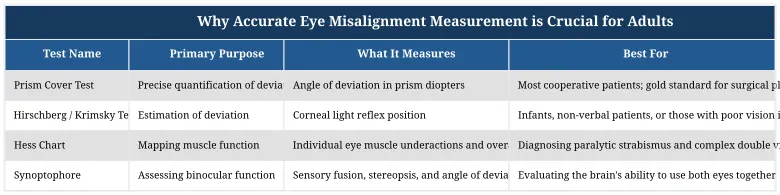
View data as table
| Test Name | Primary Purpose | What It Measures | Best For |
|---|---|---|---|
| Prism Cover Test | Precise quantification of deviation | Angle of deviation in prism diopters | Most cooperative patients; gold standard for surgical planning |
| Hirschberg / Krimsky Test | Estimation of deviation | Corneal light reflex position | Infants, non-verbal patients, or those with poor vision in one eye |
| Hess Chart | Mapping muscle function | Individual eye muscle underactions and overactions | Diagnosing paralytic strabismus and complex double vision |
| Synoptophore | Assessing binocular function | Sensory fusion, stereopsis, and angle of deviation | Evaluating the brain’s ability to use both eyes together |
How Do These Measurements Directly Inform Squint Surgery Planning?
The data from these measurements is the direct input for surgical decision-making. The surgeon uses this information to determine which eye(s) to operate on, which muscles to adjust, and by how much. This process transforms objective measurements into a surgical plan.
For example, a measurement of 30 prism diopters of esotropia (inward turn) might translate to a 6mm recession (weakening procedure) of the medial rectus muscle. A measurement of hypertropia (vertical misalignment) that increases on side gaze points to a specific oblique muscle dysfunction, guiding the surgeon to the correct target. This precision is fundamental to modern strabismus surgery, as outlined by the American Academy of Ophthalmology.
Translating Angle of Deviation into Surgical Precision
The core of surgical planning is converting the measured angle of deviation into millimetres of muscle adjustment. Surgeons use established tables and personal experience for this calculation. For instance, in a standard recession procedure, moving a horizontal muscle by 1mm typically corrects about 5 prism diopters of deviation. This can vary based on the patient’s age, previous surgeries, and muscle tone.
In complex cases, such as those seen by Mr. Nadeem Ali, measurements from different gaze positions are crucial. They inform the choice between recession/resection procedures and more complex techniques like muscle transpositions. Understanding the range of treatment options for adult squint allows for a customised approach to achieve optimal alignment across the field of vision.
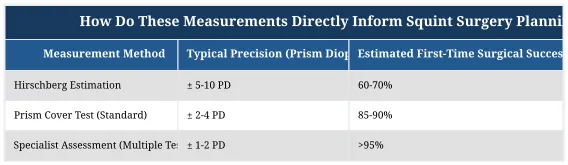
View data as table
| Measurement Method | Typical Precision (Prism Diopters) | Estimated First-Time Surgical Success Rate |
|---|---|---|
| Hirschberg Estimation | ± 5-10 PD | 60-70% |
| Prism Cover Test (Standard) | ± 2-4 PD | 85-90% |
| Specialist Assessment (Multiple Tests) | ± 1-2 PD | >95% |
The Specialist Advantage: Why Expert Assessment Matters for Outcomes
Accurate measurements require correct interpretation for a successful outcome. A consultant focused on adult strabismus, like Mr. Nadeem Ali, has experience in this interpretation, particularly in revision surgery or cases with neurological components. This expertise is critical for interpreting factors that numbers alone cannot convey.
For example, a patient may have a “dissociated” vertical deviation revealed only through specific testing techniques, or scar tissue from a previous operation may restrict a muscle in a way that mimics a nerve palsy. A general ophthalmologist might miss these subtleties, leading to an incorrect surgical plan. A specialist can differentiate between these conditions, ensuring the right procedure is performed. This is why an expert assessment for double vision diagnosis is important.
Ensuring Accuracy: The Difference an Expert Consultant Makes
A consultant with experience, such as Mr. Ali’s 13 years at Moorfields Eye Hospital leading the adult squint service, can synthesise data from multiple tests into a coherent diagnosis. They can identify inconsistencies between measurements that may point to a more complex underlying issue. This skill is honed over thousands of cases and is vital for patients who have been told elsewhere that nothing more can be done.
This specialist interpretation directly impacts success rates. By ensuring the diagnosis is correct and the measurements are validated, the surgical plan is more reliable, increasing the probability of achieving straight eyes and single vision from one operation.
Ready for Clearer Vision? Your Next Steps with a Squint Specialist
The precision of these measurements is directly linked to the surgical outcome. A specialist assessment is the most critical part of the treatment journey.
If you are an adult with a squint, seeking an expert evaluation is recommended. Contact us to arrange a consultation. Enquire about squint surgery or learn more about Squint Surgery in London.
Conclusion
Accurate measurement of eye misalignment is fundamental to successful adult squint and double vision surgery. A specialist uses a suite of tests to formulate a precise surgical plan to restore alignment and binocular vision. The key decision for a patient is choosing a surgeon who can interpret complex findings correctly. This ensures the treatment is tailored to the patient’s condition.
Frequently Asked Questions
How long does a typical consultation involving eye misalignment measurement tests usually take?
A comprehensive consultation, including all necessary eye misalignment measurement tests, typically lasts between 60 to 90 minutes. This allows the orthoptist and surgeon, like Mr. Nadeem Ali, to perform a thorough assessment in various gaze positions and conditions. The detailed evaluation ensures all aspects of the squint are accurately quantified for surgical planning.
What is the primary goal of the prism cover test in adult squint assessment?
The prism cover test, considered the gold standard among eye misalignment measurement tests, aims to precisely quantify the angle of deviation in prism diopters. This test is crucial for adults as it helps determine the exact amount of muscle adjustment needed to achieve comfortable binocular single vision, rather than just cosmetic alignment. It is performed in different gaze positions to capture the full extent of the misalignment.
How do specialists account for double vision (diplopia) when performing eye misalignment measurement tests for surgery planning?
When planning surgery for double vision, specialists use specific eye misalignment measurement tests like the Hess Chart or Lees Screen to map the exact fields of gaze where diplopia occurs. This detailed mapping helps identify which specific eye muscles are under- or over-acting. The surgical plan is then tailored to restore alignment in the primary gaze and reading positions, aiming to eliminate or significantly reduce the disabling double vision.
Are there any specific preparations required before undergoing eye misalignment measurement tests?
Generally, no special preparation is needed for most eye misalignment measurement tests. However, it is advisable to bring any previous eye reports or glasses prescriptions. Your pupils may be dilated during the assessment, which can cause temporary light sensitivity and blurred near vision for a few hours, so arranging transport or bringing sunglasses is recommended.
How does a Hess Chart specifically aid in planning surgery for complex squints like those from nerve palsies?
A Hess Chart provides a detailed graphical representation of the function of each individual eye muscle, which is invaluable for complex squints. For conditions like 3rd, 4th, or 6th nerve palsies, it precisely identifies which muscles are weak or restricted. This allows the surgeon to plan targeted interventions, such as muscle resections or recessions, to restore balance and improve eye movement and alignment.
Can eye misalignment measurement tests predict the long-term success rate of adult squint surgery?
While eye misalignment measurement tests provide critical data for a precise surgical plan, they do not directly predict long-term success. However, accurate measurements, combined with the surgeon’s expertise, significantly increase the probability of a successful outcome, with some clinics reporting a 95% audited alignment success rate from one operation. Factors like the type of squint, patient age, and the absence of dense amblyopia are also associated with higher success rates.
Related Posts

Find out if you are suitable for Double Vision Treatment
Find out if you could benefit from this life changing surgery by contacting us today
Our most popular procedures


Hello, I’m Nadeem Ali
I’m one of the few eye surgeons in the world with 100% focus on Squint and Double Vision Surgery.
I have 24 years of eye surgery experience, and worked for 13 years as a Consultant at London’s renowned Moorfields Eye Hospital.
In 2023, I left the NHS to focus fully on treating patients from across the world at the London Squint Clinic. You can read more about me here.
There’s lots of information on the website about: squint surgery, double vision surgery and our pricing.
The most rewarding part of my job is hearing patients tell me how squint or double vision surgery has changed their lives. You can hear these stories here.
Mr Nadeem Ali
MA MB BChir MRCOphth FRCSEd(Ophth)