
Surgical Approaches for Correcting Vertical Double Vision (Hypertropia)

Why Choose Private Squint Surgery?
In the UK, squint surgery may be performed through the NHS, through insurance or as self-pay. NHS treatment is free, but waiting times can be long.
Self-pay allows you to choose your surgeon directly and prioritise experience, specialisation and access.
London Squint Clinic offers two fixed-price surgical packages. Our pricing page lists exactly what each one includes.
Our Packages: Complete Care £9,750 · Signature Care £12,000
- ✔ Surgery by Mr Ali, one or both eyes as clinically required
- ✔ Adjustable sutures when clinically indicated
- ✔ Detailed pre-operative measurements & surgical planning
- ✔ Anaesthetist fees
- ✔ Post-operative eye drops
- ✔ 2 scheduled video follow-ups
- ✔ Face-to-face review if clinically required
Signature Care Also Includes
- ✔ Direct 24/7 WhatsApp access to Mr Ali during recovery
- ✔ Pre-op reassurance call with anaesthetist if desired
- ✔ Additional face-to-face review if desired
- ✔ Ongoing eye advice from Mr Ali after discharge
Initial consultation: £150 (video or in person)
Surgery can usually be offered within 4 weeks. No referral required. Self-pay only.
Vertical Double Vision Surgery: Restoring Single Vision
Vertical double vision surgery is a precise procedure designed to correct hypertropia, a condition where one eye is misaligned higher than the other. This guide details the surgical approaches for treating the underlying causes, such as superior oblique palsy (4th nerve palsy) and thyroid eye disease. We explain specific techniques, including inferior oblique myectomy and superior rectus recession, to rebalance the eye muscles. The primary goal of this surgery is to restore a single, comfortable field of vision, resolving the complex muscular and neurological issues that lead to vertical diplopia in adults.
At London Squint Clinic, Mr Nadeem Ali focuses exclusively on adult squint and double vision surgery. His expertise is grounded in his former role as a Consultant at Moorfields Eye Hospital, managing complex strabismus cases, including revision surgeries and nerve palsy-related diplopia.
To explore your options, contact us to schedule your consultation. You can also reach us via: Enquire about double vision surgery, Time to say goodbye to double vision
What is Vertical Double Vision Surgery (Hypertropia Correction)?
Vertical double vision surgery, or hypertropia surgery, corrects a vertical misalignment of the eyes. In this condition, one eye is positioned higher than the other, causing the brain to receive two different images and resulting in debilitating double vision (diplopia). The surgery adjusts the tension and position of specific eye muscles to realign the eyes and restore a single, clear field of vision.
Unlike horizontal squints, vertical misalignments often involve more complex interactions between the eye muscles, including torsional (twisting) effects. The surgeon weakens, strengthens, or repositions one or more of the six muscles attached to each eye to achieve vertical balance. For many adults, this surgery to correct double vision is necessary when non-surgical options like prism glasses are no longer effective or tolerated, restoring visual function and quality of life.
Understanding the Causes of Vertical Double Vision in Adults
Vertical diplopia in adults arises from conditions that disrupt eye muscle balance. A thorough diagnosis is essential to determine the underlying cause and inform the surgical strategy. The misalignment can be present from a young age but only become noticeable in adulthood, or it can develop suddenly from neurological or systemic health issues.
Common Conditions Leading to Hypertropia
- Superior Oblique Palsy (4th Nerve Palsy): A common cause of vertical double vision in adults. The fourth cranial nerve controls the superior oblique muscle, which moves the eye downwards and inwards. When this nerve is weakened or damaged, the muscle cannot function, causing the affected eye to drift upwards, especially when looking down and in (e.g., reading). This often leads to a compensatory head tilt to fuse the two images.
- Thyroid Eye Disease (TED): This autoimmune condition causes inflammation and swelling of tissues and muscles around the eyes. The inferior rectus muscle (pulls the eye down) and superior rectus muscle (pulls the eye up) are often affected. Scarring and restriction of these muscles can physically tether the eye, preventing normal movement and causing a significant vertical misalignment. This explains how thyroid eye disease can cause double vision.
- Skew Deviation: A vertical misalignment caused by an imbalance in the vestibular system (the brain’s balance-control network). It can result from a stroke, brain injury, or other neurological events. The double vision in skew deviation can change depending on gaze direction or head position.
- Dissociated Vertical Deviation (DVD): A complex condition where one eye drifts upwards, typically when the patient is tired, inattentive, or when the other eye is covered. Its cause is not fully understood but relates to abnormal brain wiring for eye movement control, often associated with infantile strabismus.
- Previous Eye Surgery: Complications from other eye surgeries, such as cataract or retinal detachment repair, can damage an eye muscle, leading to a secondary vertical squint.
Key Surgical Approaches for Correcting Vertical Double Vision
The surgical plan for correcting vertical diplopia is customised to the patient’s diagnosis, measurements, and the muscles involved. The surgeon restores balance by weakening an overacting muscle or strengthening a weak one. Procedures are often used in combination for precise realignment. Adjustable sutures are a common technique in adult strabismus surgery, allowing fine-tuning of the eye’s position shortly after the operation for optimal alignment.
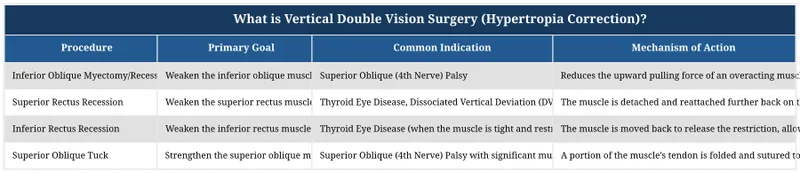
Comparing Common Vertical Eye Muscle Procedures
Fourth nerve palsy surgery often involves weakening the overacting antagonist muscle (the inferior oblique) rather than directly operating on the paretic superior oblique. You can learn more by comparing surgical techniques for different types of diplopia.
View data as table
| Procedure | Primary Goal | Common Indication | Mechanism of Action |
|---|---|---|---|
| Inferior Oblique Myectomy/Recession | Weaken the inferior oblique muscle | Superior Oblique (4th Nerve) Palsy | Reduces the upward pulling force of an overacting muscle, allowing the eye to settle into a lower position. A myectomy involves removing a section of the muscle. |
| Superior Rectus Recession | Weaken the superior rectus muscle | Thyroid Eye Disease, Dissociated Vertical Deviation (DVD) | The muscle is detached and reattached further back on the eyeball, reducing its upward pulling strength. |
| Inferior Rectus Recession | Weaken the inferior rectus muscle | Thyroid Eye Disease (when the muscle is tight and restricts upward movement) | The muscle is moved back to release the restriction, allowing the eye to move upwards more freely and correcting a downward deviation (hypotropia). |
| Superior Oblique Tuck | Strengthen the superior oblique muscle | Superior Oblique (4th Nerve) Palsy with significant muscle laxity | A portion of the muscle’s tendon is folded and sutured to shorten and tighten it, enhancing its downward pulling action. |
Why Specialist Expertise Matters for Complex Vertical Strabismus
Treating vertical double vision demands diagnostic and surgical precision beyond routine ophthalmology. Vertical and torsional eye muscle actions are linked, and an incorrect surgical adjustment can worsen symptoms or introduce a new misalignment. Consulting an eye muscle specialist with a dedicated focus on adult strabismus is critical.
A specialist like Mr Nadeem Ali, who has dedicated his practice to adult squint and double vision surgery, has essential experience. As a Consultant at Moorfields Eye Hospital for 13 years, leading the Adult Squint and Neuro-Ophthalmology services, he managed many complex cases, including revision surgeries and diplopia from neurological conditions. This type of experience is detailed by organisations like the American Academy of Ophthalmology.
The Importance of an Adult Eye Muscle Specialist
- Diagnostic Accuracy: They interpret complex misalignment patterns across different gaze positions to pinpoint the muscles at fault, especially in cases like fourth cranial nerve palsy.
- Surgical Precision: They use refined surgical techniques, including adjustable sutures, for vertical muscle surgery and to manage patient expectations realistically.
- Experience with Complex Cases: They are experienced with conditions like thyroid eye disease, previous failed surgeries, and neurological palsies, and can offer appropriate solutions.
This focused expertise is vital for patients seeking expert care for 4th nerve palsy surgery in London.
View data as table
| Factor | Consideration for Surgical Plan |
|---|---|
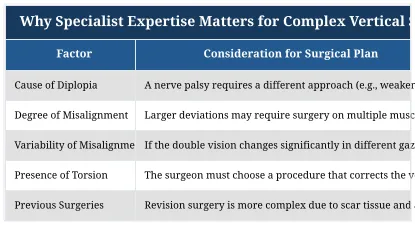
| Cause of Diplopia | A nerve palsy requires a different approach (e.g., weakening an antagonist muscle) than a restrictive process like Thyroid Eye Disease (e.g., releasing a tethered muscle). |
| Degree of Misalignment | Larger deviations may require surgery on multiple muscles or a more significant recession/resection procedure. |
| Variability of Misalignment | If the double vision changes significantly in different gaze directions, the surgical plan must address this “incomitance” by targeting the specific muscles responsible. |
| Presence of Torsion | The surgeon must choose a procedure that corrects the vertical deviation without worsening any underlying torsional (twisting) misalignment. |
| Previous Surgeries | Revision surgery is more complex due to scar tissue and altered anatomy, requiring a surgeon experienced in re-operations. |
What to Expect: Recovery and Outcomes After Vertical Double Vision Surgery
Recovery from vertical diplopia surgery is gradual. The procedure is a day case under general anaesthesia. Immediately after, the eye will be red and feel gritty or sore, managed with prescribed eye drops. Double vision may persist or change initially as the brain adapts to the new eye position and swelling subsides.
Most patients return to non-strenuous activities within a week, but full visual stabilisation can take several weeks to a few months. The surgeon provides a recovery timeline, including when to drive, return to work, and resume swimming. The goal of vertical double vision surgery is to eliminate or significantly reduce double vision in the primary (straight-ahead) and reading positions, restoring comfortable, single binocular vision.
Results and Patient Support
Eliminating constant double vision restores the ability to perform daily tasks like reading, driving, and navigating stairs. It alleviates the physical strain of compensatory head postures and reduces the emotional burden and social anxiety from a visible eye misalignment. Post-operative support, including direct access to the surgical team for any concerns, is a vital part of recovery as vision stabilises.
Considering Vertical Double Vision Surgery? Your Next Steps
If prisms no longer sufficiently solve your vertical double vision, a surgical consultation is the next step. A specialist assessment will determine the cause of your misalignment and your candidacy for a corrective procedure, allowing you to discuss the benefits, process, and expected outcomes.
To explore a permanent solution and learn more about your options, contact us for a consultation. Enquire about double vision surgery or learn how it’s Time to say goodbye to double vision.
Conclusion
Correcting vertical double vision is a specialised field of ophthalmic surgery. The key decision for a patient is who should perform the surgery. Success hinges on an accurate diagnosis of the cause—such as a nerve palsy or thyroid eye disease—and the surgeon’s ability to execute a precise, customised plan. Choosing a surgeon with extensive experience in adult strabismus is the most critical factor in achieving clear, comfortable single vision.
To address your vertical double vision, enquire about double vision surgery. It may be Time to say goodbye to double vision. Contact us for more information.
Frequently Asked Questions
How does vertical double vision surgery differ from correcting horizontal eye misalignment?
Vertical double vision surgery, also known as hypertropia correction, addresses a vertical misalignment where one eye is positioned higher than the other. This differs from horizontal squint surgery as it often involves more intricate adjustments to the oblique eye muscles, which control both vertical and torsional movements. The complexity typically requires a surgeon with specialized expertise in these specific procedures.
What is the most common underlying cause for adults requiring vertical double vision surgery?
In adults, a frequent cause for needing vertical double vision surgery is a superior oblique palsy, also known as 4th nerve palsy, which leads to the affected eye drifting upwards. Other contributing factors can include thyroid eye disease, prior eye socket trauma, or neurological events like a stroke.
What specific surgical techniques are employed to correct hypertropia?
Surgical techniques for hypertropia are highly individualized based on the underlying cause and muscle involvement. Common approaches include weakening an overactive muscle, such as an inferior oblique myectomy, or strengthening a weak one, like a superior oblique tuck. Mr. Nadeem Ali customizes the precise technique following detailed pre-operative assessments.
When should an adult consider vertical double vision surgery if prism glasses are no longer effective?
Adults should consider vertical double vision surgery when prism glasses no longer adequately correct their diplopia or become impractical for daily activities. This often occurs when the degree of misalignment is too large for prisms to manage comfortably, or if the double vision is present in multiple gaze directions. Surgery aims to provide a more permanent and comprehensive solution for clear, single vision.
What is the typical recovery experience after vertical double vision surgery?
Following vertical double vision surgery, patients typically experience some redness, mild discomfort, and possibly temporary blurry or fluctuating vision for a few days. Most individuals can resume light activities within a week, though full stabilization of vision and complete healing may take several weeks to a few months. Mr. Ali provides 24/7 WhatsApp access during recovery for peace of mind (Signature Care package).
How do adjustable sutures contribute to the precision of vertical double vision surgery?
Adjustable sutures are a specialized technique used in vertical double vision surgery to enhance the precision of eye muscle realignment. They allow the surgeon to fine-tune the eye muscle position shortly after the initial procedure, often within the first 24 hours, to achieve optimal alignment. This method is particularly beneficial for complex cases of hypertropia, aiming for the most accurate and stable visual outcome.
Related Posts
Find out if you are suitable for Double Vision Treatment
Find out if you could benefit from this life changing surgery by contacting us today
Our most popular procedures


Hello, I’m Nadeem Ali
I’m one of the few eye surgeons in the world with 100% focus on Squint and Double Vision Surgery.
I have 24 years of eye surgery experience, and worked for 13 years as a Consultant at London’s renowned Moorfields Eye Hospital.
In 2023, I left the NHS to focus fully on treating patients from across the world at the London Squint Clinic. You can read more about me here.
There’s lots of information on the website about: squint surgery, double vision surgery and our pricing.
The most rewarding part of my job is hearing patients tell me how squint or double vision surgery has changed their lives. You can hear these stories here.
Mr Nadeem Ali
MA MB BChir MRCOphth FRCSEd(Ophth)