
A Detailed Look at Adjustable Suture Surgery for Diplopia
Why Choose Private Squint Surgery?
In the UK, squint surgery may be performed via the NHS, through insurance, or as self-pay. NHS treatment is free, but waiting times can be long and surgery is often performed by trainees under supervision. Many operations are carried out by surgeons who mainly specialise in children’s squint rather than adult complex cases.
With insurance, fees are standardised — meaning some leading specialists choose not to participate. Self-pay allows you to choose your surgeon directly and prioritise experience, specialisation, and access.
Many centres quote only a surgical fee. Hospital costs, anaesthetic fees and follow-ups are frequently additional. At London Squint Clinic, everything is included in one transparent package.
Our Complete Package – £10,000
- ✔ Advanced surgery by Mr Ali (one or both eyes)
- ✔ Adjustable sutures where clinically indicated
- ✔ Detailed orthoptic planning
- ✔ All hospital & anaesthetic fees included
- ✔ Post-operative medication
- ✔ Two video follow-ups
- ✔ Face-to-face review appointment
What Makes Us Different
- ✔ 100% focused on adult squint & double vision surgery
- ✔ >95% audited success rate
- ✔ Free re-treatment at 3 months if worse (extremely rare)
- ✔ 24/7 direct WhatsApp access to your surgeon during recovery
- ✔ Optional well-being session & pre-op reassurance call
Initial consultation: from £150
Surgery typically within 4 weeks. No referral required. Self-pay only.
Adjustable Suture Surgery: Precise Diplopia Correction
Adjustable suture surgery is an advanced eye muscle surgery technique that allows for the fine-tuning of eye alignment after the initial operation. This two-stage procedure is highly effective for adults with diplopia, as it enables a surgeon to make micro-adjustments while the patient is awake, ensuring the highest precision for clear, single binocular vision. This article details how this method works, who benefits most, and what to expect during recovery. The technique provides a tailored diplopia correction that accounts for an individual’s unique visual perception, significantly increasing the success rate of eliminating double vision.
London Squint Clinic provides specialist, consultant-led care focused exclusively on adult squint and double vision surgery. This includes complex cases requiring advanced surgical techniques to restore eye alignment and achieve functional, comfortable vision for patients from the UK and internationally.
To explore your options, contact us to schedule your consultation. You can also reach us via: Enquire about double vision surgery, Time to say goodbye to double vision
What is Adjustable Suture Surgery for Diplopia?
Adjustable suture surgery is an eye muscle surgery technique for the precise correction of strabismus (squint), particularly in adults experiencing diplopia (double vision). It involves reattaching an eye muscle with a temporary, adjustable knot. This allows for fine-tuning the eye’s alignment hours after the initial operation to achieve high accuracy for single, comfortable vision.
Unlike traditional methods where the eye’s final position is fixed during the operation, this two-stage approach allows post-operative refinement. This benefits adults, whose visual systems are less adaptable than children’s and for whom a minuscule misalignment can result in persistent double vision. This diplopia correction method restores clear, functional binocular vision.
Precision Alignment for Clearer Vision
Eliminating diplopia in adults requires extremely precise eye alignment. The adult brain has lost plasticity and cannot easily ignore or fuse misaligned images. Adjustable suture surgery addresses this need for precision. The surgeon makes micro-adjustments with the patient awake and providing real-time feedback, achieving an alignment tailored to the individual’s visual perception and increasing the likelihood of resolving debilitating double vision.
How Does Adjustable Suture Surgery Work to Eliminate Double Vision?
The procedure is a two-part process combining surgery with a subsequent, non-invasive adjustment. This technique is designed for patient comfort and effective fine-tuning of eye alignment.
The Surgical Procedure and Initial Alignment
The first stage is performed under general anaesthetic. The surgeon makes a small, hidden incision, often a fornix incision (in the fold of the conjunctiva), to access the misaligned eye muscle. This approach minimises visible scarring and post-operative discomfort. The muscle is detached and reattached to the eye wall at a new position calculated to improve alignment.
The key difference is the suture. Instead of a permanent knot, the surgeon uses a temporary slipknot or ‘bow-tie’ style knot, with the suture ends left accessible on the eye’s surface. The eye is patched, and the patient rests for several hours as the anaesthetic wears off.
The Post-Operative Adjustment Process
The second stage, the post-operative adjustment, occurs 4 to 6 hours later. The patient is awake and sitting up. The surgeon administers local anaesthetic eye drops to numb the eye for a comfortable process. The eye patch is removed, and the patient’s alignment is assessed as they look in different directions.
Based on this assessment and the patient’s feedback, the surgeon pulls the suture ends to tighten or loosen the muscle’s position, making minute alignment changes. This allows for real-time calibration. Once optimal alignment is achieved and the patient confirms single vision, a permanent knot is tied, and the excess suture is trimmed. The process is typically quick and well-tolerated.
Who Benefits from Adjustable Suture Surgery for Diplopia?
This squint surgery benefits adults whose double vision is complex or where the surgical outcome is less predictable. The ability to fine-tune the alignment post-operatively is a critical advantage when achieving perfect binocular vision is the primary goal.
Ideal Candidates for Enhanced Precision
Ideal candidates for this procedure include:
- Adults with long-standing or complex diplopia: Especially those where prism glasses are no longer effective or tolerated.
- Revision surgery cases: Patients who have had previous, unsuccessful strabismus surgery have scar tissue that makes surgical outcomes unpredictable.
- Patients with paralytic strabismus: Misalignment caused by cranial nerve palsies (e.g., 3rd, 4th, or 6th nerve palsy) is challenging to correct with fixed sutures.
- Thyroid eye disease: The restrictive nature of eye muscle involvement in this condition makes precise positioning difficult to predict.
- Adults with a high demand for visual precision: Individuals whose profession or daily life requires perfect binocular vision.
For these individuals, the accuracy of an adjustable technique can be the deciding factor in restoring quality of life.
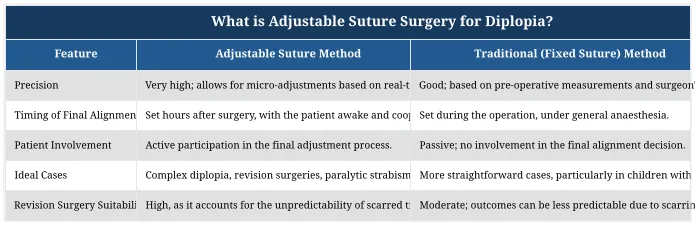
Adjustable vs. Traditional: Why Precision Matters for Diplopia
The table below highlights key differences for adult patients with double vision.
View data as table
| Feature | Adjustable Suture Method | Traditional (Fixed Suture) Method |
|---|---|---|
| Precision | Very high; allows for micro-adjustments based on real-time patient feedback. | Good; based on pre-operative measurements and surgeon’s intra-operative judgement. |
| Timing of Final Alignment | Set hours after surgery, with the patient awake and cooperative. | Set during the operation, under general anaesthesia. |
| Patient Involvement | Active participation in the final adjustment process. | Passive; no involvement in the final alignment decision. |
| Ideal Cases | Complex diplopia, revision surgeries, paralytic strabismus, thyroid eye disease. | More straightforward cases, particularly in children with adaptable visual systems. |
| Revision Surgery Suitability | High, as it accounts for the unpredictability of scarred tissue. | Moderate; outcomes can be less predictable due to scarring. |
The London Squint Clinic Advantage: Expertise in Advanced Diplopia Correction
The success of an adjustable suture procedure depends on the surgeon’s skill and experience. It requires understanding eye muscle mechanics and adult binocular vision. At London Squint Clinic, Mr Nadeem Ali is a specialist focusing on adult squint and double vision.
Mr. Nadeem Ali’s Specialised Approach to Adult Diplopia
With 24 years of eye surgery experience, Mr. Ali’s career is dedicated to this sub-specialty. He was a Consultant at Moorfields Eye Hospital for 13 years (2010-2023), where he was Lead for Adult Squint and Neuro-Ophthalmology. His training under pioneers like Mr John Lee and his fellowships at Moorfields and the National Hospital for Neurology and Neurosurgery, Queen Square, gave him extensive experience managing the most complex cases of adult diplopia.
This background provides a comprehensive understanding of the functional and neurological aspects of each patient’s condition. His 100% focus on adult strabismus means he can address the specific challenges adult patients face.
Commitment to Outcomes: Success Rates and Patient Trust
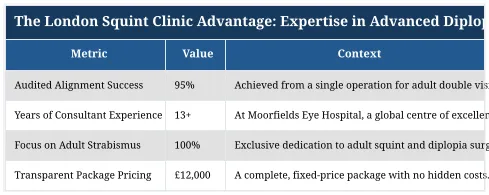
Transparency and patient outcomes are central to the clinic. Techniques are backed by audited results and a patient-centric support structure.
View data as table
| Metric | Value | Context |
|---|---|---|
| Audited Alignment Success | 95% | Achieved from a single operation for adult double vision. |
| Years of Consultant Experience | 13+ | At Moorfields Eye Hospital, a global centre of excellence. |
| Focus on Adult Strabismus | 100% | Exclusive dedication to adult squint and diplopia surgery. |
| Transparent Package Pricing | £12,000 | A complete, fixed-price package with no hidden costs. |
This commitment is supported by a re-operation policy and direct 24/7 access to Mr. Ali during recovery to achieve the best visual outcome.
What to Expect: Recovery, Results, and Life After Adjustable Suture Surgery
Understanding the recovery process helps patients prepare. The timeline is designed for comfort while maximising the benefits of the adjustable suture technique.
Immediate Post-Operative Care and Adjustment Day
Immediately after the operation, your eye will be patched. You will rest for several hours until the adjustment. During the adjustment, you will feel no pain due to anaesthetic drops, though mild pressure is normal. Once the final knot is tied, antibiotic drops are applied, and you can go home the same day.
The eye will be red and feel gritty for the first one to two weeks. You will receive a schedule of eye drops to prevent infection and reduce inflammation. Most patients return to non-strenuous activities and desk-based work within 7 to 10 days. Avoid strenuous exercise and swimming for a few weeks, as advised.
Long-Term Outcomes and Restoring Quality of Life
The primary goal is eliminating double vision in the primary (straight-ahead) position of gaze. The adjustment’s precision increases the chance of achieving this from a single operation. Successful diplopia correction improves daily life, restoring the ability to drive, read, navigate stairs, and interact socially with confidence.
Restoring comfortable binocular vision reduces the headaches, eye strain, and disorientation that accompany diplopia. The long-term result is improved eyesight, independence, and quality of life. For more details, patients can review information on what patients should know about adjustable sutures.
Take the First Step Towards Clear, Single Vision
Living with double vision is isolating and functionally limiting. If you have been told nothing more can be done or if prism glasses no longer provide relief, this surgical approach may be a solution. The precision of adjustable techniques, performed by a dedicated specialist, can restore single vision and quality of life.
To learn if this procedure can help you, contact us to schedule a consultation with Mr Nadeem Ali and explore your options for a future free from double vision.
Enquire about double vision surgery or find out why it’s Time to say goodbye to double vision.
Conclusion
Adults with diplopia should choose a treatment offering the highest precision. While standard techniques can be effective, the adjustable suture method has an advantage for complex cases, revision surgeries, or when eliminating double vision is paramount. It makes the procedure a dynamic process tailored to individual vision. A consultation with a surgeon specialising in adult strabismus can determine if this approach is right for you. To begin, contact us.
Enquire about double vision surgery and learn more about how you can Time to say goodbye to double vision.
Frequently Asked Questions
How does adjustable suture surgery specifically differ from traditional squint surgery methods?
Unlike traditional methods where eye muscle position is fixed during the initial operation, adjustable suture surgery allows for a precise post-operative adjustment. This fine-tuning, typically performed within hours of the main surgery, accounts for how the eye settles and the effects of anesthesia, leading to more accurate alignment for single vision.
What success rate can patients expect for achieving single vision with this advanced surgical technique?
At London Squint Clinic, patients undergoing eye muscle surgery for diplopia can expect a high success rate, with 95% achieving audited alignment success from a single operation. This precision significantly increases the likelihood of restoring clear, comfortable single vision, as demonstrated by Mr. Nadeem Ali’s extensive experience.
What is the typical duration of the post-operative adjustment for an adjustable suture?
The post-operative adjustment for an adjustable suture is a quick and comfortable process, typically lasting only a few minutes. It is performed a few hours after the main surgery, once the patient is fully awake, using numbing drops to ensure comfort and optimal eye positioning.
Are there specific conditions or patient types for whom adjustable suture surgery is not recommended?
While most adults and cooperative teenagers are excellent candidates for this precise technique, it may not be suitable for very young children or patients unable to cooperate during the post-operative adjustment. Mr. Nadeem Ali assesses each case individually to determine the most appropriate surgical approach for correcting double vision.
When are prism glasses no longer sufficient, making eye muscle adjustment surgery a necessary option?
Eye muscle adjustment surgery becomes a necessary option when prism glasses are no longer sufficient or tolerated, often due to increasing prism strength requirements, visual distortion, or discomfort. This indicates that the underlying eye misalignment causing diplopia requires a more definitive surgical correction to restore functional single vision and improve quality of life.
What is the typical cost for adjustable suture surgery at a specialist clinic in the UK?
At a specialist clinic like London Squint Clinic, the complete package for adjustable suture surgery for diplopia is transparently priced at £12,000. This fixed cost covers all aspects of the surgical care, from initial consultation to post-operative follow-ups, ensuring no hidden expenses.
Related Posts
Find out if you are suitable for Double Vision Treatment
Find out if you could benefit from this life changing surgery by contacting us today
Our most popular procedures


Hello, I’m Nadeem Ali
I’m one of the few eye surgeons in the world with 100% focus on Squint and Double Vision Surgery.
I have 24 years of eye surgery experience, and worked for 13 years as a Consultant at London’s renowned Moorfields Eye Hospital.
In 2023, I left the NHS to focus fully on treating patients from across the world at the London Squint Clinic. You can read more about me here.
There’s lots of information on the website about: squint surgery, double vision surgery and our pricing.
The most rewarding part of my job is hearing patients tell me how squint or double vision surgery has changed their lives. You can hear these stories here.
Mr Nadeem Ali
MA MB BChir MRCOphth FRCSEd(Ophth)