
The Link Between Head Trauma, Stroke, and Acquired Eye Misalignment
Why Choose Private Squint Surgery?
In the UK, squint surgery may be performed via the NHS, through insurance, or as self-pay. NHS treatment is free, but waiting times can be long and surgery is often performed by trainees under supervision. Many operations are carried out by surgeons who mainly specialise in children’s squint rather than adult complex cases.
With insurance, fees are standardised — meaning some leading specialists choose not to participate. Self-pay allows you to choose your surgeon directly and prioritise experience, specialisation, and access.
Many centres quote only a surgical fee. Hospital costs, anaesthetic fees and follow-ups are frequently additional. At London Squint Clinic, everything is included in one transparent package.
Our Complete Package – £10,000
- ✔ Advanced surgery by Mr Ali (one or both eyes)
- ✔ Adjustable sutures where clinically indicated
- ✔ Detailed orthoptic planning
- ✔ All hospital & anaesthetic fees included
- ✔ Post-operative medication
- ✔ Two video follow-ups
- ✔ Face-to-face review appointment
What Makes Us Different
- ✔ 100% focused on adult squint & double vision surgery
- ✔ >95% audited success rate
- ✔ Free re-treatment at 3 months if worse (extremely rare)
- ✔ 24/7 direct WhatsApp access to your surgeon during recovery
- ✔ Optional well-being session & pre-op reassurance call
Initial consultation: from £150
Surgery typically within 4 weeks. No referral required. Self-pay only.
Squint After Head Trauma: Restoring Single Vision
A squint after head trauma or stroke occurs when neurological damage disrupts eye muscle control, causing misalignment and double vision (diplopia). This guide explains the direct link between traumatic brain injury (TBI), cranial nerve palsy, and acquired strabismus. We detail the diagnostic process for post-traumatic diplopia and outline effective treatments, from prism correction to specialized strabismus surgery. Understanding these connections is the first step toward restoring single vision and requires expert neuro-ophthalmic assessment to determine the optimal path to recovery.
The London Squint Clinic focuses exclusively on adult strabismus and double vision correction. Consultant surgeon Mr Nadeem Ali applies extensive experience from his former role at Moorfields Eye Hospital to manage complex cases, including post-traumatic and neurological squints, with advanced surgical solutions.
To explore your options, contact us to schedule your consultation. You can also reach us via: Enquire about squint surgery, Squint Surgery in London
A sudden squint after head trauma or stroke affects vision and daily life. These neurological events disrupt the system controlling eye movement, leading to acquired eye misalignment (strabismus) and double vision (diplopia). This article details the causes, diagnosis, and surgical and non-surgical treatments available for adults to restore single vision.
How Head Trauma & Stroke Cause Eye Misalignment
Head trauma and stroke cause eye misalignment by damaging the neurological pathways that coordinate eye movements. The brain sends signals through cranial nerves to six muscles attached to each eye. An injury or vascular event can interrupt these signals or directly harm the nerves or brain centres, causing one or more muscles to weaken or become paralysed. This imbalance prevents the eyes from working together, resulting in a visible turn or squint and often causing double vision.
Understanding Traumatic Diplopia and Strabismus
Traumatic diplopia is double vision following a physical injury, a direct symptom of eye misalignment. Strabismus is the clinical term for this misalignment, also known as a squint. When acquired in adulthood, the brain cannot ignore the image from the misaligned eye, causing double vision. This causes functional difficulties with reading, driving, and judging distances, accompanied by headaches, eye strain, or the need to close one eye or adopt an unusual head posture.
Key Neurological Causes of Post-Traumatic Squint
The nature of an eye misalignment after an injury depends on which part of the neuro-ocular system is affected. The damage can range from direct injury to the eye socket to subtle damage to the nerves that control eye muscles.
Cranial Nerve Palsies: 3rd, 4th, and 6th Nerve Damage
The most common neurological cause of post-traumatic diplopia is damage to one of the three cranial nerves dedicated to eye movement. A sudden squint in an adult is often traced back to one of these issues.
- Sixth Nerve Palsy: The abducens (6th) nerve controls the lateral rectus muscle, which moves the eye outwards. Damage to this nerve is common after a traumatic brain injury (TBI) due to its long path through the skull. It results in an inward turn of the eye (esotropia) and horizontal double vision that worsens when looking towards the affected side.
- Fourth Nerve Palsy: The trochlear (4th) nerve is the most slender cranial nerve and is particularly vulnerable to injury. It controls the superior oblique muscle, which helps with downward and rotational eye movements. Damage causes vertical double vision, often noticed most when looking down to read or walk down stairs, and may lead to a compensatory head tilt.
- Third Nerve Palsy: The oculomotor (3rd) nerve controls four of the six eye muscles, as well as the eyelid and pupil. Damage can cause a complex misalignment, with the eye often turned down and out, accompanied by a droopy eyelid (ptosis) and a dilated pupil.
Brainstem Injury and Orbital Trauma
Direct physical trauma can also cause misalignment. An orbital fracture, a break in the bones of the eye socket, can entrap an eye muscle, physically restricting its movement and causing a squint. A stroke or injury affecting the brainstem—the area that integrates and coordinates signals for eye movements—can lead to complex patterns of strabismus not confined to a single nerve palsy.
Diagnosing and Managing Double Vision After Stroke
Diagnosing double vision after a stroke or head injury begins with a detailed history of the event and symptoms, followed by a comprehensive neuro-ophthalmic examination to measure the misalignment and identify the affected muscles or nerves.
Initial Assessment and Diagnostic Tools
The assessment evaluates eye movements in all directions of gaze, measures the angle of the squint using prisms, and assesses for associated signs like ptosis or abnormal pupil responses. Neuro-imaging such as an MRI or CT scan of the brain and orbits is often used to visualise the nerves, brainstem, and eye sockets to confirm the cause of the misalignment, especially after trauma.
Conservative Management Options
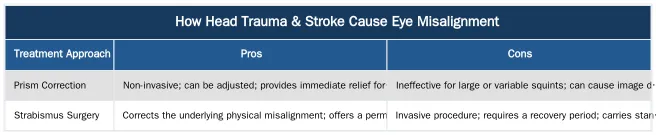
Observation is often recommended initially, as some nerve palsies recover spontaneously over 6 to 12 months. During this time, symptoms can be managed with conservative measures. Patching one eye eliminates double vision but sacrifices depth perception. Prisms are lenses fitted to glasses that bend light to merge the two images, but they are effective only for smaller, stable misalignments.
Specialist Surgical Solutions for Persistent Squint
When double vision and eye misalignment persist beyond the recovery period, or if the deviation is too large for prisms, strabismus surgery is the definitive treatment. Surgery aims to physically realign the eyes, restoring single vision and improving cosmetic appearance.
When is Strabismus Surgery Recommended?
Surgery is recommended once the eye misalignment has been stable for at least six months, indicating that spontaneous neurological recovery has plateaued. For adults with a persistent squint, surgery offers a path to recovery and a return to normal activities. The procedure adjusts the position or tension of the eye muscles to realign the eyes.
Mr Nadeem Ali’s Expertise in Complex Adult Cases
Correcting a squint after head trauma or stroke, particularly those involving cranial nerve palsies, requires advanced surgical skill. Mr Nadeem Ali focuses exclusively on adult strabismus and double vision, with 13 years of experience as a Consultant at Moorfields Eye Hospital. He has expertise in managing complex cases, including fourth nerve palsy and sixth nerve palsy, and performing revision surgery for patients with previously unsuccessful outcomes.
Mr Ali frequently uses adjustable suture techniques to fine-tune eye alignment post-operatively while the patient is awake. This technique is valuable in complex neurological cases and contributes to a high success rate in achieving optimal alignment from a single operation. For more information on cranial nerve palsies, the National Institute of Neurological Disorders and Stroke provides patient resources.

Recovery and Life After Squint Surgery
Recovery from strabismus surgery is typically swift, with most patients returning to normal activities within a week. The outcome eliminates double vision and can restore confidence and social comfort.
What to Expect During Post-Operative Recovery
Post-operatively, the eyes will be red and feel gritty or sore for a week or two. Lubricating eye drops are prescribed for comfort and healing. Most patients can resume driving and office work within one to two weeks. At London Squint Clinic, patients have direct 24/7 WhatsApp access to Mr Ali during recovery. A peace of mind policy ensures any necessary further procedures are covered if the outcome is not satisfactory at three months.
Achieving Single Vision and Improved Quality of Life
The goal of treatment is to restore a large field of single vision. Correcting a post-traumatic squint allows patients to drive, read, and interact socially without double vision or a compensatory head posture. This restoration of function positively impacts mental well-being, independence, and quality of life. Patient support organisations like Headway, the brain injury association, offer resources for individuals after a head injury.
Why Choose London Squint Clinic for Your Care?
A squint after head trauma requires specialist care. London Squint Clinic focuses exclusively on adult squint and double vision surgery, offering a direct pathway to treatment.
Access Expert, Consultant-Led Adult Squint Surgery
Led by Mr Nadeem Ali, the clinic provides consultant-delivered care from the first consultation to the final follow-up. Patients access expertise with transparent, fixed-package pricing and short waiting times. The clinic’s approach is based on understanding the functional and emotional challenges of adult strabismus. For more information, explore our services for Squint Surgery in London.
Conclusion
Acquired eye misalignment after a head injury or stroke can impact vision and quality of life. While some cases resolve spontaneously, persistent double vision and strabismus often require specialist intervention. Accurate diagnosis and surgical techniques can realign the eyes and restore single vision. If you are affected by post-traumatic eye misalignment, seeking expert care is the first step toward recovery. Contact us to schedule a consultation. You can also Enquire about squint surgery or find out more about Squint Surgery in London.
Frequently Asked Questions
How can a head injury or stroke cause a squint?
These neurological events can damage the delicate cranial nerves (specifically the 3rd, 4th, or 6th nerves) that control the eye muscles. They can also directly injure the brain centres responsible for coordinating eye movements, leading to a squint after head trauma and causing double vision. This imbalance prevents the eyes from working together as a team.
Is a squint after head trauma always permanent?
Not necessarily, as there is often a period of potential spontaneous recovery over the first 6 to 12 months. Treatment is initially managed with temporary solutions like prisms to alleviate double vision. Surgery is only considered if the squint after head trauma persists after this natural recovery period has passed.
Which nerve is most commonly affected in a squint after head trauma?
The fourth cranial nerve, also known as the trochlear nerve, is particularly vulnerable to injury during head trauma due to its long and slender path within the skull. Damage to this nerve is a frequent cause of a squint after head trauma, typically resulting in vertical double vision where one image appears tilted and higher than the other.
What is the treatment process for acquired eye misalignment?
The first step is a comprehensive neuro-ophthalmic evaluation to diagnose the exact nature of the nerve or muscle damage. Treatment then follows a step-wise approach, beginning with observation for recovery and using prisms to manage double vision. If the problem does not resolve, highly specialised eye muscle surgery can be performed to correct the alignment.
Is it safe to have eye muscle surgery after a stroke?
Yes, once a patient is medically stable and the eye misalignment has been consistent for several months, squint surgery is a safe and highly effective option. The procedure aims to permanently correct the double vision and restore a single, comfortable field of vision for the patient.
How can I get a specialist assessment for a squint after head trauma?
The best course of action is to arrange a consultation with a specialist consultant who focuses on adult strabismus and neuro-ophthalmology. A dedicated expert can perform a detailed assessment to determine the cause of your eye misalignment and recommend a personalised treatment plan. You can enquire about a consultation to start your journey towards clearer vision.
Related Posts
Find out if you are suitable for Double Vision Treatment
Find out if you could benefit from this life changing surgery by contacting us today
Our most popular procedures


Hello, I’m Nadeem Ali
I’m one of the few eye surgeons in the world with 100% focus on Squint and Double Vision Surgery.
I have 24 years of eye surgery experience, and worked for 13 years as a Consultant at London’s renowned Moorfields Eye Hospital.
In 2023, I left the NHS to focus fully on treating patients from across the world at the London Squint Clinic. You can read more about me here.
There’s lots of information on the website about: squint surgery, double vision surgery and our pricing.
The most rewarding part of my job is hearing patients tell me how squint or double vision surgery has changed their lives. You can hear these stories here.
Mr Nadeem Ali
MA MB BChir MRCOphth FRCSEd(Ophth)