
What Are Faden Procedures in Complex Double Vision Surgery?

Why Choose Private Squint Surgery?
In the UK, squint surgery may be performed via the NHS, through insurance, or as self-pay. NHS treatment is free, but waiting times can be long and surgery is often performed by trainees under supervision. Many operations are carried out by surgeons who mainly specialise in children’s squint rather than adult complex cases.
With insurance, fees are standardised — meaning some leading specialists choose not to participate. Self-pay allows you to choose your surgeon directly and prioritise experience, specialisation, and access.
Many centres quote only a surgical fee. Hospital costs, anaesthetic fees and follow-ups are frequently additional. At London Squint Clinic, everything is included in one transparent package.
Our Complete Package – £10,000
- ✔ Advanced surgery by Mr Ali (one or both eyes)
- ✔ Adjustable sutures where clinically indicated
- ✔ Detailed orthoptic planning
- ✔ All hospital & anaesthetic fees included
- ✔ Post-operative medication
- ✔ Two video follow-ups
- ✔ Face-to-face review appointment
What Makes Us Different
- ✔ 100% focused on adult squint & double vision surgery
- ✔ >95% audited success rate
- ✔ Free re-treatment at 3 months if worse (extremely rare)
- ✔ 24/7 direct WhatsApp access to your surgeon during recovery
- ✔ Optional well-being session & pre-op reassurance call
Initial consultation: from £150
Surgery typically within 4 weeks. No referral required. Self-pay only.
Faden Procedure Squint Surgery: Correcting Complex Double Vision
The faden procedure squint surgery is an advanced technique for complex double vision where eye misalignment changes with the direction of gaze. Also known as a posterior fixation suture, it selectively weakens an eye muscle’s action in one field without affecting straight-ahead vision. This article explains how this procedure corrects challenging conditions like incomitant squint and dissociated vertical deviation (DVD) by creating a new, non-functional insertion point for the muscle. Understanding this surgical approach is essential for patients seeking a tailored correction for diplopia in specific gazes.
This advanced surgical technique requires specialist expertise in adult strabismus. At London Squint Clinic, Mr Nadeem Ali applies extensive experience from his former consultant role at Moorfields Eye Hospital to perform complex eye muscle surgery for adults with challenging forms of diplopia.
To explore your options, contact us to schedule your consultation. You can also reach us via: Book your assessment
The faden procedure squint surgery, also known as a posterior fixation suture, addresses complex forms of double vision and eye misalignment. Unlike standard eye muscle surgery that adjusts the primary position of the eye, this procedure selectively weakens a muscle’s action only in certain directions of gaze. This article explains its mechanism, applications for conditions like incomitant squint and dissociated vertical deviation (DVD), and the importance of surgeon expertise for achieving single vision.
What is a Faden Procedure in Complex Squint Surgery?
A Faden procedure is a surgical technique for complex strabismus surgery. It weakens an eye muscle’s action only in a specific field of gaze. The German word “Faden” means “thread” or “suture,” reflecting the technique of placing a suture to fixate a muscle to the eyeball wall (sclera) behind its natural insertion.
This posterior fixation creates a new, non-functional insertion point. As the eye rotates into the muscle’s field of action, the muscle’s effective lever arm shortens, reducing its pulling force. The weakening effect is minimal when the eye is in the primary position (looking straight ahead). This precision corrects incomitant strabismus, where eye misalignment changes with the direction of gaze, by addressing double vision in specific gazes without disrupting forward alignment.
How Does the Posterior Fixation Suture Technique Work?
The mechanical principle of the posterior fixation suture is simple yet surgically demanding. In standard eye muscle surgery, a muscle is recessed (moved back) or resected (shortened) to weaken or strengthen it across its entire range of movement. The Faden technique offers a nuanced adjustment.
During the procedure, the surgeon exposes the target eye muscle, such as the superior rectus muscle for vertical deviations. A non-absorbable suture is passed through the muscle belly at a calculated distance (typically 12-16mm) behind its natural insertion point on the eyeball and anchored to the sclera. This creates a tether that restricts the muscle’s arc of contact with the globe as it rotates. When the eye turns towards the muscle’s field of action, the tether tightens, reducing the muscle’s rotational force.
The Principle of Selective Muscle Weakening
The benefit of this approach is its selectivity: it addresses a muscle’s over-action in one direction without causing under-action or misalignment in the opposite direction. For patients with debilitating double vision only when looking up, down, or to the side, this technique provides a tailored correction. Precision is often enhanced when combined with other techniques, like adjustable suture surgery, which allows for fine-tuning eye alignment shortly after the operation.
When is the Faden Procedure Essential for Complex Double Vision?
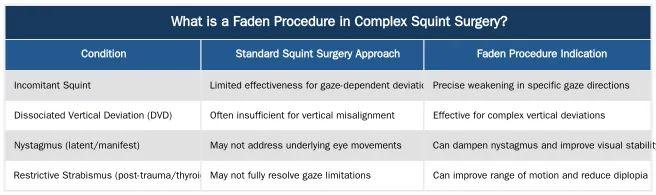
The Faden procedure is reserved for specific strabismus patterns where conventional surgery would be ineffective or worsen the condition. It manages incomitant squints, where the misalignment angle is not constant. For adults, these conditions can impact daily activities like driving, navigating stairs, or computer work.
Key indications include Dissociated Vertical Deviation (DVD), where one eye drifts upwards intermittently, and certain forms of nystagmus, where the procedure can dampen involuntary eye movements and establish a more stable null point (the direction of gaze where eye movement is minimal). It is also used for restrictive strabismus, such as that caused by thyroid eye disease or post-traumatic scarring, to improve the range of single binocular vision. Read more about this complex squint pattern.
Addressing Challenging Squint Patterns
Many Faden procedure candidates have previously been told their condition is too complex to treat. This is often because their misalignment lacks a predictable pattern. The posterior fixation suture provides a solution by targeting the mechanical anomaly responsible for gaze-specific double vision. It is a critical tool for revision squint surgery and other complex cases, offering hope and functional improvement where standard approaches fall short.
The Specialist Advantage: Mr Nadeem Ali’s Expertise in Faden Procedures
A successful faden procedure squint surgery requires a deep understanding of orbital anatomy, eye muscle mechanics, and complex strabismus pathophysiology. Suture placement is critical; a millimeter of difference can alter the outcome. This non-routine operation should only be performed by a surgeon with extensive experience in adult complex strabismus.
Mr Nadeem Ali has over 24 years of surgical experience, including 13 years as a Consultant at Moorfields Eye Hospital. From 2016 to 2023, he was the Lead for Adult Squint and Double Vision and Neuro-Ophthalmology at Moorfields South, managing complex cases. His practice at the London Squint Clinic is 100% focused on adult squint and double vision, providing expertise in techniques like the posterior fixation suture. This specialization is supported by advanced fellowship training, ensuring patient care is based on extensive knowledge and skill.
Why Advanced Expertise is Crucial for Complex Strabismus
The decision to perform a Faden procedure requires a meticulous diagnostic process. The surgeon must accurately measure the deviation in all positions of gaze and understand the underlying cause, whether a nerve palsy, mechanical restriction, or congenital anomaly. As documented by the American Academy of Ophthalmology, strabismus is a complex condition with diverse causes. Surgical planning involves precise calculations to determine which muscle to operate on and where to place the fixation suture. This level of diagnostic and surgical planning is the hallmark of a specialist centre for adult double vision surgery, where the goal is restoring functional single vision, not just cosmetic alignment.
Life After Faden Surgery: Expected Outcomes and Recovery
The primary goal of a Faden procedure is to expand the field of single binocular vision, reducing double vision in specific gazes that interfere with daily life. A successful outcome enables patients to drive, read, work, and navigate their environment with more confidence. The London Squint Clinic has an audited alignment success rate of 95% from a single operation.
Recovery from a Faden procedure is similar to other eye muscle surgeries. The eye will be red and feel gritty for a few weeks; lubricating eye drops aid comfort and healing. Most patients return to non-strenuous activities and desk-based work within one to two weeks. Final alignment can take several weeks to months to stabilize as the brain adapts to the new muscle mechanics. Follow-up appointments are crucial to monitor progress.

Achieving Life-Changing Single Vision
For adults with complex double vision, restoring single vision is profound. It restores balance, reduces eye strain and headaches, and removes a barrier to social and professional engagement. Lifting the emotional burden of eye misalignment allows a return to a more active and fulfilling life. This functional and psychological restoration is the ultimate measure of success for a faden procedure squint surgery.
Considering Faden Procedure for Your Double Vision?
If you have double vision that changes with your direction of gaze, or have been told your squint is too complex for standard treatment, a specialist consultation is the next step. The Faden procedure, performed by an expert surgeon, can offer an effective and lasting solution. At the London Squint Clinic, Mr Nadeem Ali cares for every patient from initial consultation through surgery and recovery.
We provide a patient-focused approach to care for complex adult strabismus. To learn more about your options, Book your assessment.
Conclusion
The Faden procedure, or posterior fixation suture, is a precise surgical tool for correcting complex strabismus and double vision unresponsive to standard treatments. Its ability to selectively weaken a muscle’s action in a specific gaze is indispensable for conditions like incomitant squint and DVD. Success depends on the diagnostic and surgical skill of a specialized surgeon. For adults with challenging eye misalignment, this procedure offers an opportunity to regain functional single vision and improve quality of life. To explore treatment options for complex double vision, contact us or Book your assessment directly with Mr Nadeem Ali.
Frequently Asked Questions
What is a faden procedure squint surgery?
A faden procedure squint surgery, also known as a posterior fixation suture, is a highly specialised technique for complex eye misalignment. It involves placing a suture to attach an eye muscle to the eyeball further back from its natural insertion point. This selectively weakens the muscle’s action only when the eye turns into a specific direction, without affecting its primary position.
When is a faden procedure squint surgery necessary?
This type of operation is reserved for complex cases of ‘incomitant’ double vision, where the eye misalignment changes significantly depending on the direction of gaze. A faden procedure squint surgery is often the ideal solution for conditions like Dissociated Vertical Deviation (DVD) or specific cranial nerve palsies where standard surgery would be ineffective.
How does a posterior fixation suture correct complex double vision?
The posterior fixation suture creates a new, non-functional insertion point for the eye muscle, effectively shortening its lever arm. This limits the muscle’s rotational force only when the eye turns into a specific field of gaze. This targeted weakening is crucial for resolving double vision that appears only when looking up, down, or to the side, while maintaining good alignment when looking straight ahead.
Who is qualified to perform a faden procedure squint surgery?
No, this is an advanced technique that requires significant sub-specialist training and experience in complex strabismus. A faden procedure squint surgery should only be performed by a consultant surgeon, like Mr. Nadeem Ali, who has a dedicated focus on complex adult squint and neuro-ophthalmology. This ensures the highest level of precision for these challenging cases.
Why might I need this specific operation instead of standard eye muscle surgery?
You might need this specialised operation if your double vision is only present in certain gaze positions. Standard muscle recession or resection surgery affects the eye’s alignment in all positions and could cause new problems when looking straight ahead. The posterior fixation technique offers a more nuanced, targeted approach for these specific and challenging cases of incomitant strabismus.
How can I find out if this surgery is right for my double vision?
The first step is a comprehensive assessment with a specialist to determine the precise cause of your double vision and misalignment. Mr. Nadeem Ali evaluates complex cases to see if a posterior fixation suture or another advanced technique is the most appropriate solution for you. You can start the process by booking your initial consultation to discuss your specific needs.
Related Posts


Find out if you are suitable for Double Vision Treatment
Find out if you could benefit from this life changing surgery by contacting us today
Our most popular procedures


Hello, I’m Nadeem Ali
I’m one of the few eye surgeons in the world with 100% focus on Squint and Double Vision Surgery.
I have 24 years of eye surgery experience, and worked for 13 years as a Consultant at London’s renowned Moorfields Eye Hospital.
In 2023, I left the NHS to focus fully on treating patients from across the world at the London Squint Clinic. You can read more about me here.
There’s lots of information on the website about: squint surgery, double vision surgery and our pricing.
The most rewarding part of my job is hearing patients tell me how squint or double vision surgery has changed their lives. You can hear these stories here.
Mr Nadeem Ali
MA MB BChir MRCOphth FRCSEd(Ophth)