
Is Adult-Onset Double Vision a Medical Emergency?
Why Choose Private Squint Surgery?
In the UK, squint surgery may be performed via the NHS, through insurance, or as self-pay. NHS treatment is free, but waiting times can be long and surgery is often performed by trainees under supervision. Many operations are carried out by surgeons who mainly specialise in children’s squint rather than adult complex cases.
With insurance, fees are standardised — meaning some leading specialists choose not to participate. Self-pay allows you to choose your surgeon directly and prioritise experience, specialisation, and access.
Many centres quote only a surgical fee. Hospital costs, anaesthetic fees and follow-ups are frequently additional. At London Squint Clinic, everything is included in one transparent package.
Our Complete Package – £10,000
- ✔ Advanced surgery by Mr Ali (one or both eyes)
- ✔ Adjustable sutures where clinically indicated
- ✔ Detailed orthoptic planning
- ✔ All hospital & anaesthetic fees included
- ✔ Post-operative medication
- ✔ Two video follow-ups
- ✔ Face-to-face review appointment
What Makes Us Different
- ✔ 100% focused on adult squint & double vision surgery
- ✔ >95% audited success rate
- ✔ Free re-treatment at 3 months if worse (extremely rare)
- ✔ 24/7 direct WhatsApp access to your surgeon during recovery
- ✔ Optional well-being session & pre-op reassurance call
Initial consultation: from £150
Surgery typically within 4 weeks. No referral required. Self-pay only.
Adult Onset Double Vision: When to Seek A&E
Sudden adult onset double vision requires immediate medical assessment to distinguish between a benign eye issue and a neurological emergency. This guide explains the critical red flag symptoms, such as a severe headache or facial weakness, that signal a potential stroke or aneurysm and necessitate a visit to A&E. Understanding the difference between binocular and monocular diplopia is key, as conditions like cranial nerve palsy can cause sudden eye misalignment. You will learn when to seek emergency care and when to consult a specialist for persistent double vision.
The London Squint Clinic provides specialist assessment for persistent double vision after urgent neurological causes have been excluded. This includes diplopia from cranial nerve palsy, thyroid eye disease, or decompensated long-standing squints, offering expert diagnosis and management.
To explore your options, contact us to schedule your consultation. You can also reach us via: Enquire about squint surgery, Squint Surgery in London
Adult onset double vision (diplopia) can be alarming and may indicate serious health issues. It occurs when misaligned eyes cause the brain to perceive two separate images. This article clarifies when sudden double vision is a medical emergency for A&E and when it requires a specialist, covering critical symptoms, potential causes, and necessary steps to protect your vision and health.
What is Adult-Onset Double Vision and Why Does it Occur Suddenly?
Double vision in adulthood occurs when the two eyes fail to work together, sending conflicting images to the brain. This misalignment can result from problems with eye muscles, their controlling nerves, or the brain. Its sudden appearance is a warning sign, often indicating an abrupt change in one of these systems.
Understanding Binocular vs. Monocular Diplopia
Binocular double vision, the most common and concerning type, is present only when both eyes are open and disappears when either eye is covered, indicating an eye alignment problem. Monocular double vision persists in one eye even when the other is closed. It is caused by an issue within the eye, such as a cataract or astigmatism, and is not usually a neurological emergency.
Common Non-Emergency Causes of Sudden Double Vision
Not all causes of sudden diplopia are life-threatening. Less urgent causes include decompensation of a long-standing squint (strabismus), thyroid eye disease, or severe fatigue. Because self-diagnosis is impossible, any new double vision requires prompt medical evaluation to rule out serious conditions.
When is Sudden Adult Double Vision a Medical Emergency? Recognizing Red Flags
Sudden double vision with other neurological symptoms indicates a medical emergency. These “red flag” symptoms suggest a brain problem, such as a stroke or aneurysm, that requires immediate investigation and treatment at an Accident & Emergency department.
Critical Symptoms Requiring Immediate Emergency Care
Seek immediate emergency care if sudden double vision is accompanied by any of the following:
- A sudden, severe headache, often described as the “worst headache of your life”
- Weakness, numbness, or paralysis in the face, arm, or leg, particularly on one side of the body
- Slurred speech, difficulty speaking, or trouble understanding others
- Dizziness, loss of balance, or difficulty walking
- A drooping eyelid (ptosis) or a noticeably enlarged or smaller pupil in one eye
- Confusion or a change in consciousness
- Nausea or vomiting
Differentiating Urgent vs. Non-Urgent Double Vision Symptoms
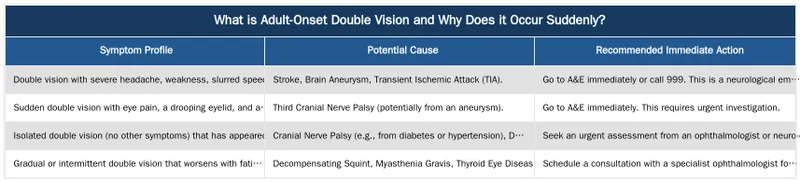
This table distinguishes between symptoms requiring an immediate trip to A&E and those warranting an urgent specialist appointment.
Neurological Causes of Sudden Diplopia: Stroke, Aneurysm, and More
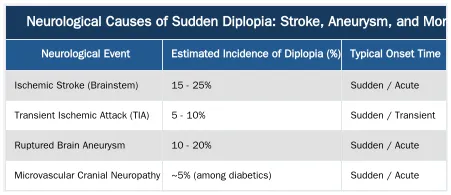
Nerves and blood vessels in the brain control eye movements, and any disruption can cause sudden double vision. The underlying mechanisms are often related to what causes a squint to suddenly appear in adults.
Understanding Cranial Nerve Palsies and Diplopia
Three cranial nerves—the third (oculomotor), fourth (trochlear), and sixth (abducens)—move the six muscles of each eye. A palsy occurs when one of these nerves is damaged, causing eye misalignment and binocular double vision. Causes include microvascular issues from diabetes or high blood pressure, or compression from a tumour or aneurysm. A neuro-ophthalmology specialist, such as Mr Nadeem Ali, is essential for diagnosing and managing these conditions.
The Link Between Double Vision and Conditions like Stroke or TIA
A stroke or transient ischemic attack (TIA) occurs when blood flow to a part of the brain is cut off. If this happens in the brainstem or cerebellum—areas coordinating eye movement—double vision can be a primary symptom. The Stroke Association reports vision problems are common after a stroke. Sudden diplopia with other neurological signs must be treated as a potential stroke.
What Should You Do if You Experience Sudden Double Vision?
Your response to sudden double vision depends on the accompanying symptoms. Do not drive if you are experiencing double vision or any other neurological symptoms.
Immediate Steps: When to Go to A&E
If your double vision is accompanied by red flag symptoms—severe headache, weakness, numbness, facial droop, or difficulty with speech or balance—it is a medical emergency. Call 999 or go to the nearest A&E department immediately. At the hospital, a neurological assessment, including a physical exam and urgent brain imaging (CT or MRI), will identify the cause.
When to Consult a Specialist Eye Doctor (Ophthalmologist or Neuro-Ophthalmologist)
Sudden double vision without other red flag symptoms is still urgent but may not require an A&E visit. Seek an urgent evaluation from an eye specialist. An ophthalmologist, particularly a neuro-ophthalmology or strabismus sub-specialist, can diagnose the cause. They will examine your eye movements and alignment to determine next steps. A comprehensive double vision diagnosis is foundational for effective treatment.
Expert Assessment and Treatment for Persistent Double Vision
After ruling out life-threatening neurological emergencies, the focus shifts to managing the double vision. Persistent diplopia can significantly impact daily activities like reading, driving, and navigation.
The Role of a Specialist in Diagnosing Complex Diplopia
A specialist in adult strabismus and neuro-ophthalmology assesses the misalignment’s cause. This involves using prisms to measure eye deviation in different gaze positions. This precise diagnosis is crucial for developing an effective treatment plan. A dedicated centre like London Squint Clinic focuses on adult squint and double vision, ensuring diagnostic accuracy for complex cases, including those from cranial nerve palsies or previous trauma.
Advanced Treatment Options for Double Vision at London Squint Clinic
Treatment for persistent double vision is tailored to the individual, with non-surgical and surgical options. Prisms can be incorporated into glasses to optically realign images. Botulinum toxin injections can temporarily weaken an overacting eye muscle to improve alignment. For significant and stable deviation, eye muscle surgery (strabismus surgery) is often the most effective permanent solution. This procedure adjusts eye muscle tension to realign the eyes and restore single vision. The American Academy of Ophthalmology notes that surgery is a primary treatment for correcting misalignment. Experienced specialists can manage complex and revision cases.
Why Choose a Specialist for Your Double Vision Care?
Effective diagnosis and treatment of double vision requires specialised knowledge. While emergency services handle acute events, managing persistent double vision requires a dedicated eye muscle specialist. A focused practice ensures the clinician has experience with the full spectrum of conditions causing diplopia.
Accessing Expert Care for Lasting Relief
A consultant-led clinic focused on adult squint and double vision provides expertise critical for the best outcome. This ensures an accurate diagnosis, a personalised treatment plan, and surgical care aimed at restoring single vision and improving quality of life. For those seeking solutions for persistent double vision, a specialist consultation is the next step.
Conclusion
Sudden adult double vision must be taken seriously. If accompanied by neurological red flags, it is a medical emergency requiring immediate A&E assessment. Isolated double vision requires an urgent evaluation by an ophthalmologist. For persistent diplopia after emergency causes are excluded, the care of a neuro-ophthalmologist and strabismus surgeon offers the best path to restoring single vision and quality of life. To explore your options, contact us for a consultation. You can also Enquire about squint surgery or learn more about Squint Surgery in London.
Frequently Asked Questions
When is adult onset double vision a medical emergency?
Sudden adult onset double vision is a medical emergency if accompanied by other symptoms like a severe headache, drooping eyelid, changes in pupil size, facial weakness, or slurred speech. These can be signs of a life-threatening condition like a stroke or aneurysm, and you must go to A&E immediately.
Is sudden double vision still an emergency if I have no other symptoms?
Yes, even if it occurs without other symptoms, the sudden appearance of double vision requires an urgent medical evaluation at A&E. It can be the first and only sign of a serious neurological problem, such as a cranial nerve palsy, that needs prompt investigation to identify the underlying cause.
What is the difference between monocular and binocular adult onset double vision?
Binocular double vision occurs when the eyes are misaligned and disappears when you cover one eye; this type of adult onset double vision can signal a serious neurological issue. Monocular double vision, which persists in one eye even when the other is covered, is typically caused by an issue within the eye itself, like a cataract, and is less urgent.
What happens at A&E for a case of adult onset double vision?
At the hospital, doctors will conduct a thorough neurological examination to assess your nerve function. They will likely order urgent brain imaging, such as a CT or MRI scan, to rule out critical conditions like a stroke or brain tumour as the cause of your adult onset double vision.
After an emergency is ruled out, who should I see for my persistent double vision?
Once life-threatening conditions are excluded, you should seek an assessment with a specialist in adult squint and neuro-ophthalmology. An expert like Mr. Nadeem Ali can accurately diagnose the cause of the eye misalignment and discuss effective treatment options, which may include prisms or corrective surgery. You can enquire about a consultation to begin your journey to clearer vision.
Related Posts

Find out if you are suitable for Double Vision Treatment
Find out if you could benefit from this life changing surgery by contacting us today
Our most popular procedures


Hello, I’m Nadeem Ali
I’m one of the few eye surgeons in the world with 100% focus on Squint and Double Vision Surgery.
I have 24 years of eye surgery experience, and worked for 13 years as a Consultant at London’s renowned Moorfields Eye Hospital.
In 2023, I left the NHS to focus fully on treating patients from across the world at the London Squint Clinic. You can read more about me here.
There’s lots of information on the website about: squint surgery, double vision surgery and our pricing.
The most rewarding part of my job is hearing patients tell me how squint or double vision surgery has changed their lives. You can hear these stories here.
Mr Nadeem Ali
MA MB BChir MRCOphth FRCSEd(Ophth)