
How Surgeons Use Prism Measurement to Quantify Double Vision
Why Choose Private Squint Surgery?
In the UK, squint surgery may be performed via the NHS, through insurance, or as self-pay. NHS treatment is free, but waiting times can be long and surgery is often performed by trainees under supervision. Many operations are carried out by surgeons who mainly specialise in children’s squint rather than adult complex cases.
With insurance, fees are standardised — meaning some leading specialists choose not to participate. Self-pay allows you to choose your surgeon directly and prioritise experience, specialisation, and access.
Many centres quote only a surgical fee. Hospital costs, anaesthetic fees and follow-ups are frequently additional. At London Squint Clinic, everything is included in one transparent package.
Our Complete Package – £10,000
- ✔ Advanced surgery by Mr Ali (one or both eyes)
- ✔ Adjustable sutures where clinically indicated
- ✔ Detailed orthoptic planning
- ✔ All hospital & anaesthetic fees included
- ✔ Post-operative medication
- ✔ Two video follow-ups
- ✔ Face-to-face review appointment
What Makes Us Different
- ✔ 100% focused on adult squint & double vision surgery
- ✔ >95% audited success rate
- ✔ Free re-treatment at 3 months if worse (extremely rare)
- ✔ 24/7 direct WhatsApp access to your surgeon during recovery
- ✔ Optional well-being session & pre-op reassurance call
Initial consultation: from £150
Surgery typically within 4 weeks. No referral required. Self-pay only.
Prism Measurement for Double Vision: Quantifying Eye Misalignment
A precise prism measurement for double vision is the essential first step in quantifying eye misalignment for surgical planning. This diagnostic process uses tools like the prism cover test and prism bars to determine the exact power, measured in prism diopters, needed to fuse two images into one. Understanding this objective measurement of the strabismus angle is critical for developing a treatment plan to correct diplopia. A thorough prism measurement ensures the surgical approach is tailored to the specific horizontal and vertical deviation, aiming for lasting single vision.
At the London Squint Clinic, Mr Nadeem Ali uses these precise diagnostic findings to inform surgical strategies for adults with complex diplopia. This specialist approach translates objective data into a plan for restoring single, comfortable vision, particularly for cases where prism glasses are no longer a sufficient solution.
To explore your options, contact us to schedule your consultation. You can also reach us via: Enquire about double vision surgery, Time to say goodbye to double vision
A precise prism measurement for double vision quantifies eye misalignment to inform an effective treatment plan. Double vision (diplopia) can disrupt daily tasks like reading or driving. This article covers the diagnostic tools and interpretation required to translate these measurements into a surgical strategy for restoring single, comfortable vision.
Understanding Prism Measurement: Your First Step to Clearer Vision
Prism measurement objectively quantifies eye misalignment. By placing prisms of varying strengths before the eyes, a specialist determines the correction needed to merge two images into a single picture.
What is a Prism and How is it Used in an Eye Test?
A prism is a transparent, wedge-shaped optical device that refracts light. Unlike a standard lens, which converges or diverges light to a focal point, a prism deviates light toward its thickest edge (the base).
During an eye test, a specialist places prisms before one or both eyes. The prism redirects the image from the misaligned eye onto the fovea, aligning it with the image from the other eye. The power required for this fusion is measured in prism diopters (PD). One prism diopter deviates a light ray by 1 centimetre at 1 metre, providing a numerical value for the eye turn.
How Do Specialists Quantify Double Vision with Prisms?
Quantifying diplopia involves measuring its exact characteristics, which can vary by gaze direction. This assessment is critical for orthoptics and surgical planning.
The Prism Cover Test and Prism Bar Explained
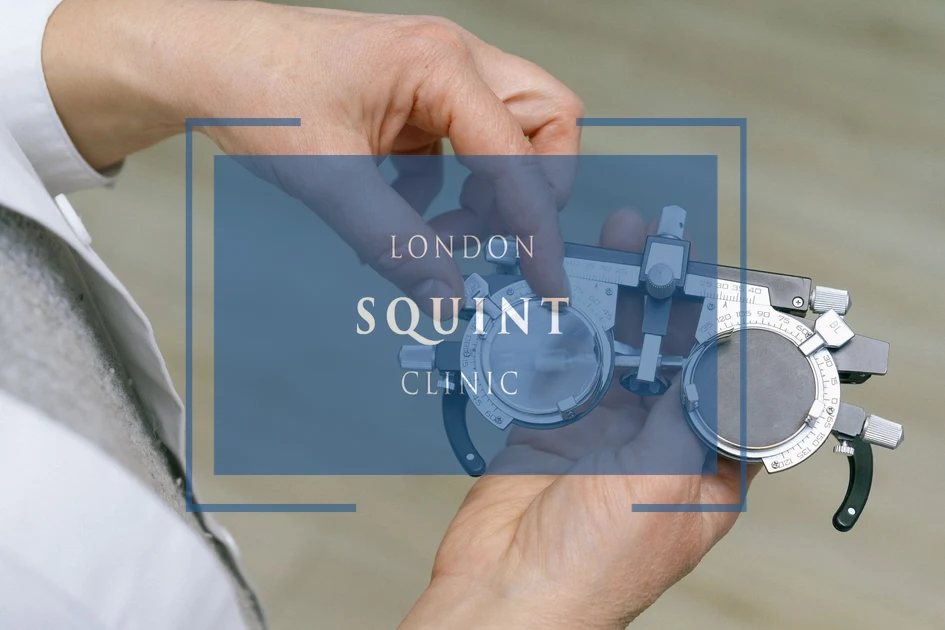
The primary method for measuring eye deviation is the prism cover test. The patient focuses on a target while the clinician alternates covering each eye, observing the uncovered eye’s movement. A prism bar—a plastic bar with prisms of increasing strength—is placed before one eye.
The specialist increases prism strength until eye movement is neutralized, meaning the eye no longer shifts to fixate. The prism diopter value that achieves this is the objective measurement of the misalignment. Prism orientation is also critical:
- A base-out prism measures an inward turn (esotropia).
- A base-in prism measures an outward turn (exotropia).
- Base-up or base-down prisms measure vertical misalignments (hypertropia or hypotropia).
Interpreting Prism Diopters: What the Numbers Mean
The prism diopter value corresponds to the magnitude of the eye deviation. A higher number indicates a larger misalignment. For example, 20 PD is a much larger eye turn than 5 PD.
A comprehensive assessment involves measurements in nine positions of gaze (straight ahead, up, down, left, right, and four corner positions) because the misalignment can change depending on which eye muscles are engaged. This mapping details the muscle imbalance and is essential for surgical planning.
The Surgical Edge: Expert Prism Interpretation for Lasting Relief
While measurement tools are standard, interpreting the results for surgical planning requires expertise. The data acts as a blueprint, guiding the surgeon in designing a specific procedure.
Why Precise Measurement is Paramount for Adult Squint Surgery
For a surgeon like Mr. Nadeem Ali, whose practice focuses on adult squint and double vision, precise measurements are critical. Surgical success depends on accurately quantifying the strabismus angle and its characteristics—whether it is consistent (comitant) or variable (incomitant) in all gaze positions. This detail, gained from specialist experience at institutions like Moorfields Eye Hospital, informs a surgical plan that targets the specific muscles causing the misalignment. This precision enables a high success rate from a single operation, minimizing the need for further procedures. For more information on the diagnostic process, review what to expect during a specialist consultation for diplopia.
When Prism Glasses Are No Longer Enough: The Surgical Threshold
Many adults with double vision initially use prism glasses, which can be a temporary solution. If the condition progresses, the required prism power may increase, making glasses thick, heavy, and cosmetically difficult. High-power prisms can also degrade vision quality, causing distortion or colour fringing.
Prism measurements help determine when this surgical threshold is crossed. When the diopter value is high or prisms no longer provide comfortable single vision, surgery is often the most effective permanent solution. It can restore single vision without spectacles, improving independence and quality of life.
Prism Options: Choosing Between Fresnel and Ground-In for Optimal Outcomes
Before surgery, and sometimes as a diagnostic tool, different types of prisms are used. The two main types are Fresnel and ground-in prisms.
Fresnel Prisms vs. Ground-In Prisms: A Comparative Look
A Fresnel prism (pronounced “fre-nel”) is a thin, flexible plastic sheet with concentric grooves etched into its surface, which can be cut to size and stuck onto a patient’s glasses. Its advantages are its light weight, low cost, and use for trialing a correction or providing temporary relief for large deviations.
A ground-in prism is manufactured directly into the spectacle lens. It provides superior optical clarity and is more cosmetically appealing. However, it is permanent and generally limited to lower prism powers, as higher powers make the lens thick and heavy on one side.

From Prism Diopters to Surgical Solutions: What Your Measurement Means
Prism diopter values are the critical inputs a surgeon uses to calculate the adjustments needed to realign the eyes and restore single vision.
Translating Measurements into a Personalized Surgical Plan
Prism measurements, combined with data from tools like the Hess screen or Maddox rod test, map eye muscle function. This map helps the surgeon determine which muscles to strengthen, weaken, or reposition. For example, a large esotropia (inward turn) measured with a base-out prism might require weakening the medial rectus muscle. This data-driven approach is fundamental to adult strabismus surgery, enabling precise calculations. Audited alignment success rates from a single operation can be as high as 95%.

Achieving Single Vision: The Outcome of Accurate Prism Assessment
The purpose of a prism assessment is to achieve comfortable, single binocular vision for the patient. Surgery guided by these measurements can eliminate or reduce double vision, restoring the ability to perform daily activities. For added precision in complex cases, techniques like adjustable suture surgery can be used. This allows fine-tuning of eye alignment shortly after the operation, optimizing the final result.
Ready to Explore Surgical Solutions for Your Double Vision?
If prism glasses no longer provide relief for your double vision, a specialist consultation may be the next step. An evaluation, including a prism measurement, is key to understanding your options.
Take the Next Step Towards Clear, Single Vision
Mr. Nadeem Ali and the team at the London Squint Clinic specialize in adult squint and double vision surgery, offering expertise and transparent pricing. Enquire about double vision surgery to move beyond temporary fixes. It may be Time to say goodbye to double vision. You can also book an appointment.
Conclusion
Quantifying eye misalignment with prism measurement is key to treating adult double vision. This diagnostic process provides the data to prescribe prism glasses or plan a surgical correction. For individuals limited by diplopia, particularly when prisms fail, surgery guided by these measurements offers the most reliable path to restoring single vision and quality of life. To learn more, contact us. Enquire about double vision surgery and see if it is your Time to say goodbye to double vision.
Frequently Asked Questions
What is a prism and how is it used for a prism measurement for double vision?
A prism is a specially shaped piece of glass or plastic that bends light. During a consultation, a specialist places prisms of different strengths in front of your eyes to find the exact power needed to merge the two separate images into a single, clear picture. This process is the foundation of a prism measurement for double vision.
What does a prism measurement for double vision tell the surgeon?
The measurement, recorded in units called ‘prism diopters’, quantifies the precise size and direction of the eye misalignment. This data provides the critical blueprint for surgery, telling the surgeon exactly how much to adjust the eye muscles to achieve proper alignment. An accurate prism measurement for double vision is the most important factor for a successful surgical outcome.
What is the prism cover test?
The prism cover test is the gold-standard clinical technique for measuring eye misalignment. During the test, the clinician covers one of your eyes while placing prisms of increasing strength in front of the other. The test is complete when the prism strength is found that stops all corrective eye movement, indicating the eyes are perfectly aligned.
Why are multiple measurements needed for my diplopia assessment?
A comprehensive assessment involves taking measurements with your eyes looking in nine different directions of gaze. This detailed mapping helps the surgeon understand which specific eye muscles are affected and how the misalignment changes with eye movement. It is essential for planning complex double vision surgery, such as for nerve palsies or thyroid eye disease.
How does an accurate prism assessment improve surgical success?
The success of double vision surgery is directly dependent on the accuracy of the pre-operative prism values. These numbers form the basis of the surgical calculation, dictating the precise amount of muscle adjustment required. An expert, detailed measurement minimises the chance of over- or under-correction, leading to a higher likelihood of achieving clear, single vision from one operation.
What is the first step if I think I need a prism measurement for double vision?
The first step is a specialist consultation to determine the cause and extent of your diplopia. An expert will perform a detailed assessment, including a prism measurement for double vision, to see if surgery is the right solution for you. You can enquire about a consultation to begin your journey toward clearer vision.
Related Posts


Find out if you are suitable for Double Vision Treatment
Find out if you could benefit from this life changing surgery by contacting us today
Our most popular procedures


Hello, I’m Nadeem Ali
I’m one of the few eye surgeons in the world with 100% focus on Squint and Double Vision Surgery.
I have 24 years of eye surgery experience, and worked for 13 years as a Consultant at London’s renowned Moorfields Eye Hospital.
In 2023, I left the NHS to focus fully on treating patients from across the world at the London Squint Clinic. You can read more about me here.
There’s lots of information on the website about: squint surgery, double vision surgery and our pricing.
The most rewarding part of my job is hearing patients tell me how squint or double vision surgery has changed their lives. You can hear these stories here.
Mr Nadeem Ali
MA MB BChir MRCOphth FRCSEd(Ophth)