
The ‘Fine-Tuning’ Process: What Happens During Post-Operative Suture Adjustment?

Why Choose Private Squint Surgery?
In the UK, squint surgery may be performed via the NHS, through insurance, or as self-pay. NHS treatment is free, but waiting times can be long and surgery is often performed by trainees under supervision. Many operations are carried out by surgeons who mainly specialise in children’s squint rather than adult complex cases.
With insurance, fees are standardised — meaning some leading specialists choose not to participate. Self-pay allows you to choose your surgeon directly and prioritise experience, specialisation, and access.
Many centres quote only a surgical fee. Hospital costs, anaesthetic fees and follow-ups are frequently additional. At London Squint Clinic, everything is included in one transparent package.
Our Complete Package – £10,000
- ✔ Advanced surgery by Mr Ali (one or both eyes)
- ✔ Adjustable sutures where clinically indicated
- ✔ Detailed orthoptic planning
- ✔ All hospital & anaesthetic fees included
- ✔ Post-operative medication
- ✔ Two video follow-ups
- ✔ Face-to-face review appointment
What Makes Us Different
- ✔ 100% focused on adult squint & double vision surgery
- ✔ >95% audited success rate
- ✔ Free re-treatment at 3 months if worse (extremely rare)
- ✔ 24/7 direct WhatsApp access to your surgeon during recovery
- ✔ Optional well-being session & pre-op reassurance call
Initial consultation: from £150
Surgery typically within 4 weeks. No referral required. Self-pay only.
Post-operative Suture Adjustment: Fine-tuning Eye Alignment
A post-operative suture adjustment is a critical refinement step following strabismus surgery, allowing for precise fine-tuning of eye alignment while the patient is awake. This procedure enables the surgeon to make micro-corrections to an eye muscle’s position, ensuring optimal results for adults seeking effective diplopia correction. This guide explains the step-by-step process, the use of topical anaesthesia, and how this technique maximizes surgical precision. Understanding the post-operative suture adjustment is key to appreciating how surgeons achieve high success rates in restoring single, comfortable binocular vision.
At London Squint Clinic, Mr. Nadeem Ali specializes in adult strabismus surgery, utilizing advanced techniques like adjustable sutures. This focus ensures every procedure is tailored to the complex needs of adults with squint and double vision, aiming for the highest standards of alignment and visual function.
To explore your options, contact us to schedule your consultation. You can also reach us via: Enquire about double vision surgery, Time to say goodbye to double vision
What is Post-Operative Suture Adjustment in Squint Surgery?
A post-operative suture adjustment is a refinement procedure performed shortly after strabismus surgery to fine-tune the alignment of the eyes. It allows the surgeon to make precise, small corrections to an eye muscle’s position for optimal single vision and cosmetic alignment once the effects of general anaesthesia have subsided.
During the primary squint surgery, the surgeon repositions one or more eye muscles using special sutures that are left accessible. This technique, known as adjustable suture surgery, creates a temporary “slip knot” mechanism. The adjustment, typically done the same or next day, involves tightening or loosening this suture to perfect the eye’s position while the patient is awake and can provide real-time feedback. This fine-tuning is critical for adults seeking to eliminate double vision (diplopia).
This refinement helps achieve high success rates by accounting for individual variations in healing and muscle response that cannot be predicted during the initial operation.
The ‘Fine-Tuning’ Process: A Step-by-Step Guide to Adjustment
The strabismus surgery adjustment is a calm, controlled, and collaborative process.
Preparing for Your Adjustment: What to Expect
The adjustment is scheduled within 24 to 48 hours following your initial surgery. This timing allows the effects of the general anaesthetic to wear off, revealing the eye’s true resting position while the sutures are still accessible for modification.
Before the session, your surgeon, Mr. Nadeem Ali, will conduct an initial binocular assessment. This involves checking your eye alignment and asking about any double vision in different positions of gaze. This baseline measurement is the starting point for the fine-tuning.
The Adjustment Session: Awake and Collaborative
The procedure takes place in a clinical setting, not an operating theatre. You will be seated or reclined.
- Anaesthetic Drops: Topical anaesthetic drops are applied to your eye’s surface. These drops numb the area to prevent pain during the adjustment.
- Accessing the Suture: The surgeon will lift your eyelid to access the end of the adjustable suture, which was left long and tucked under the lid after your surgery.
- Patient Feedback: You will be asked to look at a target, such as a light or a letter on a chart. The surgeon will then ask you to describe your vision: one image or two? If two, how far apart are they?
- Making the Adjustment: Based on your feedback and measurements, the surgeon will pull on one end of the suture to tighten the muscle’s new position or the other to loosen it. This action moves the eye by fractions of a millimetre.
- Re-assessment: After each small adjustment, the surgeon will re-assess your alignment and ask for your feedback again. This “adjust and assess” cycle continues until optimal alignment is achieved and your double vision is resolved.
- Securing the Suture: Once the ideal position is confirmed, the suture is tied off permanently, and the excess ends are trimmed. A final drop of antibiotic is often applied.
Is Post-Operative Suture Adjustment Painful? Ensuring Your Comfort
A primary concern for patients is whether the awake suture adjustment is painful. The procedure is well tolerated. While you may feel a slight pressure or a mild pulling sensation, you should not experience sharp pain. This is achieved through anaesthesia and a supportive clinical environment.
Topical Anaesthesia: Numbing the Eye for Comfort
Potent topical anaesthetic eye drops ensure a pain-free experience. These are the same type of drops used for other office-based eye procedures. They work quickly to block nerve signals on the surface of the eye (the conjunctiva), where the suture is located. Several rounds of drops may be applied to ensure the area is completely numb. The effect is localised, so you will still feel touch on your eyelids and face, but the eye itself will not register pain.
Managing Anxiety: Support During the Process
It is normal to feel anxious about a procedure performed while you are awake. The team will explain every step before it happens. Your active role in providing feedback helps you feel in control. For most patients, this clear communication and the pain-free nature of the procedure are sufficient. In rare cases of extreme anxiety, a mild oral sedative can be considered, but this is seldom necessary.
Why Expert Precision Matters: Mr. Nadeem Ali’s Approach to Eye Alignment
Optimal results from an adjustable suture procedure depend on the surgeon’s skill and experience. The adjustment is not a mechanical process; it is guided by anatomical knowledge, precise measurement, and an understanding of the patient’s visual system response.
The Role of the Specialist Strabismus Surgeon
Mr. Nadeem Ali’s practice is focused exclusively on adult squint and double vision surgery. With over two decades of experience, including 13 years as a Consultant at Moorfields Eye Hospital, he has performed thousands of these procedures. This specialisation allows for an understanding of complex cases, such as those involving nerve palsies, thyroid eye disease, or revision surgery after a previous failed operation. The ability to interpret patient feedback accurately and translate it into micro-adjustments of the muscle is a skill honed over many years. The American Academy of Ophthalmology provides a helpful overview for patients.
View data as table
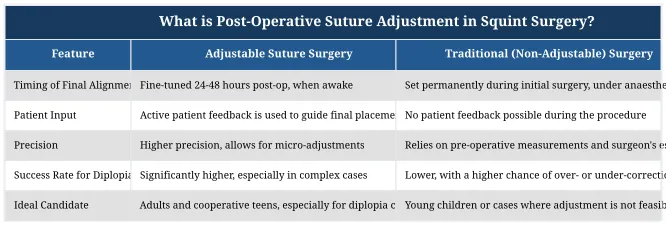
| Feature | Adjustable Suture Surgery | Traditional (Non-Adjustable) Surgery |
|---|---|---|
| Timing of Final Alignment | Fine-tuned 24-48 hours post-op, when awake | Set permanently during initial surgery, under anaesthesia |
| Patient Input | Active patient feedback is used to guide final placement | No patient feedback possible during the procedure |
| Precision | Higher precision, allows for micro-adjustments | Relies on pre-operative measurements and surgeon’s estimate |
| Success Rate for Diplopia | Significantly higher, especially in complex cases | Lower, with a higher chance of over- or under-correction |
| Ideal Candidate | Adults and cooperative teens, especially for diplopia correction | Young children or cases where adjustment is not feasible |
Achieving 95% Alignment Success: The London Squint Clinic Difference
The London Squint Clinic’s audited 95% success rate in achieving satisfactory eye alignment from a single operation is linked to the application of the adjustable suture technique. This approach minimises the risk of over- or under-correction, which are common reasons for requiring further surgery with traditional methods. By performing a final, precise adjustment based on real-world visual feedback, Mr. Ali can deliver successful outcomes for patients who may have been told elsewhere that nothing more could be done. This commitment to precision is a core part of the entire treatment journey.
Life-Changing Outcomes: What to Expect After Suture Adjustment
The goal of the fine-tuning process is to restore comfortable, single binocular vision and improve the cosmetic alignment of the eyes, enhancing daily function and quality of life.
Restored Single Vision and Enhanced Quality of Life
For adults with diplopia, the elimination of double vision is transformative. Activities that were once challenging—such as driving, reading, navigating stairs, or making eye contact—can be resumed with confidence. The removal of this visual distraction reduces eye strain, headaches, and the mental effort required to function. Patients often report profound relief and a return to a life not dictated by their vision.

View data as table
| Timeframe | Expected Status | Activity Level |
|---|---|---|
| First 24-48 Hours | Eye may be red, gritty, and watery. Vision may be blurry. | Rest is recommended. Avoid strenuous activity. |
| 1-2 Weeks | Redness and discomfort significantly improve. | Return to work (desk-based) and light activities. Driving may be possible. |
| 4-6 Weeks | Most redness has resolved. Eye alignment is stable. | Resume most normal activities, including swimming and sports. |
| 3 Months | Final alignment outcome is clear. | Full activity with stable, single vision. |
Post-Adjustment Care and Long-Term Stability
You will use prescribed antibiotic and anti-inflammatory eye drops for several weeks to aid healing and prevent infection. The eye will be red and feel gritty initially, but this subsides over the following weeks. The results achieved through the adjustment are stable and long-lasting. The fine-tuned muscle position becomes permanent as the eye heals, providing a durable solution to the misalignment. Patients can learn what to expect from adjustable sutures to understand the long-term stability of their outcome.
Ready to Explore Your Options for Precise Eye Alignment?
For an adult with a squint or disabling double vision, the adjustable suture technique offers a precise and effective solution. At the London Squint Clinic, Mr. Nadeem Ali combines this surgical method with decades of specialised experience to achieve optimal outcomes for his patients.
Take the first step towards clear, comfortable vision. Enquire about double vision surgery or find out more about how it’s Time to say goodbye to double vision.
Conclusion
Understanding the post-operative suture adjustment is key to appreciating the precision of modern strabismus correction. This fine-tuning step is a critical component that contributes to the 95% alignment success rate at specialist centres. Collaboration between an experienced surgeon and an awake, responsive patient is key to achieving the single, clear vision that restores function and confidence. If you have adult squint or diplopia, consider treatment with a surgeon who specialises in this technique.
To discuss your circumstances with Mr. Nadeem Ali, please contact us. You can also Enquire about double vision surgery and learn why it may be Time to say goodbye to double vision.
Frequently Asked Questions
How does post-operative suture adjustment specifically improve surgical outcomes for adult double vision?
The goal of this precise ‘fine-tuning’ is to achieve optimal eye alignment, which is critical for eliminating double vision. This allows Mr. Ali to perfect the eye’s position after the initial effects of anaesthesia have worn off, contributing to a 95% audited alignment success rate from one operation at London Squint Clinic.
What are the key steps involved in the adjustment procedure?
A few hours after your surgery, you will be comfortably seated, and numbing drops are applied to your eye to ensure no pain. During the post-operative suture adjustment, Mr. Ali gently moves the suture, asking you to look at a target until your double vision is resolved and alignment is optimal. The final knot is then securely tied to maintain the new position.
What sensations should I expect during the fine-tuning process?
The process is not painful, as your eye is completely numbed with topical anaesthetic drops before the adjustment. Patients typically report feeling only a slight sensation of touch or pressure, rather than any discomfort or pain. This ensures a comfortable experience while achieving precise alignment.
How much time should I allocate for the suture adjustment session?
The actual adjustment itself is very quick, typically taking only 5 to 10 minutes to complete. However, London Squint Clinic allocates ample time to ensure you are comfortable, understand the process, and achieve the perfect result for your vision.
How does adjustable suture surgery, with its post-operative refinement, differ from traditional squint surgery?
Adjustable suture surgery incorporates a unique post-operative refinement step, unlike traditional methods where sutures are permanently tied during the initial surgery. This technique, which includes a post-operative suture adjustment, removes guesswork by allowing real-time feedback from the patient while awake. This dramatically increases the likelihood of a successful, one-time fix for double vision by achieving a level of precision not possible with non-adjustable techniques.
When is the eye muscle adjustment typically performed after adult squint surgery?
The eye muscle adjustment is usually performed shortly after your primary squint surgery, typically a few hours later on the same day, or sometimes the next day. This timing is crucial as it allows the initial effects of general anaesthesia to wear off, enabling you to provide accurate feedback for optimal alignment.
Related Posts

Find out if you are suitable for Double Vision Treatment
Find out if you could benefit from this life changing surgery by contacting us today
Our most popular procedures



Hello, I’m Nadeem Ali
I’m one of the few eye surgeons in the world with 100% focus on Squint and Double Vision Surgery.
I have 24 years of eye surgery experience, and worked for 13 years as a Consultant at London’s renowned Moorfields Eye Hospital.
In 2023, I left the NHS to focus fully on treating patients from across the world at the London Squint Clinic. You can read more about me here.
There’s lots of information on the website about: squint surgery, double vision surgery and our pricing.
The most rewarding part of my job is hearing patients tell me how squint or double vision surgery has changed their lives. You can hear these stories here.
Mr Nadeem Ali
MA MB BChir MRCOphth FRCSEd(Ophth)