
What Happens to an Untreated Childhood Squint Over Time?
Why Choose Private Squint Surgery?
In the UK, squint surgery may be performed via the NHS, through insurance, or as self-pay. NHS treatment is free, but waiting times can be long and surgery is often performed by trainees under supervision. Many operations are carried out by surgeons who mainly specialise in children’s squint rather than adult complex cases.
With insurance, fees are standardised — meaning some leading specialists choose not to participate. Self-pay allows you to choose your surgeon directly and prioritise experience, specialisation, and access.
Many centres quote only a surgical fee. Hospital costs, anaesthetic fees and follow-ups are frequently additional. At London Squint Clinic, everything is included in one transparent package.
Our Complete Package – £10,000
- ✔ Advanced surgery by Mr Ali (one or both eyes)
- ✔ Adjustable sutures where clinically indicated
- ✔ Detailed orthoptic planning
- ✔ All hospital & anaesthetic fees included
- ✔ Post-operative medication
- ✔ Two video follow-ups
- ✔ Face-to-face review appointment
What Makes Us Different
- ✔ 100% focused on adult squint & double vision surgery
- ✔ >95% audited success rate
- ✔ Free re-treatment at 3 months if worse (extremely rare)
- ✔ 24/7 direct WhatsApp access to your surgeon during recovery
- ✔ Optional well-being session & pre-op reassurance call
Initial consultation: from £150
Surgery typically within 4 weeks. No referral required. Self-pay only.
Untreated Childhood Squint: Understanding Lifelong Effects
An untreated childhood squint leads to permanent vision deficits and functional challenges that carry into adulthood. When the eye misalignment (strabismus) is not corrected, the brain suppresses the image from the turned eye, causing amblyopia (lazy eye) and a permanent loss of binocular vision. This results in poor depth perception, which can affect coordination and daily tasks. Understanding these long-term consequences is the first step for adults considering corrective surgery to improve eye alignment, function, and confidence.
The London Squint Clinic focuses exclusively on adult strabismus surgery. Consultant Ophthalmic Surgeon Mr Nadeem Ali provides expert evaluation and surgical treatment for adults living with the effects of a childhood squint, including complex cases requiring revision surgery for improved alignment.
To explore your options, contact us to schedule your consultation. You can also reach us via: Enquire about squint surgery, Squint Surgery in London
An untreated childhood squint (strabismus) leads to long-term visual, functional, and psychological challenges that persist into adulthood. Leaving the eye misalignment unaddressed during critical periods of vision development can cause permanent consequences, from vision loss to reduced quality of life. Expert evaluation in adulthood is crucial for potential correction.
What is an Untreated Childhood Squint and Its Immediate Impact?
A childhood squint (strabismus) is a condition where the eyes do not align. One eye may look straight ahead while the other turns inwards, outwards, upwards, or downwards. To avoid double vision, the brain ignores visual input from the misaligned eye. This leads to a permanent reduction in vision in that eye, a condition called amblyopia.
The Development of Amblyopia (Lazy Eye)
During the first several years of life, the brain and eyes form critical connections for vision development. When a squint is present, the brain receives two different images. To create a single, clear picture, it suppresses the image from the wandering eye. This constant suppression prevents the neural pathways for that eye from developing properly.
If this process is not interrupted with treatment like patching or glasses during childhood, the vision loss becomes permanent. This condition, amblyopia (“lazy eye”), means the affected eye cannot see clearly, even with the best possible glasses.
How Does Untreated Strabismus Affect Vision Long-Term?
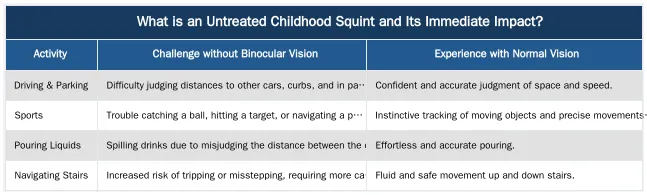
The long-term effects of strabismus extend beyond poor vision in one eye. The lack of coordinated eye movement alters how a person sees the world, creating practical daily challenges.
Loss of Binocular Vision and Depth Perception
The brain fuses slightly different images from each eye into a single three-dimensional picture, an ability called binocular vision, which provides depth perception (stereopsis). When the brain ignores one eye due to a squint, this ability is lost, creating depth perception issues that make everyday tasks difficult. You can learn more about the difference between amblyopia and strabismus and how they relate.
Chronic Eye Strain and Headaches
For individuals with intermittent squints, the brain may fight to align the eyes. This constant effort can lead to significant eye strain (asthenopia), fatigue, and frequent headaches, affecting concentration during work, reading, and other focused tasks.
Is It Too Late to Correct a Childhood Squint in Adulthood?
A common misconception is that a squint not fixed in childhood cannot be corrected in adulthood. While restoring full binocular vision or reversing amblyopia is not typically possible, adult strabismus surgery can significantly improve eye alignment, visual comfort, and appearance.
The goals of adult squint correction are to improve eye alignment for a normal appearance, enhance self-confidence, eliminate double vision, and expand the field of single vision. It is often possible to correct a childhood squint in adulthood.
Advanced Techniques for Adult Strabismus Correction
Modern surgical techniques like adjustable sutures have improved outcomes for adult squint correction. This technique allows the surgeon to fine-tune the eye’s alignment hours after the operation, while the patient is awake. This precision is valuable in complex cases, including re-operations or long-standing squints, and leads to higher success rates.
The Role of a Specialist Adult Squint Surgeon
Correcting a long-standing childhood squint requires specialist expertise, as eye muscles change over decades and scar tissue from previous operations can complicate the procedure. A surgeon like Mr. Nadeem Ali, with experience as a Consultant at Moorfields Eye Hospital and a practice focused on adult strabismus, has the skills for these complex cases. The Royal College of Ophthalmologists provides patient information on the effectiveness of adult surgery for improving quality of life.
The Benefits of Addressing Untreated Squint as an Adult
Undergoing squint surgery as an adult provides benefits beyond cosmetic improvement, encompassing functional vision, psychological well-being, and quality of life.
Improved Alignment and Visual Comfort
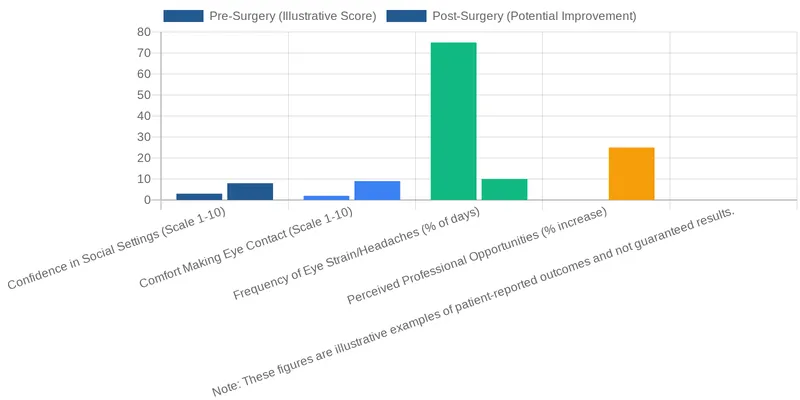
The most immediate result of successful surgery is straighter eyes, which can relieve the chronic eye strain and headaches from controlling the misalignment. While full 3D vision is rarely restored, some patients experience an expanded field of single vision and improved peripheral fusion, making visual tasks more comfortable. Research in journals like the American Journal of Ophthalmology shows high rates of surgical success and patient satisfaction in adults.
Enhanced Confidence and Quality of Life
The psychological benefits are significant. Patients often report a boost in self-esteem and confidence. Looking people in the eye without anxiety improves social and professional interactions, creating opportunities that previously felt out of reach. Patient advocacy groups, supported by organizations like Squint Clinic, provide communities for individuals sharing these experiences.
Take the First Step Towards Clearer Vision and Confidence
Living with the consequences of an untreated childhood squint is not necessary. Modern surgical options offer improved alignment, comfort, and confidence. If you have an eye misalignment and were previously told nothing could be done, seek a specialist opinion.
Why Choose London Squint Clinic for Adult Correction
At London Squint Clinic, Mr. Nadeem Ali provides consultant-led care from consultation through recovery. His practice focuses 100% on adult squint and double vision, with transparent package pricing and an audited 95% alignment success rate from one operation. To learn about your options for private squint surgery, Enquire about squint surgery or explore our approach to Squint Surgery in London.
Conclusion
An uncorrected childhood squint impacts vision, function, and psychological well-being into adulthood, causing amblyopia, poor depth perception, and social anxiety. It is rarely too late for effective treatment. Specialist adult squint surgery offers a solution for straighter eyes and renewed confidence. To address a long-standing eye misalignment, contact us for a consultation. You can also Enquire about squint surgery or learn more about Squint Surgery in London.
Frequently Asked Questions
Can an untreated childhood squint cause permanent vision loss?
Yes. An untreated childhood squint can lead to a condition called amblyopia, or ‘lazy eye’. To avoid double vision, the brain learns to ignore the image from the misaligned eye, which can result in a permanent reduction of vision if not addressed during the critical period of visual development.
Does an untreated childhood squint get harder to correct in adulthood?
While correcting a long-standing eye turn can be more complex due to changes in eye muscles over many years, it is almost never too late for improvement. A specialist surgeon with experience in adult strabismus can successfully realign the eyes, even for a condition that has been present since childhood.
What are the long-term psychological effects of an untreated childhood squint?
Many adults who have lived with an untreated childhood squint report significant psychological and social challenges. These can include low self-esteem, social anxiety, and difficulty with direct eye contact, which often become primary reasons for seeking corrective surgery later in life.
Can a squint that was present in childhood cause double vision later in life?
Yes, this is a common occurrence. The brain’s ability to suppress the image from the misaligned eye can weaken with age, leading to the onset of double vision (diplopia). This new symptom can be very disruptive and is a key reason many adults seek treatment for a long-standing squint.
Will the eye turn from an untreated childhood squint worsen over time?
In many cases, the angle of the eye turn from an untreated childhood squint can increase with age. This is due to natural changes in the eye muscles, which can make the misalignment more noticeable and potentially lead to new symptoms.
How can I get an expert opinion on my childhood squint as an adult?
The first step is to schedule a consultation with a specialist in adult strabismus surgery. An expert can assess your specific eye alignment, discuss your symptoms and goals, and determine the most effective treatment plan for you. You can enquire about a specialist consultation to explore your options for correction.
Related Posts
Find out if you are suitable for Double Vision Treatment
Find out if you could benefit from this life changing surgery by contacting us today
Our most popular procedures


Hello, I’m Nadeem Ali
I’m one of the few eye surgeons in the world with 100% focus on Squint and Double Vision Surgery.
I have 24 years of eye surgery experience, and worked for 13 years as a Consultant at London’s renowned Moorfields Eye Hospital.
In 2023, I left the NHS to focus fully on treating patients from across the world at the London Squint Clinic. You can read more about me here.
There’s lots of information on the website about: squint surgery, double vision surgery and our pricing.
The most rewarding part of my job is hearing patients tell me how squint or double vision surgery has changed their lives. You can hear these stories here.
Mr Nadeem Ali
MA MB BChir MRCOphth FRCSEd(Ophth)