
The Definitive Guide to Adult Double Vision (Diplopia) and When Surgery is Necessary
Why Choose Private Squint Surgery?
In the UK, squint surgery may be performed via the NHS, through insurance, or as self-pay. NHS treatment is free, but waiting times can be long and surgery is often performed by trainees under supervision. Many operations are carried out by surgeons who mainly specialise in children’s squint rather than adult complex cases.
With insurance, fees are standardised — meaning some leading specialists choose not to participate. Self-pay allows you to choose your surgeon directly and prioritise experience, specialisation, and access.
Many centres quote only a surgical fee. Hospital costs, anaesthetic fees and follow-ups are frequently additional. At London Squint Clinic, everything is included in one transparent package.
Our Complete Package – £10,000
- ✔ Advanced surgery by Mr Ali (one or both eyes)
- ✔ Adjustable sutures where clinically indicated
- ✔ Detailed orthoptic planning
- ✔ All hospital & anaesthetic fees included
- ✔ Post-operative medication
- ✔ Two video follow-ups
- ✔ Face-to-face review appointment
What Makes Us Different
- ✔ 100% focused on adult squint & double vision surgery
- ✔ >95% audited success rate
- ✔ Free re-treatment at 3 months if worse (extremely rare)
- ✔ 24/7 direct WhatsApp access to your surgeon during recovery
- ✔ Optional well-being session & pre-op reassurance call
Initial consultation: from £150
Surgery typically within 4 weeks. No referral required. Self-pay only.
Adult Double Vision: Restoring Single Vision With Surgery
This guide explains the causes of adult double vision (diplopia) and the path to restoring clear, single vision. It details how eye misalignment (strabismus) leads to diplopia and why non-surgical options like prism glasses can become insufficient over time. The article outlines the diagnostic process for conditions such as cranial nerve palsies and thyroid eye disease. It provides a clear framework for understanding when eye alignment surgery is the most effective solution for adult double vision, helping patients make informed decisions about their care and quality of life.
London Squint Clinic focuses exclusively on adult strabismus and diplopia correction. Led by consultant ophthalmologist Mr Nadeem Ali, the clinic provides specialist assessment and surgical solutions for complex cases, including those where previous treatments have not been successful.
To explore your options, contact us to schedule your consultation. You can also reach us via: Enquire about double vision surgery, Time to say goodbye to double vision
Adult double vision (diplopia) is disorienting and disrupts daily activities like driving, reading, and navigating spaces. This condition occurs when the eyes are misaligned, sending two different images to the brain, which it cannot fuse into a single, clear picture. This guide explains the causes of adult diplopia, non-surgical treatments, when eye alignment surgery is the most effective solution, and how specialist care can restore single vision and quality of life.
Understanding Adult Double Vision (Diplopia): Causes and Symptoms
Adult double vision (diplopia) is seeing two images of a single object. This condition arises when the eyes do not point at the same object simultaneously (strabismus or eye misalignment). The brain receives conflicting visual information, resulting in a double image that can be horizontal, vertical, or diagonal.
What is Diplopia and Why Does it Happen?
Binocular diplopia, the most common form, occurs only when both eyes are open and resolves when one eye is covered. It results from misalignment. For single vision, the six muscles surrounding each eye must work in coordination. When one or more of these muscles are weak, restricted, or receive incorrect signals from the brain, the eyes lose their alignment. The brain can no longer compensate for the large discrepancy, leading to the perception of two distinct images. This can cause functional difficulties, headaches, and disorientation.
Beyond the Basics: Common & Complex Causes of Adult Diplopia
Seeing double in adulthood can stem from long-standing eye alignment issues or new neurological or systemic problems.
Structural & Neurological Factors Leading to Misalignment
Several conditions can disrupt the system controlling eye movement. Strabismus, a general term for eye misalignment, can decompensate in adulthood, leading to new or worsening diplopia. This includes inward turns (esotropia), outward turns (exotropia), and vertical misalignments (hypertropia/hypotropia).
Neurological issues are another significant cause. Cranial nerve palsies affecting the third, fourth, or sixth cranial nerves—which directly control eye muscles—can cause sudden double vision. Systemic conditions like Thyroid Eye Disease can cause inflammation and scarring of the eye muscles, restricting their movement and leading to misalignment. The National Eye Institute provides a detailed overview of strabismus.
When Previous Surgery or Trauma Leads to Double Vision
Diplopia can also arise from other events. A head injury or trauma can damage the eye muscles or the nerves that control them. Complications from previous eye surgeries, such as cataract or retinal procedures, can alter eye muscle function. In some cases, a brain tumour can exert pressure on cranial nerves, leading to double vision as a primary symptom. These complex cases, including revision surgery for unsuccessful squint operations, require specialised assessment and management.
When Do Prism Glasses Fail? Evaluating Non-Surgical Options
Non-surgical options are explored before surgery. The most common are prism glasses and patching. While effective for some, they have limitations and often represent a temporary or incomplete solution.
The Role and Limitations of Prism Glasses and Patching
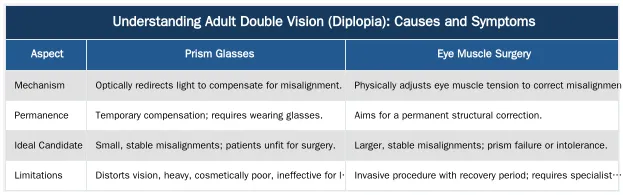
Prism lenses bend light, redirecting the image from the misaligned eye to match the image from the straight eye, allowing the brain to fuse them. They can be effective for small, stable misalignments. Prisms do not cure the underlying problem; they only compensate for it.
Limitations become apparent when the misalignment is large, variable, or worsening. High-power prisms can be thick, heavy, and cosmetically noticeable. They can also distort vision and reduce visual acuity. Patching one eye eliminates double vision but sacrifices binocular vision and depth perception, making it an impractical long-term solution for most adults.
Signs That Non-Surgical Approaches Are No Longer Enough
Non-surgical management is insufficient when a patient needs progressively stronger prisms, experiences persistent eye strain or headaches despite glasses, or has double vision in certain directions of gaze. When the condition impairs quality of life—making driving unsafe, work difficult, or hobbies unenjoyable—a more definitive solution is needed.
Is Surgery Necessary? Deciding on Adult Double Vision Correction
The decision for surgery is made when restoring single, binocular vision outweighs the effectiveness of non-surgical options. This is determined through consultation and diagnostic evaluation.
Key Indicators for Surgical Intervention
Surgery is recommended when the eye misalignment is stable and non-surgical methods like prisms are no longer sufficient or are poorly tolerated. The goal of eye muscle surgery is to physically realign the eyes, restore comfortable single vision, and expand the patient’s field of binocular vision.
The Surgical Consultation: What to Expect
A surgical consultation involves an assessment by a specialist ophthalmologist. This includes detailed measurements of the eye misalignment in all positions of gaze to quantify the problem. The surgeon discusses your symptoms, functional difficulties, and treatment goals. This process ensures the surgical plan is tailored to your needs. Choosing a surgeon with expertise in adult strabismus is critical for complex cases. You can learn more about the qualifications of a Specialist Ophthalmologist to understand the level of experience required.
Achieving Single Vision: The London Squint Clinic Difference
Specialist care is essential for patients seeking a definitive solution for diplopia, especially those told nothing more can be done. The approach combines expertise with a patient-focused process.
Expert-Led Adult Eye Alignment Surgery by Mr Nadeem Ali
Effective surgery for adult diplopia requires a surgeon with dedicated expertise. Mr Nadeem Ali has over 24 years of eye surgery experience, including 13 years as a Consultant at Moorfields Eye Hospital, and now focuses exclusively on adult squint and double vision. This focus allows a refined approach to complex cases, including revision surgeries and diplopia from neurological conditions. Techniques such as adjustable suture surgery are used to fine-tune the eye alignment after the operation, contributing to a 95% audited alignment success rate from a single operation.
The Patient Journey: From Consultation to Recovery
The process requires no GP referral, with options for video and in-person consultations. Financials are clear, with transparent fixed package pricing covering all care from pre-operative assessment to post-operative follow-ups. During recovery, patients have direct 24/7 WhatsApp access to Mr Ali for any concerns. A re-operation policy provides additional assurance.
Life After Double Vision Surgery: Restored Independence & Quality of Life
Correcting diplopia restores a patient’s ability to engage with the world. Successful eye muscle surgery eliminates the distraction and functional impairment of seeing double.
Recovery Timeline and Post-Operative Care
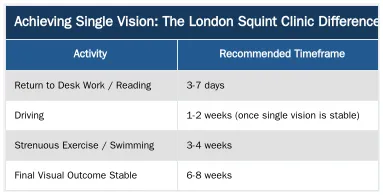
Recovery from eye muscle surgery is generally swift. The eye will be red and feel gritty for a couple of weeks, but significant pain is uncommon. Medicated eye drops are used to prevent infection and reduce inflammation. Most patients can return to non-strenuous activities and desk work within a week.
The Transformative Impact of Single Vision
Restoring single, binocular vision has a profound impact. Functionally, it allows a return to activities like driving, reading, watching films, and playing sports. It improves depth perception and spatial awareness, reducing the risk of trips and falls. The relief from the effort of trying to see clearly can reduce anxiety and boost confidence. As documented by sources like the American Academy of Ophthalmology, correcting strabismus in adults enhances quality of life by restoring the normalcy and independence that diplopia takes away.
Ready to Say Goodbye to Double Vision? Take the Next Step
Living with diplopia is a challenge, but it does not have to be permanent. When non-surgical options fail, eye muscle surgery by a specialist offers a reliable path to restoring single vision. Correcting the misalignment can improve functional ability, independence, and quality of life. A specialist consultation is the first step towards a solution for double vision.
To learn more about your options, contact us today. It may be Time to say goodbye to double vision. You can also Enquire about double vision surgery directly to schedule a consultation.
Frequently Asked Questions
What is adult double vision and why does it happen?
Adult double vision, known medically as diplopia, is the experience of seeing two images of a single object. This occurs when the eyes are misaligned and cannot work together to focus on the same point. Common causes include problems with the eye muscles, the nerves that control them, or underlying conditions like thyroid eye disease, a head injury, or a pre-existing squint that has worsened over time.
When is surgery considered for adult double vision?
Surgery is typically recommended for persistent adult double vision when non-surgical options, such as prism glasses, are no longer effective or are poorly tolerated. If the misalignment is too large for prisms to correct, or if the glasses are too heavy and disorienting, eye muscle surgery becomes the most effective solution to restore single, comfortable vision.
Can surgery permanently correct diplopia in adults?
Yes, for the majority of patients, eye muscle surgery can provide a permanent solution for diplopia by physically realigning the eyes. The goal is to restore comfortable single binocular vision for daily activities like driving and reading. At the London Squint Clinic, our audited success rate for achieving alignment from a single operation is 95%.
What are the common causes of adult double vision that may require surgery?
Many cases of adult double vision that require surgical correction stem from specific conditions affecting the eye muscles or their controlling nerves. These frequently include cranial nerve palsies (such as 3rd, 4th, or 6th nerve palsy), thyroid eye disease, the effects of a previous head injury, or a long-standing squint that has decompensated with age.
What does recovery from eye alignment surgery involve?
Recovery is generally straightforward, with most patients experiencing some redness and mild discomfort for the first week. You can typically return to most daily activities, including work and driving, within one to two weeks, once your vision has stabilised. Mr. Ali provides dedicated aftercare, including 24/7 WhatsApp access, to support you throughout your recovery period.
How can I find out if I am a suitable candidate for adult double vision surgery?
The first step is to schedule a specialist consultation with an expert surgeon like Mr. Nadeem Ali. During this assessment, he will perform detailed measurements and a comprehensive examination to diagnose the precise cause of your adult double vision and determine the most effective treatment plan. To learn more or book an appointment, you can enquire about double vision surgery on our website.
Find out if you are suitable for Double Vision Treatment
Find out if you could benefit from this life changing surgery by contacting us today
Our most popular procedures


Hello, I’m Nadeem Ali
I’m one of the few eye surgeons in the world with 100% focus on Squint and Double Vision Surgery.
I have 24 years of eye surgery experience, and worked for 13 years as a Consultant at London’s renowned Moorfields Eye Hospital.
In 2023, I left the NHS to focus fully on treating patients from across the world at the London Squint Clinic. You can read more about me here.
There’s lots of information on the website about: squint surgery, double vision surgery and our pricing.
The most rewarding part of my job is hearing patients tell me how squint or double vision surgery has changed their lives. You can hear these stories here.
Mr Nadeem Ali
MA MB BChir MRCOphth FRCSEd(Ophth)